
Micron’s AI Boom: A Trillion-Dollar Bet on Geopolitics, Not Just Chips
Arjun Vedanta
- 0
- 5 minutes read
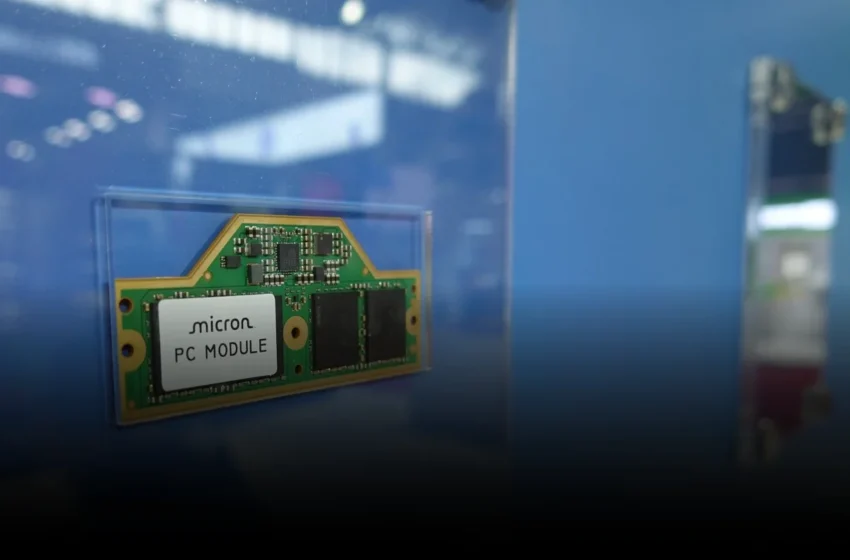
The Price of AI: Beyond Demand-Supply Economics
A single AI server demands exponentially more High-Bandwidth Memory (HBM) than any consumer PC ever did. This stark technical reality, not merely speculative fervor, is what catapulted Micron Technology’s market valuation past a dizzying $1.2 trillion this past week. Wall Street, ever in search of the next Nvidia, has found a compelling narrative in the Boise, Idaho-based memory chipmaker. Its stock has surged over 236% in the last month alone, closing Friday at $1,132 a share, a precipitous climb for a company that languished below $100 just a year and a half ago. Quarterly revenue quadrupled to $41.45 billion, while profits soared from $1.88 billion to $28.2 billion year-over-year. These are not merely good numbers; they are the kind of figures that redefine market expectations. Yet, beneath the euphoria of these staggering financial victories, an undercurrent of geopolitical vulnerability and concentrated demand ripples, a factor largely unexamined in the rush to crown Micron as the next AI darling.
The current scramble, dubbed ‘RAMageddon’ by some, for essential DRAM and NAND components, particularly HBM, is predicted to persist into 2027. This scarcity is not just driving up Micron’s balance sheet; it’s quietly inflating the cost of everything from Apple products to Xbox consoles. Hyperscalers like Microsoft, Amazon AWS, Google, and Oracle, alongside AI system giants like Nvidia, are buying up memory in unprecedented quantities, forcing even traditional PC makers such as Dell and HP to hoard supply. This intense concentration of demand from a handful of mega-corporations, predominantly US-based, presents a precarious foundation for Micron’s supposedly ‘durable earnings growth.’ While Micron touts 16 strategic customer agreements, these largely reflect commitments from the very players driving the current, intense demand, exposing the company to a single, albeit massive, market vector. The real bet on Micron is not just on AI’s growth, but on the sustained political and economic alignment of a select few global tech titans.
The Illusion of Supply Chain Resilience in a Fragmented World
Micron’s strategy to insulate itself from the historically brutal memory bust cycles – where overcapacity inevitably follows demand spikes – hinges on these long-term supply agreements. Analyst Sebastien Naji of William Blair notes, "Given the strong likelihood of continued ASP growth in the coming quarters and improving revenue visibility thanks to a rapidly expanding set of long-term agreements (SCAs) with key customers, we see potential for more durable earnings growth." This sentiment, echoed across Wall Street, assumes these contracts are a shield. But what happens when the demand isn’t just from the ‘market’ but from specific national priorities? The US government’s push for domestic semiconductor manufacturing, for instance, isn’t just about economics; it’s about national security and technological sovereignty. While beneficial for Micron in the short term, this nationalization of supply chains inherently reduces flexibility and global optionality, making the company less adaptable to unforeseen international shifts.
Memory manufacturing, unlike fabless chip design, demands immense capital expenditure and years to bring new cleanroom space online. Samsung, a global memory powerhouse, understands this deeply. The traditional wisdom dictates that as capacity finally catches up, prices crash. Micron’s strategic customer agreements (SCAs) are meant to smooth out this boom-and-bust, but they also lock Micron into specific customer ecosystems. This is where Silicon Valley myopia often misses the bigger picture: the US-centric view of AI demand ignores the burgeoning, often state-backed, AI ambitions in other regions. What if a significant portion of future AI demand shifts to non-US players, or if geopolitical tensions lead to fragmentation of the AI infrastructure market? Micron’s long-term contracts might secure current revenue, but they also limit its agility to capture new, emerging markets that fall outside the current Western-dominated AI landscape.
National Champions and the Fragility of AI’s Foundation
The current narrative surrounding Micron’s ascendance posits a simple equation: more AI means more HBM, and Micron makes HBM. This is true, but it’s an oversimplification that ignores the fundamental incentive behind the current market frenzy. The push to declare Micron as ‘the next Nvidia’ is less about intrinsic similarities in business models — Nvidia’s platform lock-in is far more robust than a memory producer’s — and more about Wall Street’s desperate search for publicly traded pure-plays in the AI infrastructure gold rush. Investors want a diversified portfolio of AI bets beyond just GPU manufacturers, and Micron, as a critical enabler, fits that profile neatly. This framing benefits analysts who can attract capital to a new ‘AI winner,’ even if its underlying business is still prone to the same historical cyclicality, albeit with new contractual guardrails.
The reality is that memory, while essential, remains a commodity, albeit a high-value one in its HBM incarnation. The core technology, though complex, is more standardized than the proprietary architectures of an Nvidia GPU. This distinction is critical for understanding long-term value. While Micron benefits from the current HBM scarcity, the fundamental economic forces of commoditization will eventually exert pressure, especially as competitors like Samsung ramp up their own HBM production. The notion that Micron’s SCAs fundamentally transform its business model, moving it beyond cyclicality, requires a level of faith in the permanence of current market dynamics that history repeatedly disproves. For Micron, this correction might not just be economic; it could be geopolitical, where the foundational infrastructure of AI becomes a pawn in a larger global power play.
