
Cosmic Bombardment: Reshaping Earth’s Origins and Scientific Methodologies
- Artificial Intelligence
Arjun Vedanta
- 0
- 4 minutes read
Challenging the Terrestrial Orthodoxy
For decades, the story of Earth’s continents has largely been told from within its own crust. Plate tectonics, mantle plumes, volcanic activity – these internal forces have long served as the primary architects in our geological narratives. That narrative is now cracking, not from internal pressure, but from an external, cosmic bombardment.
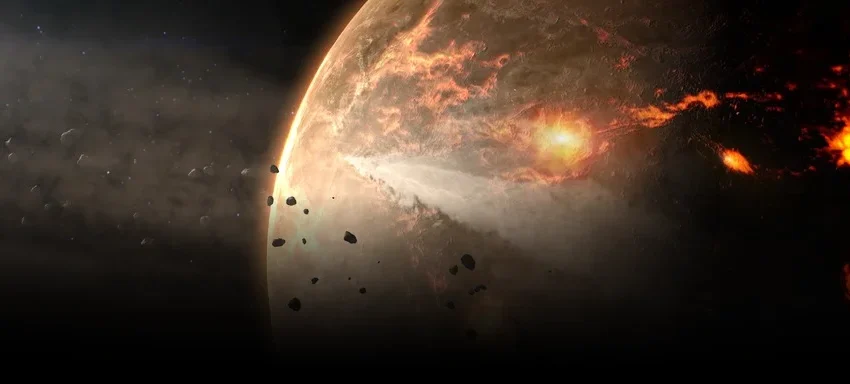
Geologist Tim Johnson and his colleagues at Curtin University have posited a provocative theory: Earth’s distinctive, buoyant, silica-rich continents formed around four billion years ago, not merely through endogenous forces, but largely due to an intense, sustained barrage of asteroid impacts. This ancient rain of space rocks, they argue, kept the early crust hot and thin enough, facilitating the very mechanism that allowed continental landmasses to emerge.
This isn’t merely an update to geological timelines; it’s a fundamental re-weighting of causal factors in planetary formation. It suggests that the land we stand on is less a product of Earth’s singular internal processes and more a consequence of its violent early interactions with the wider solar system. The implication is profound, shifting our gaze from solely terrestrial drivers to an understanding where extraterrestrial forces are integral to the most fundamental aspects of our planet’s identity.
The Scarcity of Deep Time Data
The challenge in reconstructing Earth’s earliest history, particularly the Hadean eon that spanned its first 500 million years, lies squarely in the scarcity of direct evidence. The oldest known continental-type rocks crystallized a mere 4.03 billion years ago, while rare basaltic rocks date back only 4.2 billion years. Even the most ancient zircon crystals push the record back a scant 4.4 billion years, leaving a vast, primordial gap in our geological archives.
“There are huge debates about what was going on in the early Earth, because the data is so scarce,” Johnson candidly admits. This absence forces scientists to rely heavily on inference, sophisticated computational modeling, and a comparative planetology informed by data from the Moon or Mars. It’s a stark reminder that even our most fundamental understandings of Earth’s genesis remain remarkably fluid, often shaped as much by the available evidence as by the prevailing intellectual currents of the era.
This methodological tightrope — theorizing grand planetary processes from fragmented, ancient whispers — isn’t unique to early Earth geochronology. Fields investigating the origins of life or the universe itself grapple with similar evidentiary voids. The current scientific climate, flush with advanced computational modeling and data from lunar samples or Martian exploration, provides an incentive to synthesize previously disparate fields – astrophysics, geology, and impact dynamics – to fill these deep temporal voids.
A Broader Lens for Planetary Formation
If Earth’s unique continents owe their existence to cosmic bombardment, the implications extend far beyond our home world. This theory encourages us to view planetary evolution through a broader lens, challenging Earth-centric assumptions that have long underpinned our search for habitability elsewhere. What if sustained bombardment is not merely a destructive force, but a necessary catalyst for certain types of planetary development, even shaping mantle dynamics?
This perspective fundamentally recontextualizes ongoing debates surrounding internal processes like plates and plumes, suggesting their manifestation might be intimately linked to initial external conditions. It compels planetary scientists to integrate impact physics more deeply into models of crustal differentiation and early atmospheric evolution, moving away from purely internal geodynamic explanations.
The work of Johnson and his team serves as a crucial reminder that the scientific endeavor thrives on challenging established narratives, especially when faced with the tantalizing potential of new evidence and interdisciplinary synthesis. It is this persistent questioning, often spurred by data previously overlooked or unavailable, that drives true understanding across all scales of existence, from the ancient, molten core of our planet to the distant echoes of exoplanetary research.
