
Xbox Layoffs Unmask Deeper Cracks in Tech’s Consolidation Dream
- Tech
Arjun Vedanta
- 0
- 5 minutes read
The Cost of Consolidation: A Global Friction Point
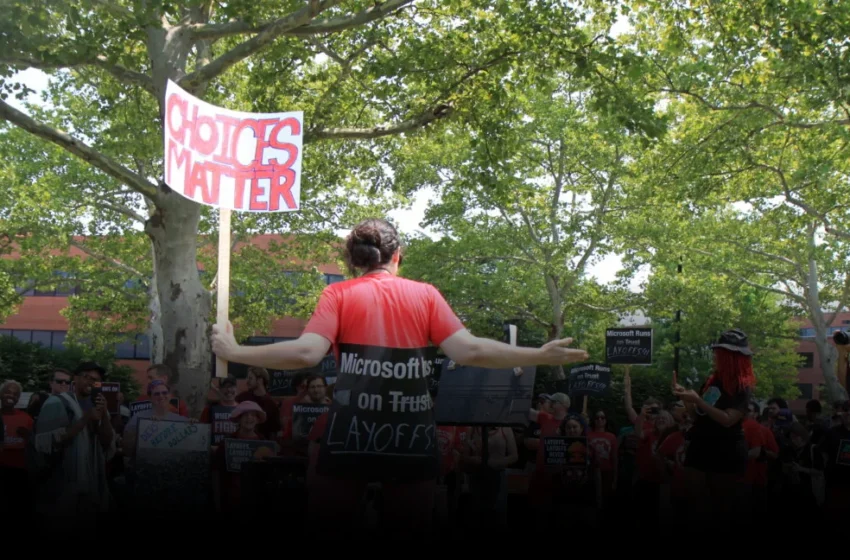
Hundreds of game developers rallying in front of Zenimax’s Rockville, Maryland, headquarters last week wasn’t just a local labor dispute; it was a potent symbol of global tech’s deepening fault lines. Under a near 100-degree sun, employees from Bethesda Game Studios and Zenimax Online Studios, backed by Zenimax Workers United and the Communication Workers of America, protested sweeping Xbox layoffs. Their signs, like “Layoffs… layoffs never change,” highlighted a growing contradiction: tech giants tout seamless integration and boundless synergy post-acquisition, while the human capital they acquire often faces redundancy.
Microsoft’s aggressive expansion into the gaming sector, notably its colossal acquisition of Activision Blizzard for nearly $69 billion, was pitched as a strategic masterstroke that would solidify its Xbox ecosystem. Yet, the subsequent job cuts across Bethesda and Zenimax, despite record revenues and the absorption of a major competitor, reveal a brutal economic calculus. This isn’t merely an unfortunate consequence; it’s an inherent tension in the modern M&A playbook, where market valuation often hinges on projected cost-cutting efficiencies, not just revenue growth. The market celebrates these deals as strategic brilliance, often overlooking the human cost and the inevitable internal resistance that such rationalization sparks.
From my vantage point covering global tech over a decade, this pattern is distressingly familiar. Companies announce grand visions, swallow competitors whole, then pare down their workforce months later, framing it as necessary optimization. This incident, while US-centric, echoes similar employee anxieties and protests seen from Berlin to Singapore when tech behemoths restructure after a merger, proving that the ‘efficiency’ narrative rarely mentions the human price tag.
Labor’s Rising Leverage in Gaming’s Uneasy Gig Economy
The gaming industry has long operated in a precarious state, defined by intense crunch periods, project-based contracts, and an often-volatile employment landscape. The sight of Zenimax employees, many of whom are crucial to highly technical game development cycles and meticulous quality assurance, openly challenging Microsoft is a significant shift. Nathan Hahn, a Bethesda technical producer and union organizer, put it bluntly: “It’s about us building our movement and making sure that we get seen and we’re visible. Because we want to make sure that we’re not okay with these layoffs and that Xbox knows.”
This isn’t an isolated incident but part of a broader, more organized labor movement emerging within the tech sector, one that Silicon Valley reporters, focused on unicorn valuations and founder narratives, sometimes struggle to grasp. The Communication Workers of America’s involvement, organizing five simultaneous rallies across different states and Canada, signals a coordinated, strategic push. This collective action examines incentive: Microsoft is driven to consolidate and cut costs post-acquisition, demonstrating financial discipline to shareholders. The union, conversely, is driven to protect its members’ livelihoods and leverage public opinion, challenging the perception that tech workers are somehow immune to traditional labor struggles, particularly in highly creative and project-based sectors like gaming, proving increasingly naive.
For Microsoft, a company with global operations, ignoring these protests isn’t an option. The optics of a powerful corporation laying off staff from acquired studios, especially after a highly scrutinized acquisition like Activision Blizzard, resonate far beyond Bethesda’s parking lot. This directly impacts talent retention, public image, and potentially, future regulatory scrutiny. These actions aren’t just about financial statements; they are about the intangible cost of trust and morale across a diverse, globally distributed workforce.
A Precedent Beyond Bethesda’s Gates
What unfolded at Zenimax is more than just a localized protest against Microsoft. It sets a precedent for how employees within increasingly consolidated tech giants will respond to the inevitable post-acquisition rationalizations. The gaming industry, once perceived as a passion-driven niche, is now a multi-billion dollar segment of the global entertainment economy, attracting the same intense corporate scrutiny and cost-cutting measures as any other sector.
This moment signals a changing power dynamic. As **inflation** and **recession fears** drive more aggressive cost-cutting across all industries, the pushback from organized labor, particularly within the historically less unionized tech sector, is likely to intensify. The question for Microsoft, and indeed for every major tech player eyeing the next big acquisition, is not just how to integrate new companies, but how to integrate, motivate, and retain the human beings who actually build the products and services. The seamless ‘synergy’ promised in investor calls is proving to be a much messier, human endeavor on the ground.
