
Autonomous Wildfire Drones: A Tactical Distraction from Deeper Systemic Failures?
- AI Infrastructure
Arjun Vedanta
- 0
- 5 minutes read
The Allure of Rapid Response, The Weight of Reality
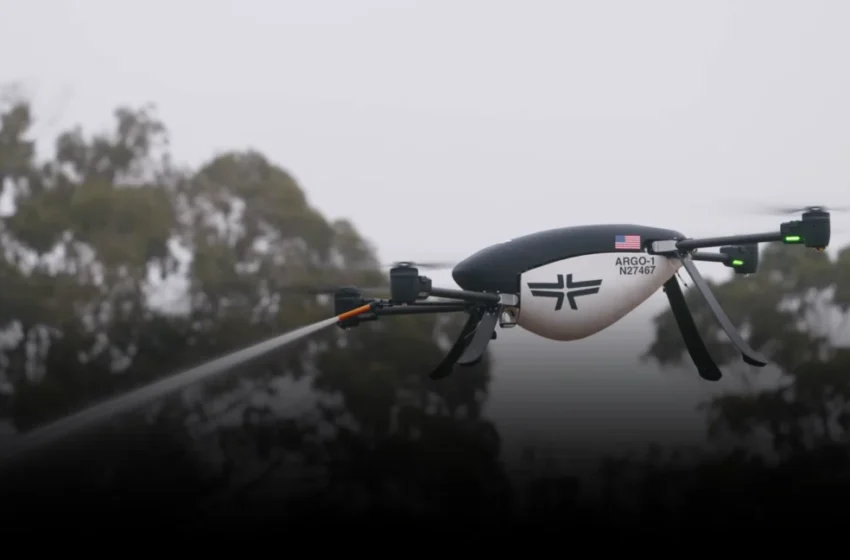
California and Alaska, plagued by an increasingly relentless wildfire season, are now testing autonomous drones equipped to spray water and foam. The California Department of Forestry and Fire Protection, or CAL FIRE, recently showcased five such drones, deploying between 500 and 1,000 gallons of fire-suppressing foam in a July 15 field test. Companies like Seneca, set to commercialize these systems by 2026, and the multi-million dollar XPRIZE competition, are driving the narrative: these drones promise a rapid-response capability, designed to snuff out small fires before they explode into infernos. It’s a compelling vision, offering a glimmer of hope against a backdrop of annual devastation.
Yet, this focused technological push, while superficially appealing, subtly shifts attention from the systemic failures in large-scale fire management and prevention. The immediate problem is not a lack of localized rapid response tools, but the *scale* of the problem itself, now magnified by climate change. As the source material itself notes, these drones “cannot replace large airtankers in delivering massive payloads of water or other fire-suppressing payloads to remote wildfires.” The implication is clear: this is a surgical tool in a battle that often requires carpet bombing, or more accurately, holistic strategy.
The current emphasis on early intervention via technology, while intuitively sound, risks creating an illusion of control over a problem that demands far more fundamental re-evaluation of land management, infrastructure, and climate policy. It’s a classic move: apply a high-tech patch to a deeply structural wound. The question isn’t just if drones *can* extinguish nascent fires, but whether a handful of autonomous units can meaningfully alter the trajectory of a season where a single lightning strike can ignite hundreds of thousands of acres.
Regulation, Liability, and the Untamed Skies
Beyond the technical capacity, the actual integration of autonomous firefighting drones into national emergency response systems faces immense regulatory and public trust hurdles. Seneca aims for commercial availability in 2026, a timeline that feels remarkably optimistic given the bureaucratic inertia typical of aviation regulation and public safety. Who is ultimately liable when an autonomous drone, operating in a highly dynamic and dangerous environment, misidentifies a target, malfunctions, or causes unintended damage? The legal and ethical frameworks for autonomous decision-making in life-or-death scenarios are still nascent, let alone fully codified for federal and state emergency operations.
Airspace management during a major wildfire is a complex ballet of crewed aircraft—helicopters, airtankers, reconnaissance planes—all operating under strict command and control. Introducing a fleet of autonomous, potentially swarm-capable, drones requires an entirely new paradigm for air traffic control in uncontrolled airspace. The Federal Aviation Administration (FAA) is notoriously cautious, and for good reason, when human lives are at stake. Gaining widespread approval will necessitate years of rigorous testing, certification, and the development of robust fail-safe protocols that go far beyond what’s required for a package delivery drone.
This announcement arrives as wildfire seasons intensify globally, generating immense public and political pressure for visible solutions. For companies like Seneca, the timing is opportune; publicizing innovation in a high-stakes arena attracts investment and positions them favorably in a burgeoning market, even if the path to widespread deployment is fraught with challenges. The incentive here is twofold: addressing public anxiety with a technological beacon of hope, and opening a new, potentially lucrative, vertical for advanced drone applications.
A Global Perspective: Beyond the Tech Fixation
My years covering technology from Geneva to Singapore have revealed a persistent pattern: the US, particularly its Silicon Valley-driven tech sector, often prioritizes a technological fix over systemic change. While US-based reporters frequently marvel at the ingenuity of such solutions, what they sometimes miss is the broader context of how other nations approach similar crises. Countries like Australia, grappling with similar climate-driven wildfire challenges, are indeed exploring drone technology, but often within a much wider suite of strategies. Their focus frequently includes aggressive prescribed burn programs, enhanced early warning systems leveraging geospatial data and AI-driven analytics, and deep investments in community resilience and education at the urban-wildland interface.
Consider Europe, where countries facing increasing fire risks are investing heavily in continent-wide prevention strategies, cross-border resource sharing, and more adaptive forest management practices. These approaches, less glamorous than flying robots, acknowledge that technology is a tool, not a panacea. The deployment of autonomous drones for early fire suppression is a tactical advance, to be sure. But it risks diverting crucial resources and political will from the larger, less visible, and more politically challenging transformations required in land use, infrastructure hardening, and genuine climate action. The sharpest observation to be made here is that while we cheer on these drones, the real battle is not just against the flames, but against a collective complacency that seeks easy answers to complex, interconnected problems.
