
Climate-Induced Wildfires Expose Fragility of Global Space Communication Networks
- AI Infrastructure
Arjun Vedanta
- 0
- 5 minutes read
When Distributed Systems Fail Locally
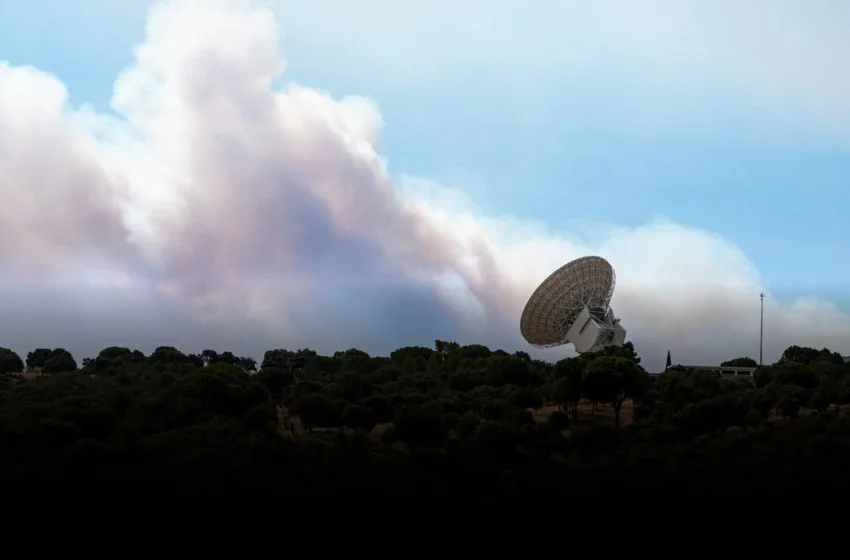
One of NASA’s three Deep Space Communications Complexes, the critical ground station near Madrid, was engulfed by Spanish wildfires on Friday. The "seamless transition" NASA announced masks a far more fundamental vulnerability: critical, geographically dispersed infrastructure is increasingly at the mercy of localized, escalating climate disasters.
For decades, NASA has relied on its Deep Space Network (DSN) — three ground stations strategically placed roughly 120 degrees apart around the globe, in Goldstone, California; Canberra, Australia; and Robledo de Chavela, Spain. This design ensures constant contact with spacecraft like Voyager 1, the James Webb Space Telescope, and the recently completed Artemis mission, providing redundancy for continuous telemetry and data uplink/downlink, even as Earth rotates. The network is hailed as the “largest and most sensitive scientific telecommunications system in the world.” Yet, the recent inferno near Madrid revealed that even this meticulously engineered global redundancy faces increasingly severe localized threats.
While NASA confirmed the evacuation of all personnel and stated a "seamless transition" of mission operations to the Goldstone Deep Space Communications Complex, the phrasing itself demands scrutiny. The immediate impact on the highly sensitive radio telescopes and control systems remains unknown; assessments can only begin when it’s safe. The language of “seamless transition” serves a crucial purpose: to project confidence and maintain public and political support for ongoing planetary science missions. It suggests a robust system in action, rather than a frantic scramble to reroute vital communications for the most distant human-made objects and multi-billion-dollar orbital observatories.
This incident is not an isolated weather anomaly but a stark reminder of the escalating climate crisis, which saw 200,000 people evacuated across Spain and France due to record heat and widespread blazes. The European continent is experiencing unprecedented heat domes, drying vegetation and turning vast areas into tinderboxes. When a critical node in a global communications network can be compromised by a regional environmental disaster, the very definition of redundancy shifts. It moves beyond technical failure into the realm of environmental fragility.
Climate Resilience: The New Engineering Frontier
The assumption of geopolitical stability and predictable environmental conditions underpin the design of most long-term, high-value infrastructure projects. NASA’s DSN, like much of our global AI infrastructure and satellite communication systems, was conceived in an era where localized wildfires or unprecedented heat waves did not pose an existential threat to its operational continuity. Now, these are not edge cases; they are increasingly frequent realities. We saw similar stories unfold recently in Ontario, Canada, and the US Pacific Northwest. Expected temperature surges of up to 10 degrees Celsius above normal in the Mediterranean signal this trend will only intensify.
What does this mean for the next generation of ground stations, data centers, and critical edge computing facilities? Engineers can no longer merely design for component failure or power outages. They must contend with entire regions becoming uninhabitable or inaccessible for extended periods. This requires rethinking everything from physical siting — perhaps burying critical components underground, designing for extreme heat and smoke, or even deploying mobile, rapidly reconfigurable ground segment assets. The costs will be astronomical, but the alternative is risking invaluable scientific data and the operational integrity of missions pushing the boundaries of human exploration.
The incentive to frame this as a controlled, managed event is obvious: NASA needs to assure its stakeholders that its deep space missions remain secure. But the longer-term implication is that the operational risk calculus for critical space infrastructure has fundamentally changed. The world’s leading space agency is now battling climate change not just from orbit, but directly on its doorstep.
Beyond Redundancy: Towards True Environmental Robustness
The wildfires underscore a deeper challenge facing all high-value, geographically dispersed technological assets. From submarine fiber optic cables threatened by rising sea levels to crucial microchip fabrication plants facing water shortages, the physical world is asserting its disruptive power over our meticulously constructed digital one. Relying on mere geographic separation for redundancy is no longer sufficient; the interconnectedness of climate risks means widely separated points can experience correlated failures.
The most skeptical observation here is that "seamless transitions" and "robust backup systems" often mean temporarily shifting a burden, not eradicating a systemic vulnerability. This isn’t just a matter of switching a feed from Madrid to Goldstone; it’s about the very real possibility that both could be compromised simultaneously by climate-induced events, perhaps not wildfires, but extreme weather of another kind. The Goldstone complex, after all, is in California, a state no stranger to wildfires and drought.
Moving forward, the industry must prioritize designs that embrace not just technical fault tolerance but genuine environmental robustness. This includes comprehensive climate risk assessments for every new facility, investing in advanced fire suppression and cooling technologies, and exploring novel methods for data transmission that reduce reliance on fixed ground infrastructure. The future of global tech and scientific endeavor depends on building systems that can withstand the planet’s increasingly volatile temper, rather than just sidestepping its immediate outbursts.
