
Black Holes as Galactic Architects: The Unseen Stability of Cosmic Recycling
- Space
Arjun Vedanta
- 0
- 5 minutes read
Recalibrating the Universe’s Engines
The universe’s most fearsome gravitational behemoths, black holes, don’t merely consume; new observations suggest they are, in fact, cosmic gardeners, cultivating the very fuel that sustains them across eons. This revelation, stemming from the James Webb Space Telescope’s unprecedented gaze into NGC 4696, doesn’t just solve a long-standing astrophysical puzzle; it fundamentally alters our perception of these galactic anchors, shifting them from pure destroyers to essential, self-regulating components of galactic stability. The traditional narrative of a black hole as an insatiable maw often misses the crucial feedback loops now being directly observed.
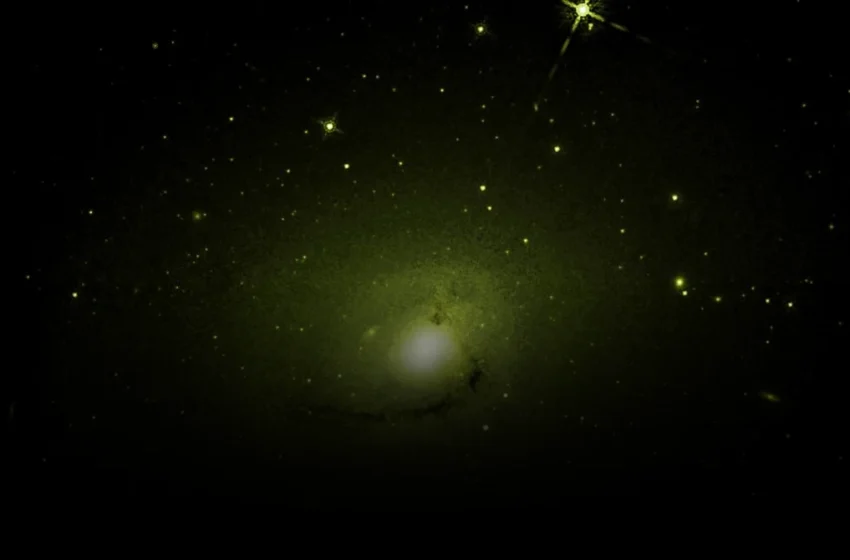
Julie Hlavacek-Larrondo and her team have delivered visual proof of what was once theoretical: gas blown away by a black hole’s powerful energy jets eventually cools, condenses into delicate filaments, and then spirals back into the central accretion disk. This direct visualization of the “cosmic recycling system” in action, detailing gas flows across 800 light-years at speeds up to 600 kilometers per second, transforms a conceptual model into tangible, observed fact. It’s a cyclical process – heating and dispersal followed by cooling and infall – that ensures a continuous supply of matter, demonstrating an unexpected equilibrium at the heart of galaxy clusters.
For decades, the supermassive black hole at a galaxy’s core has been cast in a binary role: either passively feeding or violently expelling energy that stifles star formation. The enigma always persisted: how could these entities sustain their growth if their jets constantly cleared away their sustenance? What Hlavacek-Larrondo’s team has now confirmed in NGC 4696 using JWST’s Near-Infrared Spectrograph, capable of distinguishing structures only 30 light-years across, demonstrates that this expulsion isn’t a wasteful act but a critical part of a longer-term, self-sustaining mechanism. The gas isn’t simply gone; it’s reset, prepared for its return journey.
This dynamic balance suggests that instead of purely destructive forces, black holes operate as integral regulators, mediating the flow of matter and energy within their host galaxies. The idea that magnetic fields can torque away angular momentum, guiding gas into the disk, further illustrates an intricate, finely tuned system, far from chaotic. This discovery invites a re-evaluation of how we model galactic evolution, particularly the interplay between a galaxy’s central engine and its broader cosmic web.
The incentive to frame this as a groundbreaking observation, beyond pure scientific curiosity, is clear: it validates the immense investment in instruments like JWST, ensuring continued funding and justifying the strategic allocation of scarce observing time for subsequent programs investigating gas behavior at different temperatures across other galaxies.
Galactic Harmony: Stability in the Vortex
The implications of a self-sustaining black hole go beyond just its personal dietary habits; they speak to a profound, inherent stability within galactic cores. If black holes are constantly recycling their fuel, ensuring long-term growth and activity, then their influence on galactic evolution is less an intermittent burst and more a steady, persistent hum. The wobble of the accretion disk, caused by incoming filaments from multiple directions, means jets uniformly heat the surrounding cluster, preventing localized excessive cooling, thereby maintaining a specific thermal environment conducive to regulating star formation over cosmic timescales.
This constant, self-correcting feedback loop fundamentally challenges the popular, almost mythological, portrayal of black holes as cosmic vacuum cleaners leading solely to catastrophe. While their power remains immense, the new data reveals a more sophisticated role: black holes aren’t just destructive; they appear to be architects of long-term galactic equilibrium, providing a consistent, albeit powerful, influence. The question then becomes: how many other systems are similarly self-regulating, hidden behind the veil of insufficient observational resolution or theoretical preconception?
It’s a stark reminder that even within the highest echelons of astrophysics, narratives can ossify; the idea of black holes as purely destructive engines has perhaps hindered a full appreciation of their more complex, constructive roles in galactic dynamics.
Rethinking Cosmic Design
The notion that a black hole’s activity can fundamentally alter the behavior of surrounding gas—from forming a stable disk to creating a chaotic state in more energetic systems—underscores a spectrum of regulatory functions, not a singular mode of operation. This is not simply a matter of scale but of fundamental interaction pathways. This tiered understanding, where different levels of black hole power lead to distinct galactic environments, provides a crucial missing link in our models of large-scale structure formation.
What we are witnessing is a paradigm shift in understanding, moving from black holes as mere gravitational singularities to recognizing them as active, adaptive components in a vast, interconnected cosmic ecosystem. The ongoing series of papers and the approval of new JWST programs signal that this is just the beginning of truly mapping these intricate relationships. The “ultimate cosmic recyclers” are not just observed; they are finally understood to be central to the universe’s enduring design, continually shaping the destinies of galaxies in a dance of creation and dissolution.
The long-term stability implied by this recycling mechanism directly contradicts the conventional, cataclysmic portrayal of black holes as purely destructive forces, hinting at a more profound, constructive role in galactic evolution over eons.
