
Personal Radiation Shielding Reshapes Deep Space Mission Economics
- Hardware
Arjun Vedanta
- 0
- 5 minutes read
Rethinking Deep Space Protection
The engineering dogma for deep-space missions has always been monumental: encase humanity in a fortress. This week, an Israeli-American startup quietly demonstrated a path toward a far more agile, individualistic future for astronaut safety, challenging decades of conventional wisdom about surviving the solar system’s harsh radiation. The revelation that a wearable vest can offer protection equivalent to a spacecraft’s dedicated bunker isn’t just a technical achievement; it’s a profound re-evaluation of how we approach human expeditions beyond Earth orbit.
For too long, the primary solution to cosmic radiation has been mass – layers of metal, water, or other dense materials intended to absorb dangerous particles. This thinking stems from critical historical events, like the intense solar storm in August 1972, which struck between the Apollo 16 and Apollo 17 missions, posing a lethal threat to any astronaut caught in its path without adequate shielding. The sheer scale and cost of hardening an entire vessel have always been a limiting factor for ambitious endeavors like lunar bases or Mars transit vehicles.
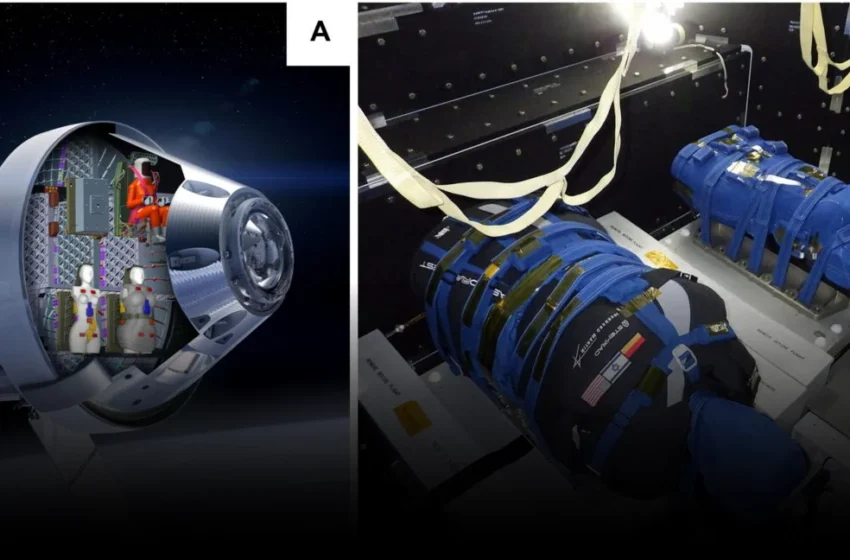
However, the recent test by StemRad, co-founded by Jordan Houri and Oren Milstein, on NASA’s uncrewed Artemis I mission, offers an alternative. Their AstroRad vest, designed to protect vital organs, was flown to the Moon and back. Post-flight analysis confirmed its efficacy, showing it could perform roughly as well as the heavily shielded shelter within the Orion spacecraft itself. This isn’t just an incremental improvement in radiation technology; it’s a fundamental shift from protecting the vehicle to protecting the person, opening up new possibilities for mission design and crew composition.
Beyond the One-Size-Fits-All Spaceship
The implications of effective personal radiation shielding extend far beyond mere engineering elegance. Historically, astronauts have been selected from an extremely narrow pool of individuals — typically military test pilots — who possess exceptional physical resilience and a high tolerance for risk. This made sense when every gram of shielding was a battle, and any crew member’s susceptibility became a mission liability.
Yet, if localized, personal shielding can genuinely provide equivalent protection to a multi-ton bunker, the calculus shifts dramatically. Suddenly, the physical prerequisites for deep-space travel could become less stringent, potentially allowing for a far more diverse range of experts, scientists, and even private citizens to participate in extended lunar surface operations or voyages to Mars. The notion that bespoke, localized shielding provides equivalent protection to an entire spacecraft’s bunker should give pause to anyone still planning multi-billion-dollar hardened modules.
This personal shielding approach, while promising, also implicitly shifts some of the burden of safety from the mission architect to the individual astronaut, a subtle but significant re-allocation of risk that warrants closer scrutiny. It’s a move away from institutionalized protection and towards individual responsibility, a characteristic often seen in nascent or highly exploratory fields. This could accelerate the development of commercial space stations and deep space gateways, where varied personnel with differing risk profiles might operate.
A New Calculus for Space Exploration
The economic ramifications of this breakthrough are profound. Building massive, heavily shielded spacecraft is astronomically expensive, not just in terms of material but also in launch mass. By reducing the reliance on bulk shielding, missions can become lighter, cheaper to launch, and capable of carrying more scientific payload or essential supplies. This allows for greater flexibility in mission planning, from optimal orbital mechanics for transit to the design of advanced materials for future habitats.
This innovative step also aligns perfectly with current strategic imperatives. NASA, facing budget constraints and an ambitious Mars timeline, desperately needs to de-risk and de-cost its radiation problem. StemRad benefits by aligning its innovation directly with this strategic imperative, positioning itself as a critical enabler for future missions. This commercial incentive drives further refinement of the AstroRad technology, potentially leading to fully integrated radiation protection within flight suits or even as part of regenerative life support systems.
Ultimately, the successful demonstration of AstroRad challenges a foundational tenet of space exploration: that only giant, impenetrable vessels can ferry humans safely beyond Earth’s magnetic embrace. Instead, it suggests a future where individuals are empowered with their own adaptable defense, fundamentally altering the economics and accessibility of deep space. This is not just a technological advancement; it is a structural implication that could redefine who goes to space, how they get there, and what they can achieve.
