
Tesla Semi Launch Exposes Global Infrastructure Reality Amidst AI Dreams
- Electric Mobility
Arjun Vedanta
- 0
- 5 minutes read
Musk’s Trillion-Dollar Tango with Trucking
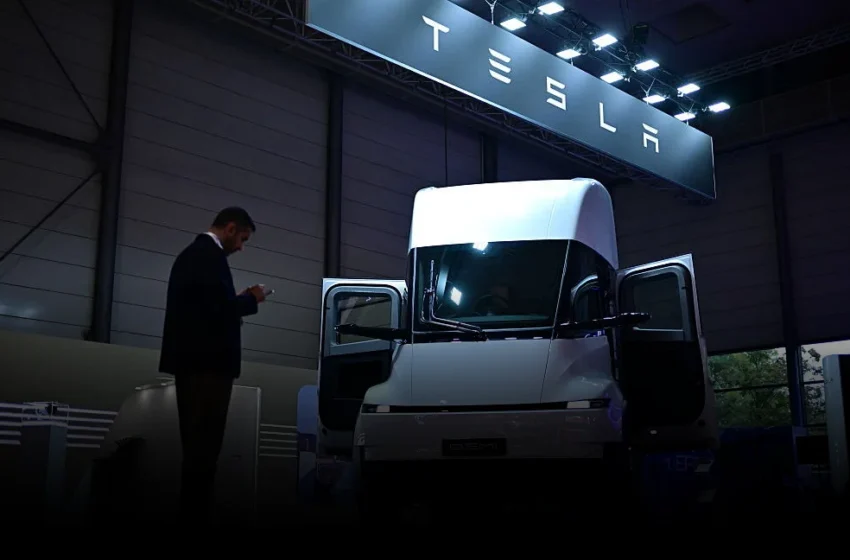
A $20 trillion valuation. That’s the figure Elon Musk has floated for Tesla, not as an electric vehicle manufacturer, but as a robotics and autonomous vehicle company—a sum nearly four times the current market capitalization of AI infrastructure leader Nvidia. Yet, the week saw Tesla’s team in Sparks, Nevada, celebrating the official high-volume production launch of the Tesla Semi, an electric truck that, despite its sleek lines, remains stubbornly tethered to the ground, requiring charging, not just algorithms.
This launch, nearly a decade after the Semi’s initial concept reveal in late 2017, represents a tangible, if somewhat terrestrial, milestone. It targets a specific, pragmatic audience: the cost-conscious managers of large trucking fleets. The event itself, invite-only and livestreamed, featured these men, presumably customers, trooping across a stage to a techno beat, thanked for their orders. Musk, who once revelled in these theatrics, was notably absent, reportedly at a White House China State Dinner, underscoring the curious disconnect between his global diplomatic engagements and the grounded business of moving freight.
The central argument here is simple: while Musk touts Tesla as an AI and robotics behemoth, the practical rollout of a heavy-duty electric truck highlights a profound structural implication the original report missed. The success of the Tesla Semi, and indeed the broader electrification of *global* logistics, is far less about advanced AI and far more about gritty, unsexy grid infrastructure and a vastly underdeveloped international charging network. This reality starkly contradicts the ethereal valuation narrative.
The Global Grid’s Heavy Haul Problem
Musk’s vision of a ‘sports car in truck form’ — as he put it in a pre-taped video — is compelling on a Powerpoint slide. But on the roads of Europe, Asia, or indeed large swathes of the United States beyond California, the practicalities are sobering. Long-haul heavy-duty transport demands immense power, quick turnaround times, and a resilient charging network that simply does not exist at scale. Where will these 80,000-pound vehicles charge, especially when traversing thousands of kilometres, often across borders with differing grid standards and regulations?
This isn’t merely an inconvenience; it’s a fundamental barrier to widespread adoption. While a handful of specific routes or regional delivery loops might be viable for the Tesla Semi, especially for large corporate fleets operating within a controlled ecosystem, the ambition of replacing the global fleet of diesel trucking demands exponential investments in grid infrastructure and dedicated ultra-fast charging stations. Traditional heavy vehicle manufacturers like Daimler and Volvo, with their deeply entrenched supply chain and service networks, understand this better. They are exploring a mix of battery-electric, hydrogen fuel cell, and hybrid solutions, often focusing on regional hubs rather than a singular, universally applicable EV model.
Here’s the skeptical observation: the idea that this regional electric truck launch is a significant stepping stone to a $20 trillion robotics and AI empire requires a leap of faith not supported by the current state of global energy infrastructure or the timelines for its development. The incentive for this launch, right now, appears to be a dual play: to show tangible vehicle progress and placate investors who still view Tesla primarily as an automaker, even as Musk attempts to pivot its identity.
Recalibrating Tesla’s True North
This dichotomy between Musk’s aspirational branding and Tesla’s actual product roadmap reveals a significant internal tension. Is Tesla primarily an EV manufacturer, or is it an AI and robotics company whose products happen to be vehicles? The Semi launch reinforces the former, grounding the narrative in the industrial challenge of heavy-duty transport electrification, rather than the abstract promises of artificial intelligence. While AI certainly plays a role in autonomous driving features, the immediate hurdle for the Semi isn’t a lack of smarts, but a lack of sockets.
The impact on global decarbonization, particularly in sectors like logistics, is substantial. Transitioning from fossil fuels in trucking is critical for emissions reduction, but it’s a marathon, not a sprint, and it’s heavily dependent on public and private investment in charging infrastructure. For companies managing vast fleet management operations globally, the total cost of ownership needs to factor in not just the truck, but the necessary depot upgrades, energy contracts, and downtime associated with charging.
Ultimately, the Tesla Semi is a capable vehicle for specific, regional use cases, a testament to Tesla’s engineering prowess in power train design. However, its launch does little to bridge the chasm between Musk’s ambitious AI-driven valuation and the practical, gritty reality of powering a global fleet of electric trucks. It reminds us that for all the talk of software and robots, sometimes the biggest challenge is simply getting enough electrons to the right place, at the right time, at scale.
