
ASML’s Growing Chokehold: The Unacknowledged Geopolitical Risk of Next-Gen Chips
- AI Infrastructure
Arjun Vedanta
- 0
- 4 minutes read
ASML’s Growing Chokehold: The Unacknowledged Geopolitical Risk of Next-Gen Chips
The global semiconductor industry just collectively leaned harder into its single greatest dependency. Samsung Electronics and Taiwan Semiconductor Manufacturing Co. (TSMC), titans that collectively fabricate the vast majority of advanced chips, are now publicly committing to ASML’s latest high-numerical aperture extreme ultraviolet (High NA EUV) lithography machines. They’ve even agreed to a crucial technology change that promises a 40 percent boost in chip production, mirroring Intel’s earlier embrace of the standard.
This isn’t merely about churning out faster processors for AI data centers or more efficient components for next-generation smartphones. It’s a global tech supply chain, already fragile from recent shocks, further locking itself into an even tighter embrace with a sole-source provider from a small European country. This deepening reliance on ASML represents an implicit agreement to a geopolitical reality few want to acknowledge aloud: that the future of advanced computing ultimately rests on the fortunes and strategic decisions of one Dutch company.
The €370 Million Bottleneck Powering Progress
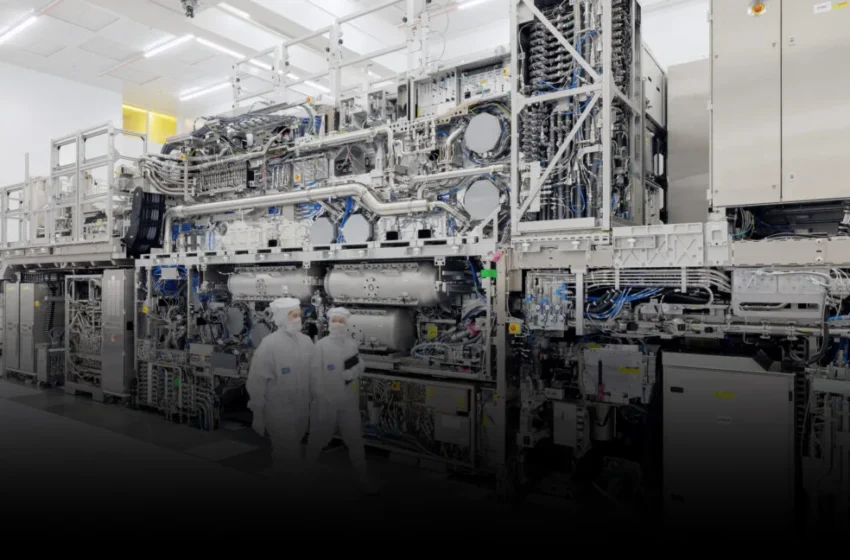
ASML’s High NA EUV machines are engineering marvels, each costing up to $400 million (around €370 million) and standing as the most complex manufacturing equipment ever built. These devices leverage ultra-short wavelength light to imprint impossibly tiny patterns onto silicon wafers, enabling the creation of transistors measured in mere angstroms. Without this technology, the continuous miniaturization of computer circuitry – the very engine of modern digital innovation – would grind to a halt.
Chipmakers, driven by relentless market demands for smaller, faster, and more power-efficient silicon, have little choice but to queue up for ASML’s offerings. The incentive is clear: access to the cutting edge, enabling market leadership in a fiercely competitive industry. Yet, this undisputed technical supremacy has consolidated an irreplaceable choke point in the global chip supply chain, transforming an engineering feat into a structural vulnerability disguised as efficiency. No other company, globally, possesses the capability to produce these machines, making ASML a critical single point of failure and leverage.
Dutch Leverage: The Unseen Hand in Global Tech Wars
The concentration of this foundational technology within a single company in the Netherlands grants it, and by extension its host nation, disproportionate strategic influence. This isn’t just about economic power; it’s about geopolitical leverage in an era defined by technological competition. When the U.S. seeks to limit China’s access to advanced chipmaking capabilities, ASML’s export controls become a crucial instrument of policy, far more effective than any trade tariff or diplomatic pressure.
Beijing, acutely aware of its dependence, is investing billions into developing its own domestic lithography capabilities, yet remains years, if not decades, behind. For other nations, like Taiwan, South Korea, and even the United States, the arrangement creates a paradox: to be at the forefront of AI and high-performance computing, they must cede a degree of strategic autonomy to Veldhoven. The 40 percent production boost heralded by the new technology change will only deepen this entanglement. It means greater efficiency and potentially lower costs for advanced chips, but also a more profound lock-in to ASML’s ecosystem, making any future disentanglement even more complex and costly.
The Unpriced Risk of Single-Source Dominance
The inherent risks of such a concentrated supply chain extend far beyond trade wars. What happens if a localized natural disaster impacts ASML’s operations? Or a sudden shift in Dutch or EU foreign policy? The global economy, increasingly reliant on advanced microchips for everything from military hardware to healthcare devices, would face catastrophic disruption. The lessons learned from the COVID-19 pandemic’s supply chain shocks, particularly in industries like automotive, highlighted the perils of just-in-time manufacturing and limited sourcing. Yet, in the most critical sector of all, the industry doubles down.
The cost of ASML’s machines isn’t just their staggering price tag; it’s the erosion of strategic independence for major technology powers. While immediate benefits of smaller features and more powerful chips are undeniable, the long-term implications of this single-source dominance are rarely factored into corporate strategies or national security assessments. The world’s leading technology companies, chasing the next nanometer, continue to build their towering digital empires upon a foundation increasingly controlled by one, virtually irreplaceable, company.
