
BepiColombo’s Quiet Triumph: The Slow Science vs. Fast Space Chasm
- Space
Arjun Vedanta
- 0
- 5 minutes read
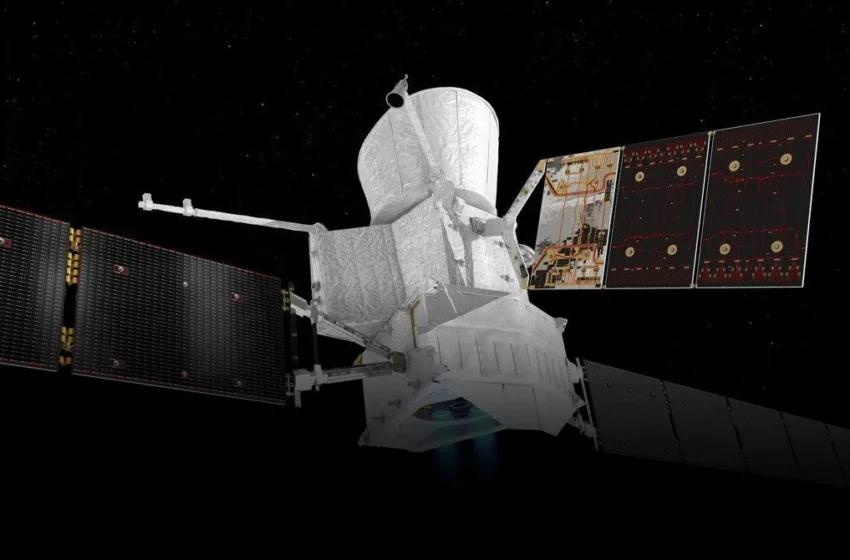
A Martian Dream, a Mercurian Reality: Eight Years of Relentless Pursuit
Eight years in the void, hurtling across billions of miles, not towards a bustling orbital station or a future lunar base, but towards a desolate, scorching rock closest to our sun. The BepiColombo probe, a joint endeavor by the European Space Agency (ESA) and the Japan Aerospace Aerospace Exploration Agency (JAXA), has finally begun its descent towards Mercury. This is not the stuff of Elon Musk’s Mars manifestos or Jeff Bezos’s orbital habitats; it is a testament to an entirely different philosophy of space exploration — one that often gets lost in the relentless drumbeat of commercial space launches and venture capital valuations.
On September 3, ground control confirmed the propulsion module’s successful separation, marking the final approach after a journey protracted by a propulsion malfunction that delayed its arrival by nearly a year. Reaching Mercury, as NASA discovered twice before, is a unique celestial challenge. The planet’s extreme proximity to the sun means spacecraft don’t just ‘fall’ in; they must actively brake against the sun’s immense gravitational pull, consuming vast amounts of fuel or executing intricate, years-long gravity assist maneuvers. BepiColombo performed nine such assists, looping around Earth once, Venus twice, and Mercury six times, traveling 9.9 billion kilometers just to slow down.
This mission, set to unravel mysteries like Mercury’s outsized iron core, the puzzling presence of ice in shadowed craters, and its unique magnetic field among rocky planets, is a triumph of engineering and scientific perseverance. Yet, it also quietly underscores a profound divergence between the patient, high-stakes endeavor of deep space scientific discovery and the rapid-fire commercialization narratives now defining the global space sector.
The Unsung Value of Slow Science in a Fast Space Economy
The popular imagination of space has largely been captured by the private sector’s promises: reusable rockets, satellite internet constellations, asteroid mining, and trips to the Moon or Mars within a decade. These visions, often delivered with a Silicon Valley cadence, prioritize speed, iteration, and often, nationalistic ambition. BepiColombo, by contrast, embodies an older, more painstaking model. It is a multi-generational project, requiring decades of planning, engineering, and sustained international collaboration between ESA and JAXA, far from the quarterly earnings calls of commercial space.
When BepiColombo’s twin orbiters, the Mercury Planetary Orbiter (MPO) and the Mercury Magnetospheric Orbiter (Mio), finally begin full-scale scientific observations in April 2027 – almost a full decade after its launch – the data they gather will not immediately yield a new product or an IPO. Instead, it will feed into fundamental astrophysical research, probing Einstein’s general theory of relativity and providing crucial clues about the formation and evolution of terrestrial planets, including our own. This is the definition of slow science, where returns are measured in paradigm shifts in understanding, not market share.
For all its undeniable scientific merit and the sheer complexity of its execution, one has to wonder if such protracted, high-cost endeavors can truly compete for public imagination or sustained governmental funding in an era fixated on immediate commercial return and nationalistic bragging rights. The long lead times and distant scientific payoffs often struggle to gain traction against the faster, shinier promises of orbital tourism or lunar resource extraction. This announcement, coming after a significant delay, serves not only to celebrate a hard-won technical triumph but also, subtly, to reassert the enduring value proposition of established international space agencies in an arena increasingly cluttered by ‘New Space’ evangelists promising faster, cheaper, and often more nationally self-serving alternatives.
Geopolitics, Gravitas, and the Next Generation of Exploration
The sheer international composition of BepiColombo is a critical, yet often underappreciated, aspect of its significance. In an increasingly fragmented global landscape, the ESA-JAXA partnership on BepiColombo stands as a counter-narrative to the prevailing trends of national space programs vying for individual dominance. It’s a reminder that some of the most challenging scientific endeavors still demand shared resources, expertise, and a collective long-term vision that transcends immediate political cycles.
The successful navigation through technical malfunctions and the commitment to a nearly decade-long transit highlight a certain gravitas inherent to state-sponsored, collaborative planetary science missions. While commercial entities might pivot quickly or fail spectacularly with private capital, agencies like ESA and JAXA bear the weight of public funding and scientific reputation, necessitating a different calculus of risk and reward. Their incentive lies in the incremental, verifiable expansion of human knowledge, rather than the rapid scale-up of a new market.
As the probes prepare for deployment and the intricate process of activating their sunshields and instruments, the mission’s final phase will provide a crucial dataset. This data will not merely satisfy scientific curiosity; it will inform our understanding of the fundamental mechanics of our solar system, perhaps even shaping future deep space architectures. But critically, it will also serve as a quiet, powerful argument for why the painstaking, collaborative pursuit of pure science, even when measured in years and billions of kilometers, remains an indispensable component of humanity’s reach beyond Earth, distinct from – and perhaps even more foundational than – the commercial ambitions that tend to hog the headlines.
