
Beyond AI and Robotics: Why Superworms Expose Tech’s Overlooked Blind Spots
- Tech
Arjun Vedanta
- 0
- 5 minutes read
The Hidden Value of Analog Resilience
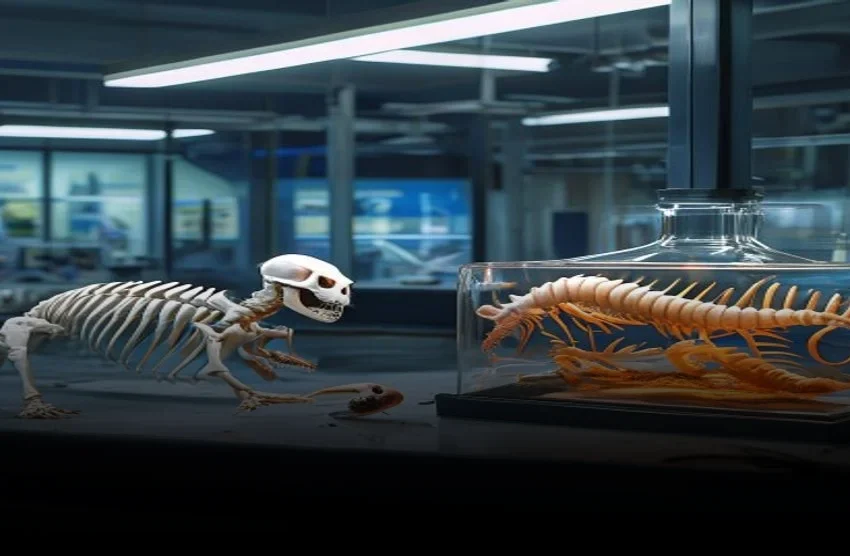
The world’s most advanced laboratories, from London to Singapore, are not always defined by their gleaming server racks or their sophisticated robotic arms. Sometimes, they are defined by a carefully contained colony of insects. This is the understated reality brought to light by recent research from Iran’s Ferdowsi University of Mashhad, published in PLoS One: a proposal to use Zophobas morio, commonly known as superworms, as the preferred method for preparing delicate skeletal remains.
On the surface, it’s a niche entomological update. But beneath, it’s a stark reminder that in our relentless pursuit of ‘next-gen’ solutions, we often overlook the elegant robustness of the deeply analog, the biologically optimized, and frankly, the cheap, in favor of digital complexity that introduces more risk than it solves. While venture capitalists pour billions into autonomous systems that promise to revolutionize everything from warehouse logistics to surgical precision, some of the most pressing, specialized problems in scientific and forensic fields are finding their best answers not in code, but in chitin and instinct.
The conundrum of cleaning skeletal remains is deceptively simple: remove all soft tissue without damaging fragile bone structures. Traditional methods—harsh chemicals, digestive enzymes, or lengthy burial—all carry significant drawbacks, from environmental contamination to irreversible specimen damage. For decades, dermestid beetles have been the industry standard, efficient biological deconstructors.
Yet, these beetle colonies, crucial as they are, harbor a well-understood, persistent threat: escape and subsequent infestation. An escaped colony can lay eggs, compromising entire museum collections, a risk that sophisticated containment protocols merely mitigate, never eliminate.
Beyond Digital Fetish: Risk vs. Robustness
This is where the superworm larvae enter the scene, not as a technological marvel, but as an operational improvement. The research highlights their potential to match the cleaning efficiency of beetles while drastically reducing the systemic risk. Unlike beetles, which require managing an entire life cycle, superworm application focuses solely on the larval stage.
This isn’t just a minor procedural tweak; it’s a fundamental shift in risk profile. The larvae are easier to manage, less prone to pupating in crowded conditions, and crucially, less likely to become an invasive, destructive force if they breach containment. It’s a solution that trades marginal speed (beetles clean faster, 5-7 weeks vs. superworms’ 10-12 weeks) for significantly enhanced security and reduced operational overhead.
What this quiet advancement truly reveals is technology’s persistent blind spot: the fetishization of the complex over the robust. We are living through an era obsessed with ‘smart’ solutions—smart cities, smart factories, smart homes—where ‘smart’ often equates to ‘digital’ and ‘interconnected.’ Yet, the interconnectedness itself becomes the primary vector for new vulnerabilities.
The incentive for many tech companies is to sell more sensors, more data streams, more platforms, creating an ecosystem that benefits from perpetual upgrades and maintenance contracts. But this superworm anecdote provides a counter-narrative, suggesting that sometimes, the most elegant and resilient solutions are those that simplify, those that leverage existing biological efficiencies rather than trying to engineer entirely new, often brittle, digital frameworks.
It’s almost as if the more we push for algorithms to govern every aspect of our physical world, the more we find ourselves scrambling for low-tech, analog stopgaps when those systems inevitably fail or introduce unforeseen liabilities.
Prioritizing Reliability Over Innovation Hype
Consider the broader implications across critical infrastructure, from global supply chains to even space exploration. When a multi-billion dollar satellite goes rogue, the most effective ‘fix’ often isn’t another AI algorithm, but a precisely timed gravitational slingshot or a manual override initiated by human operators on the ground. When a complex logistics network grinds to a halt, the solution often involves rerouting physical trucks and ships, not just optimizing algorithms on a screen.
The ‘superworm solution’ is not just about cleaning bones; it’s a metaphor for prioritizing fundamental resilience and practicality in systems design, especially for tasks where failure is simply not an option. This announcement, while modest in scope, arrives at a moment when industries are hyper-aware of supply chain vulnerabilities and systemic risks.
The drive isn’t merely about finding a solution, but finding the most reliable solution. For institutions like museums and forensic labs, preserving priceless specimens isn’t a profit-driven enterprise; it’s a mission. The incentive here isn’t to innovate for innovation’s sake, but to reduce exposure to catastrophic loss, a motivation that often gets lost in the hype cycles of venture capital and quarterly earnings calls. This framing suggests a pivot from ‘what’s the newest?’ to ‘what’s the most robust and secure?’
Perhaps the lesson from the humble superworm isn’t that we should abandon high-tech innovation, but rather that we should inject a dose of biological pragmatism into our technological ambitions. For every moonshot AI project, there needs to be an equally rigorous assessment of whether a simpler, less-prone-to-failure method—even one involving an insect larva—might not just be better, but absolutely essential. The smartest technology, it turns out, often knows when to get out of its own way.
