
Bumblebee Intelligence Forces an AI Rethink Beyond Silicon Valley’s Scale Obsession
- Artificial Intelligence
Arjun Vedanta
- 0
- 4 minutes read
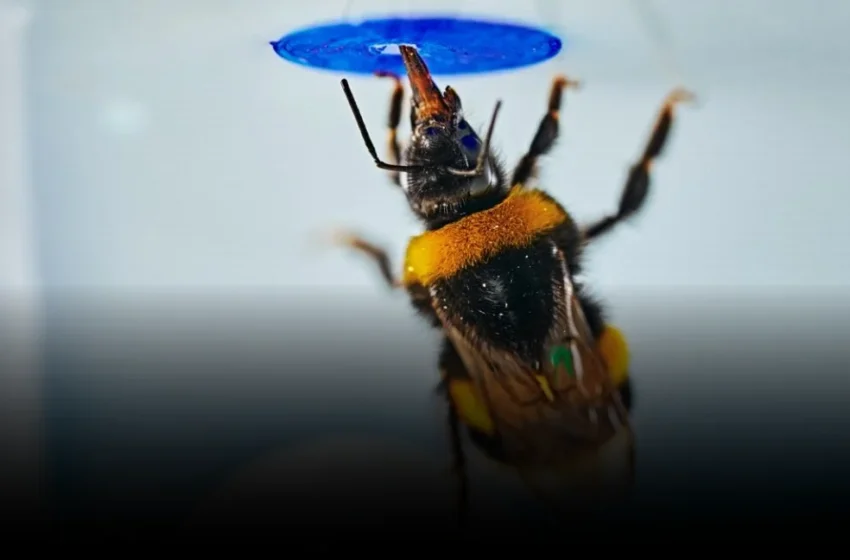
The Micro-Brain Paradox Redefining Intelligence
A bumblebee, with a brain no larger than a poppy seed, has once again exposed the inherent anthropocentrism in our understanding of intelligence. New research reveals these tiny insects can spontaneously solve object-manipulation tasks without any prior training, a cognitive leap previously thought exclusive to large-brained mammals. This isn’t merely a fascinating biological footnote; it’s a profound challenge to the foundational assumptions driving the multi-billion-dollar quest for artificial intelligence.
For years, the prevailing wisdom in AI has been deeply intertwined with scale: bigger models, more parameters, vaster datasets, and ever-increasing computational power. Yet, the bumblebee repeatedly demonstrates that complex, adaptive, and even social problem-solving can emerge from minimal biological hardware. Olli Loukola’s earlier work in 2024 already showed bumblebees cooperating to solve puzzles and use tools. Now, the revelation of spontaneous problem-solving, without learned heuristics, suggests an intrinsic cognitive capacity that defies our prevailing benchmarks for ‘smartness’.
This is where the Silicon Valley narrative often falters. Its focus on ever-larger neural networks, while yielding impressive results in specific domains like natural language processing or image recognition, often overlooks the elegant efficiency found in nature. We’re building digital behemoths, while life itself provides blueprints for highly capable, energy-efficient, and robust ‘agents’ operating with fractions of the resources.
Emergent Cognition vs. Engineered Complexity
The contradiction is stark: much of the AI industry is engaged in an arms race of engineered complexity, adding layers upon layers of abstract computation. A bumblebee, however, offers a masterclass in emergent cognition. Its cognitive architecture, while not fully understood, allows for learning, social transmission, and now, de novo problem-solving in novel situations. This implies a different kind of intelligence—one deeply embodied and intrinsically linked to its environment, far removed from the disembodied, statistical reasoning of most current machine learning models.
The sharpest skeptical observation here is that while tech giants are pouring billions into training models on internet-scale data, the solutions might lie not in more data, but in fundamentally different algorithmic and architectural principles. Perhaps the incentive behind the relentless pursuit of scale is less about reaching true intelligence and more about sustaining a profitable, hardware-intensive development cycle. The benefits accrue to those selling compute power, not necessarily those seeking radical new forms of AI.
Researchers in fields like embodied AI and swarm robotics have long grappled with these questions, often drawing inspiration from biology. The bumblebee’s latest trick only strengthens their argument: intelligence isn’t just about processing power; it’s about effective interaction with the world. This insight is critical for developing more resilient, adaptable robots, or AI systems that can function effectively in unpredictable real-world scenarios without constant retraining.
Rethinking the Foundations of Artificial Intelligence
What the bumblebee saga truly underscores is the limitations of our current definitions of intelligence—definitions often implicitly biased towards human-like symbolic reasoning or pattern recognition. If an insect with a ‘tiny brain’ can exhibit spontaneous problem-solving, our metrics for what constitutes advanced cognition, and thus what we should strive for in artificial systems, need a serious overhaul. This isn’t merely a philosophical debate; it has direct implications for the research funding, design choices, and ethical considerations surrounding AI development.
The lesson from Geneva, Singapore, or London, looking beyond the Palo Alto bubble, is clear: the most profound breakthroughs in understanding intelligence might not come from building bigger models in climate-controlled server farms. They might come from observing a creature navigating its complex world with elegant simplicity. We need to shift our focus from merely scaling up existing paradigms to fundamentally re-evaluating the underlying principles of intelligence itself. The bumblebee isn’t just solving a puzzle; it’s challenging humanity to solve its own cognitive puzzle about what ‘smart’ truly means.
