
Caterpillar’s AI Ambition: A Dual Economy in Heavy Industry’s Future
- Artificial Intelligence
Arjun Vedanta
- 0
- 4 minutes read
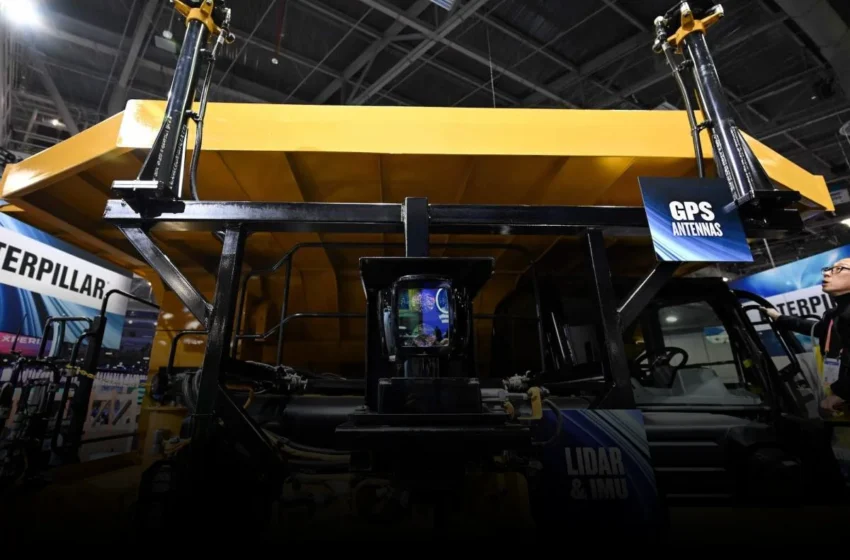
The Price of Progress in Heavy Industry
In an industry obsessed with the abstract, the financial figures and employment realities behind artificial intelligence tell a starker, more physical story. Caterpillar, the venerable name synonymous with earth-moving machinery, finds itself in a peculiar dual role: both a foundational enabler of the AI boom and an aggressive adopter of AI to automate its own substantial operations. While its power-generation division recently recorded a staggering 72% sales spike, hitting $3.10 billion, fueled directly by demand for data center infrastructure, the company’s internal investment in preparing its 118,000-strong workforce for an AI-driven future paints a very different picture.
This dichotomy, where a company profits enormously from the infrastructure underpinning a technological revolution while simultaneously navigating its disruptive internal impacts, reveals a profound structural contradiction often overlooked by those too close to the Silicon Valley narrative. The initial article celebrated Caterpillar’s ingenious application of its mining automation expertise to broader AI deployment; what it missed was the subtle, yet significant, tension created by this dual mandate.
The Unseen Costs of Automation: Beyond Retraining Budgets
Caterpillar’s CTO, Jaime Mineart, articulated the company’s pivot from automating hazardous mining environments to integrating AI across its more dynamic construction sites and quarries. Products like the Cat AI Assistant, which empowers field technicians with voice-activated repair guidance drawn from 1.6 million connected assets and 16 petabytes of proprietary data, exemplify a compelling vision of enhanced efficiency and safety. The company is also leveraging AI agents for software modernization and defect identification, and digital twins for operational analysis in manufacturing.
However, the “hard part about autonomy,” as Mineart rightly stated, is not merely building the technology but integrating it into existing customer jobsites and workflows. This means rethinking how people work alongside intelligent machines. The company has committed $100 million over five years to train its entire global workforce in AI, autonomy, and robotics. This figure, while substantial on its face, translates to roughly $170 per employee per year. For an industrial behemoth generating record quarterly revenues of $20.5 billion, a figure boosted directly by the AI infrastructure arms race, this level of investment in comprehensive workforce transformation appears remarkably modest, almost an afterthought, when weighed against the scale of the impending automation. It is a sum that feels designed to manage optics rather than fundamentally re-skill a global workforce for a radically different industrial landscape.
Whose Jobs, Whose Future: The Global Impact of Physical AI
The incentive for framing this transformation positively is clear: to smooth the transition for Caterpillar’s vast customer base, many of whom operate on razor-thin margins and depend on a human workforce for intricate operations. By showcasing its internal adoption, Caterpillar not only positions itself as a leader in industrial automation but also subtly shifts the burden of workforce adaptation onto its customers. If Caterpillar is automating its own processes and supplying the tools to automate its customers’, the ripple effect on traditional labor structures in heavy construction, logistics, and resource extraction globally is immense.
Joe Creed, Caterpillar’s CEO, noted that “no one is slowing down” on demand for cloud computing and generative AI infrastructure, indicating a sustained boom. Yet, this relentless push for efficiency in physical AI, while promising increased safety and productivity, inevitably brings a profound re-evaluation of human roles. Operators once controlling a single machine might oversee multiple autonomous units from a remote command center, a shift that requires a different skill set and potentially fewer hands. This is not just a technological upgrade; it is a fundamental reordering of economic relationships and job functions within a critical global industry.
The Silicon Valley lens often focuses on the software layer, the algorithms, and the venture capital flows. What that view misses are the concrete implications of AI when it moves from the data center to the quarry, from abstract code to heavy machinery. The global industrial landscape, especially in markets beyond the immediate purview of San Francisco, is not merely adopting new tools; it is undergoing a quiet, yet significant, structural transformation that will redefine skilled labor and employment for decades. Caterpillar’s journey, rather than a simple success story of AI adoption, serves as a harbinger of the complex, often contradictory, forces shaping the future of work in the world’s most foundational industries.
