
Chicxulub’s Echo: What Ancient Extinctions Tell Us About Tech’s Planetary Ambitions
- Tech
Arjun Vedanta
- 0
- 5 minutes read
The Deep Time Mirror: Precedent for Planetary Scale
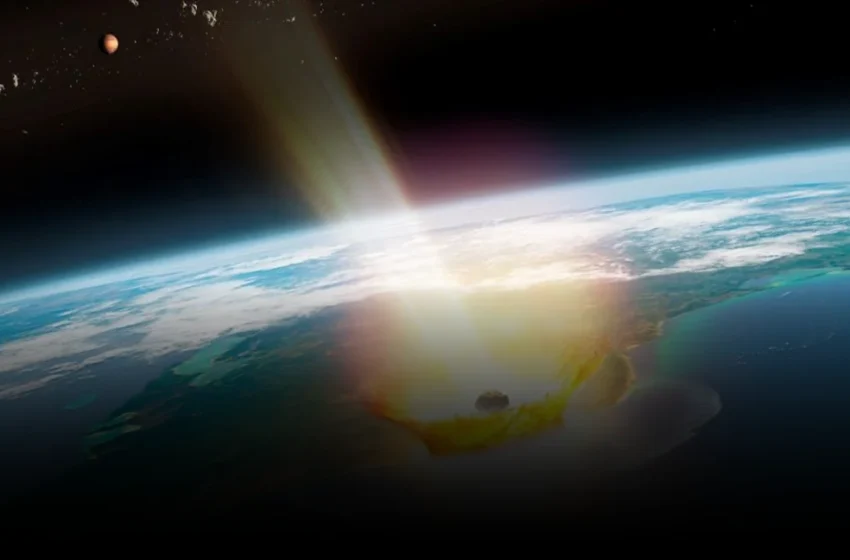
A new paper in the Journal of Geophysical Research: Biogeosciences offers unnervingly precise details on how Earth incinerated its dominant lifeforms 66 million years ago: a superheated atmosphere, widespread charbroiling, and global wildfires following an asteroid strike. While the scientific community celebrates this clarity on the Chicxulub impact, an uncomfortable paradox emerges for anyone tracking the trajectory of human technology. We are gaining ever more sophisticated insight into the planet’s ancient, violent past, even as our own technological ambitions and unintended consequences push us towards unprecedented, self-inflicted planetary-scale alterations.
This latest research, building upon the foundational Alvarez hypothesis from 1980, paints a stark picture: an impactor between 11 and 81 kilometers wide, striking the Yucatan Peninsula, ejected granite, vaporized rock, and sulfates, releasing energy a billion times greater than the atomic bombs dropped on Hiroshima and Nagasaki. The sheer scale of destruction, leading to the extinction of three-quarters of all plant and animal species, is now understood with a chilling mechanical precision. It’s a geological force described with an engineer’s clarity: cause-and-effect, from atmospheric dust clouds to global thermal pulses.
But the story here isn’t just about dinosaurs; it’s about the deep-time precedents for what constitutes a truly planetary event. For decades, humanity has grappled with the notion of the Anthropocene, the argument that human activity has become the dominant geological force shaping Earth. This new understanding of Chicxulub doesn’t just confirm a past natural catastrophe; it recalibrates our understanding of what it means to possess the power to alter global systems — a power we are increasingly attempting to wield, albeit with far less intention and certainly less wisdom.
The Hubris of Human Intervention: From Geoengineering to Space Mining
The tech industry, particularly its more audacious factions, often frames its work as pushing humanity beyond earthly constraints, whether through climate engineering proposals to cool the planet or grand visions of space colonization. Yet, even as we grasp the mechanics of a 66-million-year-old catastrophe, the discourse around contemporary planetary-scale interventions remains remarkably naive.
Consider the escalating discussions around geoengineering. Proposals range from injecting aerosols into the stratosphere to mimic volcanic eruptions – a clear parallel to Chicxulub’s atmospheric dust effects – to vast ocean fertilization schemes. These are not minor tweaks; they are attempts to deliberately manipulate global systems, often with a startling lack of understanding about potential cascading consequences. The scientific impulse to understand the past appears to exist in a separate intellectual silo from the technological impulse to control the future, a critical blind spot for many Silicon Valley evangelists.
The same applies to nascent efforts in space mining, driven by the lure of trillions in asteroid minerals. While framed as resource acquisition for an expanding civilization, it also represents an evolving capability to perturb celestial mechanics. The irony that our scientific understanding of historical asteroid impacts provides a sobering backdrop to the very human desire to master and exploit asteroids is often lost in the breathless pursuit of the next trillion-dollar market. One might even say that Silicon Valley, in its relentless pursuit of ‘disruption,’ risks becoming its own version of a geological event, albeit a slow-motion one.
When the Narrative Shifts: Examining the Incentives
The steady drip of such scientific findings, however meticulously peer-reviewed, serves a dual purpose: it advances our knowledge of planetary mechanics, yes, but also subtly reinforces a narrative that humanity is merely reacting to grand, natural forces, rather than accelerating its own. For the scientific community, publishing a paper in the Journal of Geophysical Research: Biogeosciences is about contributing to a global body of knowledge, enhancing understanding, and gaining peer recognition. For the wider tech narrative, however, such a story can become a convenient backdrop, underscoring humanity’s vulnerability to external threats while deflecting scrutiny from internally generated existential risks.
Why is this announcement happening now? Because the rigorous scientific process of refining hypotheses and accumulating evidence is incremental. But who benefits from its framing? This latest data gives us another piece of the puzzle on Earth’s deep history, yet it doesn’t automatically connect to humanity’s present trajectory. That interpretive leap, often missed by those too close to the daily grind of product launches and funding rounds, is where the real meaning lies. Silicon Valley might dream of terraforming Mars, yet it remains largely oblivious to the deep geological lessons of Earth’s own past, seeing only a frontier to conquer, not a system to understand.
The lesson from Chicxulub is not merely a historical footnote about dinosaurs; it is a profound testament to the delicate balance of Earth’s systems and the immense, often destructive, power of truly global-scale events. As humanity develops increasingly powerful technologies, from advanced AI that could influence global markets to sophisticated planetary defense systems designed to avert future asteroid impacts, we must internalize this lesson. The capacity for vast, unforeseen consequences is not unique to ancient natural phenomena; it is now a defining characteristic of our own technological frontier. Understanding how the Earth actually worked when it reset itself 66 million years ago should serve as a stark warning, not just a fascinating scientific anecdote, for a species that is rapidly acquiring similar, if self-made, reset buttons.
