
From Cambrian Sludge to Silicon Valley’s Scrutiny: Re-evaluating Waste’s Role
- Tech
Arjun Vedanta
- 0
- 5 minutes read
The Uncomfortable Truth of Early Life
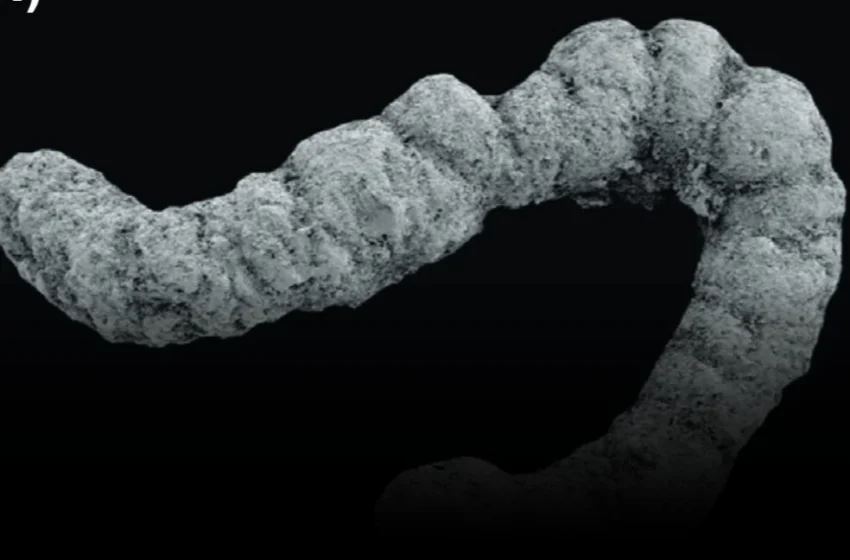
Life got complex, not just because organisms learned to eat, but because they learned to excrete. This isn’t a Silicon Valley origin story; it’s a fundamental biological truth unearthed from the deep past, suggesting that the very act of producing waste fundamentally enabled the Cambrian Explosion some 600 million years ago. Imagine: the proliferation of diverse animal forms, the intricate ecosystems, the biological richness we trace back to that era – all potentially kickstarted by the humble fecal pellet. This is a crucial pivot from our modern, often reductionist view of waste as merely an inconvenient byproduct.
A recent study posits that as early animals evolved the digestive machinery to process food and, crucially, to poop, they inadvertently engineered a planet-scale nutrient distribution system. These early faecal aggregates, dense and sinking, efficiently carried organic matter and vital minerals from the oxygenated surface waters to the nutrient-starved ocean depths. Without this biological plumbing, deeper waters would have remained a sterile abyss, limiting the expansion and diversification of life to a thin, sunlit veneer. The consequence, largely unexplored by the initial scientific framing, is profound: the historical role of waste in enabling biological complexity stands in stark contrast to its current, overwhelming threat to planetary ecosystems.
For too long, our dominant technological narrative, particularly from the hyper-efficient dogma of Silicon Valley, has painted waste as a problem to be eliminated, minimized, or, at best, repurposed through a linear lens. This ancient biological mechanism, however, suggests waste isn’t merely an externality; it was once an **integral, generative force** within an emergent system. This perspective challenges our contemporary understanding of resource management and industrial ecology, particularly as we grapple with unprecedented levels of human-generated waste now overwhelming the very cycles that once thrived on it.
Nature’s Ancient Algorithms vs. Modern Industrial Waste
The Cambrian story is not some quaint scientific footnote; it’s a blunt lesson for an industry often blind to the long-term, systemic impacts of its innovations. The same Silicon Valley gurus who envision terraforming Mars with meticulously closed-loop systems often fail to apply Earth’s ancient, proven lessons of waste cycling to the planet they already inhabit. While early marine organisms innovated a circular economy through their excretions, our current industrial practices are creating a monumental linear flow, clogging natural systems rather than enriching them.
Consider the scale: 600 million years ago, a nascent biosphere deployed waste to fertilize its expansion. Today, humanity generates billions of tonnes of waste annually — from plastic microparticles permeating every corner of the ocean to electronic waste mountains leaching toxins. Our current waste output doesn’t fertilize deeper ecosystems; it chokes them. It disrupts ocean currents, alters pH levels, and introduces novel chemical compounds that nature, even over geological timescales, has never encountered. This isn’t a problem of too much waste; it’s a problem of **misunderstood waste**, fundamentally disconnected from its potential role in a functional ecosystem.
The incentive for many in the industrial sector is to externalize waste costs, to frame byproducts as someone else’s problem, or to lobby for policies that don’t mandate true circularity. The very idea that waste was once a catalyst for life offers a convenient, if cynical, historical alibi for those who might argue that ‘natural processes’ can absorb anything. This historical truth, however, becomes a double-edged sword: it proves waste’s power, but also highlights the catastrophic consequences when that power is misdirected or overwhelms natural processing capacities. The subtle irony is that the same fundamental principle of nutrient cycling, once a boon, has become a bane under humanity’s unchecked industrial metabolism.
Re-engineering for Earth: Beyond Silicon Valley’s Linear Fixes
The distinction between the Cambrian model and our current predicament lies in scale, composition, and reversibility. Ancient waste was organic, biodegradable, and part of a finite feedback loop. Modern waste, particularly from advanced manufacturing and consumer electronics, is often persistent, toxic, and introduced at a rate that far exceeds any natural bio-remediation capacity. The challenge for contemporary technology isn’t just to manage waste, but to fundamentally redesign products and processes to mimic nature’s circularity — a task that requires a radical shift in thinking, moving beyond superficial recycling initiatives.
This isn’t just about better sorting algorithms or more efficient incinerators; it’s about embedding ecological intelligence into product design from the ground up. Companies touting their commitment to sustainability, for instance, must confront how their complex supply chains generate vast amounts of waste at every step, often in jurisdictions with lax environmental oversight. We need **biotechnology solutions** for materials that can genuinely re-enter natural cycles, advanced **AI-driven logistics** for truly closed-loop systems, and a complete re-evaluation of material science. This means looking at waste not as a landfill problem, but as a critical, undervalued resource waiting to be integrated back into production systems.
The global south, often the recipient of the developed world’s discarded e-waste, understands this crisis with stark clarity. Their informal economies, while often hazardous, offer a grassroots, if imperfect, lesson in material recovery that Western supply chains frequently ignore. The lesson from 600 million years ago is clear: waste is not inert. It always, inevitably, impacts the system. The question for modern tech is whether that impact will be one of collapse or, through conscious, intelligent design, a renewed complexity.
