
General Motors’ Robot Gambit: A Global EV Manufacturing Play Beyond Detroit’s Layoffs
- Robotics
Arjun Vedanta
- 0
- 5 minutes read
GM’s Quiet Declaration on the Factory Floor
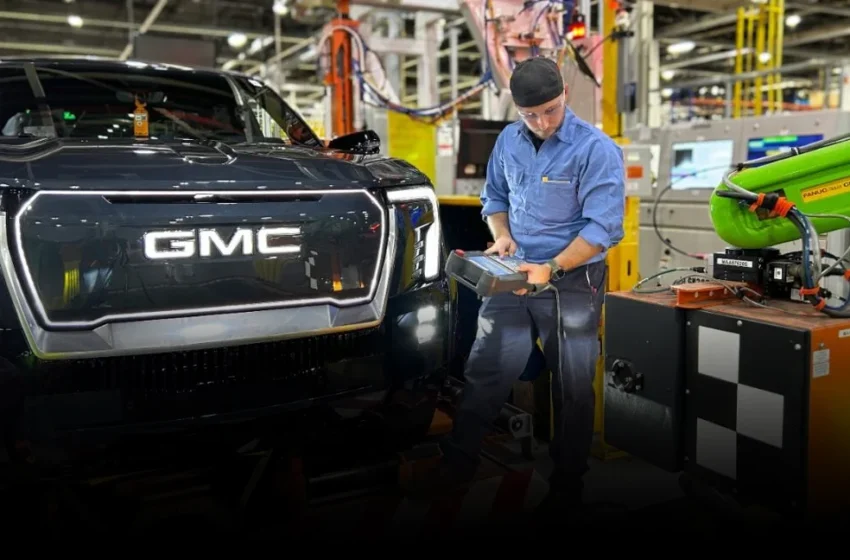
The dozens of new FANUC robot arms humming to life inside General Motors’ flagship Factory Zero EV plant in Detroit are not merely an operational upgrade; they are a stark, mechanical declaration of intent. This isn’t just about attaching components to vehicles faster. It’s about a legacy automaker — under immense pressure to rapidly scale electric vehicle production — making a definitive, long-term strategic move to secure global cost competitiveness. And it’s doing so precisely as 1,300 UAW workers, initially told their layoffs in March were temporary, remain indefinitely sidelined.
This isn’t a story about short-term market fluctuations or temporary pauses in production. This is about GM consciously leveraging automation to fundamentally restructure its manufacturing cost base, particularly its labor component. The UAW’s predictable outrage, articulated by Local 22 President James Cotton to The Detroit News, asking why GM couldn’t recall members instead of installing these robots, captures the immediate human cost. But it misses the broader, calculated calculus being deployed: a multi-pronged strategy that insulates GM from future wage demands and strengthens its hand in upcoming contract negotiations, all while pushing the narrative of inevitable technological progress.
The Unspoken Economics of Automation
Fifty new robots versus 1,300 indefinitely laid-off workers presents a stark image, one that immediately triggers alarm bells for labor advocates. But GM’s incentives stretch far beyond simply replacing human hands with mechanical ones for a marginal efficiency gain. This deployment at Factory Zero, a facility critical to GM’s EV future, signals a profound commitment to manufacturing efficiency and cost control, a necessity in the cutthroat global EV market.
While the Inflation Reduction Act (IRA) offers substantial incentives for domestic EV production, those benefits are often offset by higher operating costs in the United States compared to rivals in Asia or Europe. Automakers like GM are not just competing within the U.S.; they are battling companies such as BYD, CATL, and other emerging players globally, many of whom operate with fundamentally different cost structures. Automation, particularly advanced robotics, offers a pathway to decouple output from escalating labor costs, a critical lever in a high-inflation environment where wage demands are constant.
The timing is also critical. These robots aren’t just about assembly; they are about establishing a baseline for production capacity and cost ahead of future market shifts and, crucially, ahead of future UAW contract negotiations. Is this just about ‘temporary’ market fluctuations, or a permanent shift masked by them, strategically timed to soften future union resistance? The company’s move is a clear signal: GM intends to build EVs at scale, with or without a full complement of highly-paid unionized labor.
Global Pressures, Local Impact
The installation of these FANUC robots, a Japanese brand, underscores a broader trend: the global race for EV dominance is increasingly a technological and manufacturing arms race. Chinese EV makers, backed by extensive government support and sophisticated domestic supply chains, are pushing aggressive pricing strategies that American legacy automakers simply cannot match without radical changes to their own operations. This isn’t just about quality or brand loyalty anymore; it’s about unit economics at an unprecedented scale.
GM’s automation strategy at Factory Zero should be seen in this geopolitical light. It’s an investment in a resilient, less labor-dependent future, designed to safeguard production against future supply chain disruptions, skilled labor shortages, or indeed, industrial action. By integrating more autonomous systems, GM aims to enhance production consistency and throughput, directly impacting its ability to compete on price and volume. This move isn’t just about Detroit; it’s about securing a position in the global EV market, where every dollar saved in production directly translates to competitive advantage.
The underlying dynamic is a push towards re-shoring advanced manufacturing not as a return to old industrial models, but as an embrace of highly automated ‘lights-out’ factories. This isn’t just about creating American jobs; it’s about retaining advanced industrial capacity within the US borders, albeit with a significantly smaller human footprint. This shift inevitably creates tension with traditional labor models, forcing unions to confront a future where their leverage might be diminished by the very technology designed to make manufacturing more competitive.
For the UAW, this represents more than just a battle over specific layoffs. It’s an existential challenge to the very structure of unionized labor within advanced manufacturing. The focus now must shift beyond merely preserving headcount to demanding significant investment in retraining and upskilling programs. Otherwise, the ‘temporary’ layoffs at Factory Zero will become a grim preview of a permanent economic restructuring, one where the promise of a green energy future brings fewer, not more, well-paying factory jobs for the traditional American workforce.
