
GEO’s New Gold Rush: The Blurring Lines Between Surveillance and Orbital Conflict
- Tech
Arjun Vedanta
- 0
- 5 minutes read
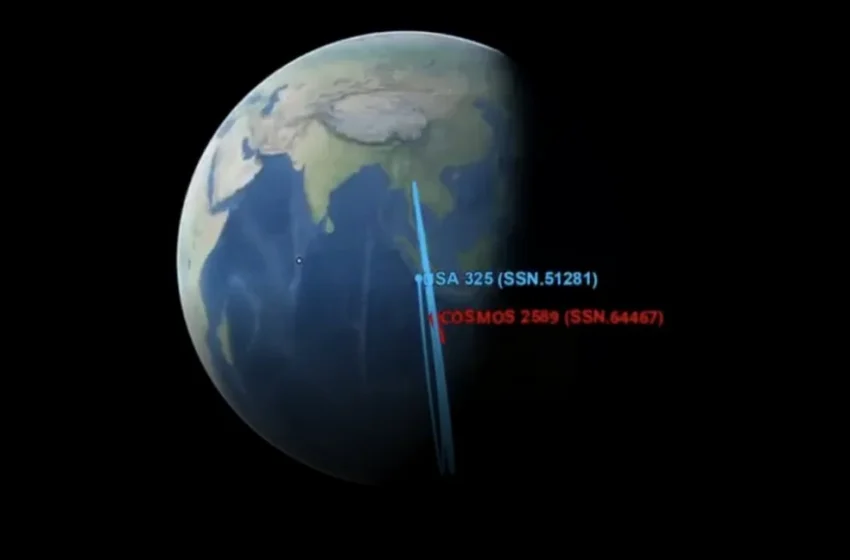
Geosynchronous Orbit: Where Inspection Meets Implication
The recent arrival of Russia’s suspected “inspector” satellite in geosynchronous orbit (GEO) is not merely a new player joining an existing observation game. It marks a critical and dangerous turning point, structurally implying that the domain of outer space, once a theoretical battleground, is now rapidly becoming an active front. The line between what constitutes benign surveillance and what might be a precursor to orbital weaponization has never been finer, and the major powers are deliberately erasing it.
For over a decade, the United States military has deployed a fleet of specialized spacecraft designed to maneuver close to other satellites in GEO – that peculiar orbital band 36,000 kilometers above the equator where satellites appear to hover motionlessly over a fixed point on Earth. These US “inspector” satellites are, ostensibly, for gathering intelligence on foreign space assets. China joined this high-stakes orbital ballet in 2018 with its own similar capabilities, adding another layer of strategic competition to a domain critical for global communications and military intelligence.
Russia’s entry, observed within the last few months, escalates this pattern of proliferation from a bilateral contest to a trilateral one, fundamentally altering the risk calculus. When a nation deploys a satellite capable of “inspecting” — or, as the euphemism often suggests, interfering with — another nation’s assets, the intent is open to interpretation. This ambiguity is precisely the point: it allows for plausible deniability while simultaneously projecting capability. We are seeing a dangerous form of brinkmanship unfold 22,000 miles above our heads.
The Ascent of Suspicion: Who Benefits from Ambiguity?
The US Space Force, not to be outdone, is now poised to order more reconnaissance satellites for the geosynchronous belt. This isn’t just about maintaining an edge; it’s an undeniable response to a perceived threat, further cementing a self-fulfilling prophecy of an orbital arms race. Every nation claims its capabilities are defensive, or for intelligence gathering, yet the inherent dual-use nature of these close-proximity operations is glaringly obvious to anyone paying attention.
The incentive driving this escalating deployment is clear: national security establishments in Washington, Beijing, and Moscow recognize the immense strategic value of GEO. It hosts critical military communications, early warning systems, and navigation infrastructure. The ability to monitor, disable, or even destroy an adversary’s assets in this band would confer an unparalleled strategic advantage in any terrestrial conflict. The current framing as “inspection” benefits all parties by allowing them to develop and deploy potentially offensive capabilities under a veil of benign observation, deferring the international outcry that a direct “anti-satellite weapon” declaration would provoke.
Here is the sharpest observation: the very notion of an “inspector” satellite operating in GEO is fundamentally predicated on the idea of violating another nation’s perceived orbital sovereignty. It’s an implicitly aggressive act cloaked in a technicality. In a domain where speed and distance render traditional borders meaningless, the deliberate close approach of one nation’s satellite to another’s is not an act of neighborly curiosity; it is a direct challenge to operational integrity and security. This is not about observation; it’s about establishing dominance through presence and potential.
A Precarious Commons: Geopolitics in the Geobelt
The consequences for the stability of outer space are dire. For years, the international community has grappled with the problem of orbital debris – shattered fragments from collisions or weapons tests that pose a long-term threat to all space operations. The proliferation of maneuverable “inspector” or “attack” satellites in GEO exponentially increases the risk of accidental or intentional kinetic events. Even a non-kinetic disabling maneuver could lead to a loss of control, transforming a functioning satellite into a piece of dangerous, uncontrolled junk.
This isn’t merely a military concern. Commercial satellites, providing everything from global internet to weather forecasting, also populate GEO. Their operators rely on predictable orbital mechanics and a reasonable expectation of non-interference. As the major powers engage in this high-altitude game of cat and mouse, the entire ecosystem becomes more fragile. The potential for miscalculation, given the lack of clear international norms governing close-proximity operations, is alarming. A single misinterpreted maneuver could trigger an escalation with global repercussions far beyond the initial target.
What US-centric tech reporting often misses is the geopolitical asymmetry: for nations like China and Russia, challenging American dominance in space is a strategic imperative. The United States has long enjoyed a qualitative and quantitative edge. These new deployments, by introducing ambiguity and escalating the potential for localized conflict, aim to erode that advantage. The shared commons of geosynchronous orbit is rapidly becoming a theatre of proxy skirmishes, and the long-term implications for global stability, not just technological advancement, are profound. The space powers are not just probing each other’s vulnerabilities; they are actively making space less safe for everyone.
