
Google Pics: The Quiet Redrawing of Creative Economics for AI
- Artificial Intelligence
Arjun Vedanta
- 0
- 5 minutes read
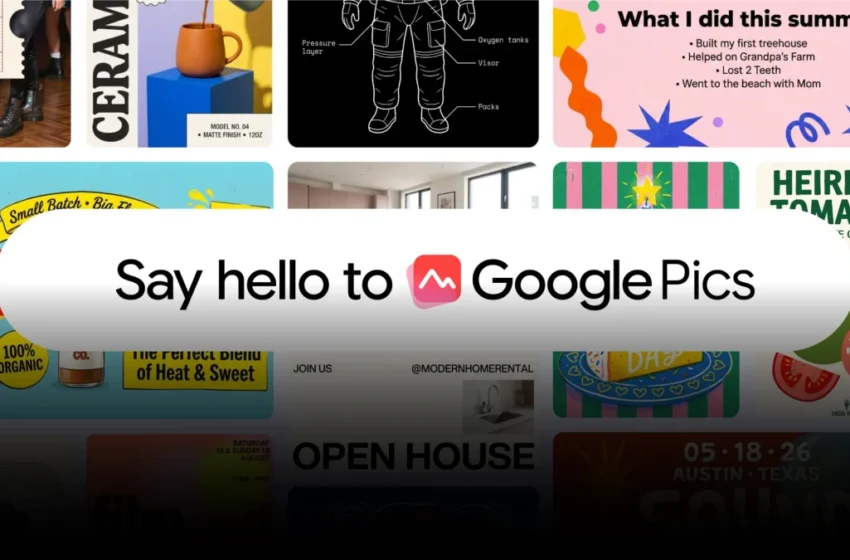
Google’s Invisible Hand in the Creator Economy
Google’s new AI image-creation and editing tool, Google Pics, landing quietly on September 1, 2026, within the Google Workspace suite, is far more than just another competitor to Canva or Adobe Express. At first glance, it appears to be a logical extension of Google’s AI ambitions, offering business users and premium subscribers the ability to generate visuals with a simple prompt, powered by the Nano Banana image-generation model. Yet, its true significance lies not in its functionality, but in its stark redefinition of where value accrues in the increasingly AI-mediated creative economy. The subtle genius of Google Pics, from a corporate perspective, is its direct bypass of the royalty structures that underpin existing creator platforms, absorbing creative labor without direct remuneration.
While Canva built a billion-dollar business on empowering designers and photographers to publish templates and graphics, sharing revenue through royalties, Google Pics makes no such provision. It operates on a fundamentally different principle: AI-generated output, trained on an enormous corpus of existing art, is offered as a utility. This isn’t just a product differentiation; it’s a structural realignment, where the very act of creation shifts from human-to-human transaction to a machine-to-human service. This move quietly but decisively concentrates the economic upside within the platform owner – in this case, Google – rather than distributing it among the original human creators whose collective work provided the training data.
The most cynical observation one can make here is that Google is effectively monetizing the entire history of digital art without paying a dime to the artists.
The Prompt as a Design Interface: A Deceptive Simplicity
The allure of Google Pics for the everyday user is undeniable. Imagine needing a social media graphic or a presentation slide illustration. Instead of sifting through stock libraries or wrestling with complex design software, users simply prompt the system: “create a vibrant poster for a sustainability conference, featuring interconnected green leaves and global motifs.” The Nano Banana model delivers multiple iterations, editable with integrated tools for object isolation, text modification, and collaborative tweaks, all woven into Docs and Slides. This streamlined workflow, soon to extend to Google Drive, reflects a deep understanding of enterprise friction points, delivering efficiency at scale.
However, this perceived simplicity masks a deeper erosion of creative agency and value. When the prompt becomes the primary interface, the demand for nuanced artistic skill diminishes. This isn’t to say there’s no skill in crafting effective prompts, but it shifts from a visual, compositional, or illustrative mastery to a linguistic one. While Adobe Express serves as a tool for creators to make original work, Google Pics positions itself as an alternative to that work, generated on demand. This is not about democratizing design; it is about automating it, transforming the designer from a skilled artisan into a curator of machine outputs.
Why is this announcement happening now? The incentive is clear: Google is racing to embed AI capabilities deep into its core enterprise offerings, aiming to solidify Workspace’s competitive edge against rivals like Microsoft 365. Capturing a slice of the burgeoning design utility market, projected to reach significant figures by the end of the decade, without the overhead of a royalty-based marketplace, presents a compelling financial opportunity.
The Long Shadow of Generative AI on Creative Labor
This isn’t merely a Silicon Valley skirmish; it’s a global structural implication for anyone whose livelihood depends on visual creation. From graphic designers in Singapore to illustrators in London, the proliferation of AI tools like Google Pics will inevitably compress prices and reduce demand for entry-level, and even mid-tier, creative services. The argument for efficiency is persuasive to businesses, but the human cost remains an open question. While Google positions Pics as a tool for “everyday design tasks,” the line between mundane and professional design is increasingly blurry in a world saturated with digital visuals.
We have seen similar dynamics play out in other sectors, from manufacturing automation to content generation. What makes generative AI unique is its direct appropriation of intellectual and aesthetic capital without clear mechanisms for redress or compensation for the original creators. When Google leveraged human-generated data to train its search algorithms, the implicit value exchange was traffic to original content. With AI art, that exchange is severed; the AI consumes the input and produces a new, synthetic output that bypasses the original source economically.
The current lack of robust international legal frameworks around AI training data and intellectual property means companies like Google can push these tools into the market with relative impunity. This is not just a commercial launch; it is an experiment in a new kind of creative capitalism, one where the platforms themselves become the primary beneficiaries of a vast, uncompensated archive of human ingenuity. Google Pics marks another step in this quiet revolution, transforming creative output from a unique human endeavor into a commodified, prompt-driven utility.
