
Home Data Centers: When AI’s Compute Thirst Invades Your Neighborhood
- AI Infrastructure
Arjun Vedanta
- 0
- 4 minutes read
Home Computing: A Trojan Horse for AI’s Power Problem
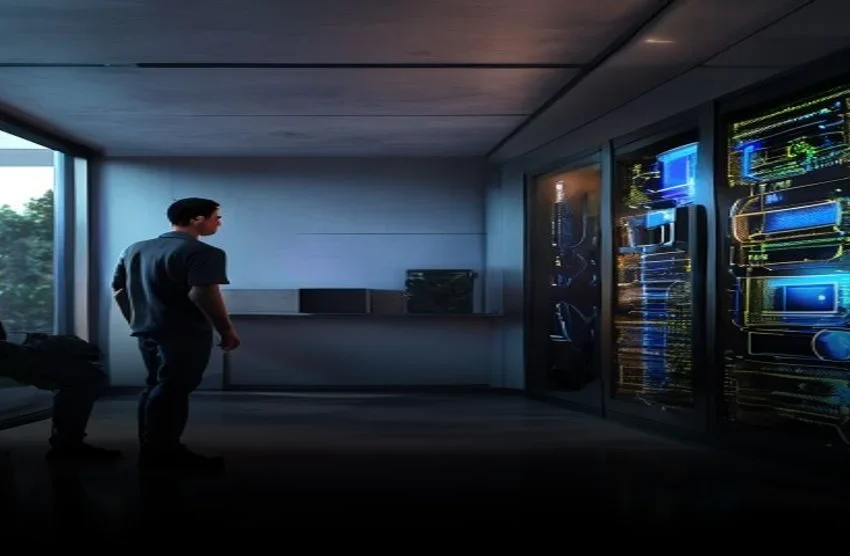
A liquid-cooled Nvidia GPU rack humming quietly in a suburban garage, powered by subsidized electricity and promises of faster internet, sounds less like a technological leap and more like a meticulously crafted social experiment. This is the vision of SPAN, a San Francisco startup now piloting its XFRA nodes: thousands of Nvidia RTX Pro 6000 Blackwell Server Edition GPUs, quietly deployed into residential homes. On the surface, it’s an elegant solution to AI’s insatiable compute demands, sidestepping the colossal costs and delays of building traditional hyperscale data centers. SPAN Vice President Chris Lander frames it as making “energy more affordable for the host and community,” contrasting it with the perceived “loud, ugly” industrial facilities.
Yet, this proposal, poised for a 100-home trial run this year, reveals a profound and potentially problematic structural implication that most Silicon Valley reportage overlooks: the quiet shifting of industrial-scale infrastructure burdens—and their associated risks—from corporations to private citizens. What SPAN presents as an innovative distributed solution could, in practice, externalize the true social and logistical costs of AI compute, embedding them within communities ill-equipped to handle them. Is this genuinely distributed innovation, or merely offshoring infrastructure problems to the lowest-cost, least-regulated denominator?
The Cost of “Distributed”: Shifting Industrial Burdens to Residences
The allure for homeowners is clear: subsidized electricity, free internet, and backup power—a compelling package in an era of rising utility costs. But embedding industrial compute within a residential setting introduces a cascade of practical questions. Data centers, even “mini” ones, demand robust physical security, constant maintenance, and meticulous environmental control. While SPAN emphasizes liquid cooling for minimal noise, the physics of thousands of GPUs processing complex AI workloads still generate substantial heat. How will suburban homes, often built with different thermal envelopes and safety standards, manage this effectively over time without impacting long-term structural integrity or comfort?
Beyond physical infrastructure, there are profound implications for data sovereignty and security. While the specific data processed by these XFRA nodes isn’t detailed, the very purpose of an AI compute cluster implies handling sensitive, often proprietary, workloads. Trusting such operations to a geographically dispersed network of residential hosts introduces a sprawling attack surface and a nightmare scenario for regulatory compliance in sectors like finance, healthcare, or defense. Unlike highly secured, purpose-built facilities, the notion of thousands of private homes becoming de facto data processing units — however small individually — creates an unprecedented regulatory vacuum. This approach essentially creates a new form of edge computing, but one where the edge is a homeowner’s garage rather than a hardened network facility.
Regulatory Gaps and the Erosion of Infrastructure Norms
The incentive for SPAN and its partners, implicitly including Nvidia who stands to sell thousands of its latest GPUs, is undeniable: rapidly scale compute capacity without the typical permitting, real estate acquisition, and energy infrastructure upgrades that plague traditional data center construction. This framing benefits those who need to scale fast, pushing the problem of grid stability onto existing residential networks. The idea of “harnessing excess power capacity among US households” sounds efficient, but the aggregated demand of thousands of high-performance GPUs could strain local power grids designed for residential rather than industrial loads, leading to localized brownouts or increased strain during peak usage that homeowners would then bear.
Consider the regulatory frameworks. How do residential zoning laws, property insurance policies, and fire safety codes adapt to a liquid-cooled server rack, containing components worth tens of thousands of dollars, operating 24/7 in a single-family home? Will this model lead to increased homeowner liability, or will the risks be subtly underwritten by ambiguous service agreements? The shift toward distributed home-based compute isn’t merely a technological innovation; it’s a redefinition of the social contract around infrastructure. It transforms ordinary homes into participants in massive industrial operations, without the commensurate regulatory oversight, public discourse, or community benefit that typically accompanies such developments. We risk creating a system where the convenience of AI development is subsidized by homeowners, while the systemic risks of a burgeoning, power-hungry industry are quietly woven into the fabric of residential life.
