
Japan’s MMX Mission: Beyond Martian Science, A Strategic Play For Deep Space Dominance
- Space
Arjun Vedanta
- 0
- 5 minutes read
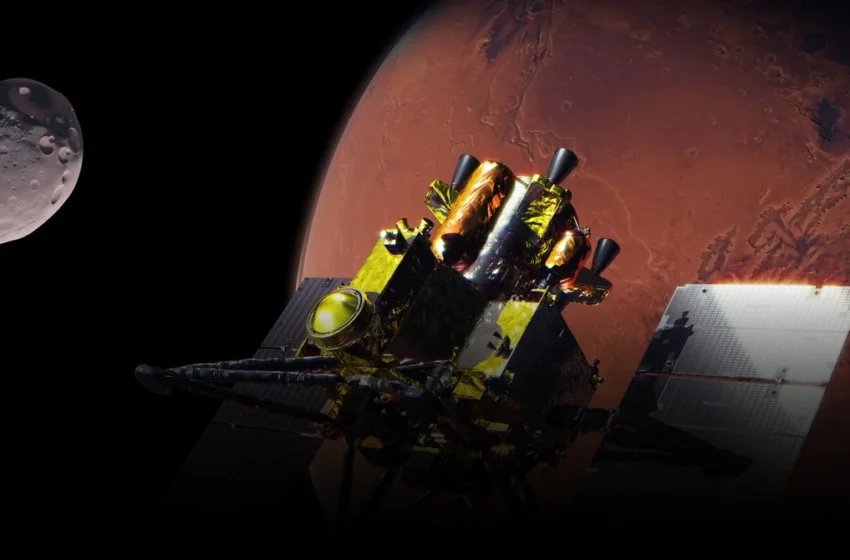
Japan’s Quiet Ascent in the New Space Race
The Japan Aerospace Exploration Agency (JAXA) is preparing for a defining moment on October 20, 2026, with the launch of its Martian Moons eXploration (MMX) probe. This isn’t merely another scientific expedition to scoop up some rocks; it’s a strategically significant maneuver, years in the making, aimed at positioning Japan as a formidable player in the burgeoning field of deep-space resource exploration. While the world’s space agencies often tout scientific discovery as their primary driver, the MMX mission quietly lays groundwork for future national claims and technical leadership far beyond the Red Planet’s immediate vicinity.
MMX aims to collect a minimum of 10 grams of material from Phobos, Mars’ larger moon, with samples expected to arrive back on Earth by 2031. This would mark the first time humanity has retrieved material from a Martian moon, a feat that would answer critical questions about the moons’ origins—whether they are captured asteroids or remnants of a colossal impact with Mars itself. But the engineering challenge, costing around $345 million US, hints at objectives stretching beyond planetary geology: the mission is designed to validate new technologies for future round-trip travel and sampling, capabilities vital for sustained extraterrestrial operations.
For too long, the narrative of space exploration has been dominated by the US, Russia, and more recently, China. Yet, Japan, with missions like Hayabusa and Hayabusa2, has quietly demonstrated an unparalleled prowess in precision asteroid sampling and return. This quiet expertise, honed over decades, is now being projected onto a much larger, and arguably more strategic, target.
The Gravitational Pull of Resources and Autonomy
Phobos, with a radius of just 11 kilometers, presents an engineering paradox: its low gravity makes a conventional hover-and-land approach impractical due to fuel consumption, yet it’s substantial enough to complicate the gentle touch-and-go methods used on smaller asteroids like Ryugu. The MMX probe, designed by Mitsubishi Electric, relies on high-precision autonomous navigation to execute its descent and ascent, a necessity given the 20-minute radio signal delay between Earth and Mars. This isn’t just about landing on Phobos; it’s about perfecting the autonomy required for future missions where human real-time intervention is impossible.
The deployment of the IDEFIX rover, a collaboration between French and German space agencies, ahead of the main landing vehicle, underscores a European interest in leveraging Japan’s technical lead. This multinational participation might seem like a benign scientific partnership, but it also reflects a quiet scramble among nations to secure a foothold in space capabilities, particularly those related to resource prospecting. Why is this announcement happening now? Because the window for establishing technical precedents and international partnerships in deep space is closing, and those who lead on capability define the terms of future engagement.
Skeptics will note that 0.1 percent of the expected samples will be Martian debris, blasted onto Phobos over millennia. This small detail, often overlooked in the primary scientific discourse, suggests a pragmatic acknowledgment of the moon as a secondary source of planetary material, sidestepping the immense challenges of a direct Mars surface return mission. It’s a clever, cost-effective way to get some Martian material without going to Mars, highlighting a resourcefulness that challenges traditional mission planning.
Setting Precedents for Off-World Claiming
The most profound implication of the MMX mission extends beyond the scientific debate over Phobos’s origins or the engineering marvels of autonomous navigation. It is about establishing a precedent for national capabilities in accessing and returning extraterrestrial resources. While current international treaties, notably the Outer Space Treaty of 1967, prohibit national appropriation of outer space, the ability to physically retrieve material represents a significant, if undeclared, step toward de facto control or at least access to such resources.
Consider the broader context: the burgeoning asteroid mining industry, the race for lunar resources, and the long-term vision for human settlements off-world. Japan’s methodical approach to sample return missions, from the near-Earth asteroid Itokawa to Ryugu, and now to a Martian moon, builds a cumulative resume of undeniable expertise. This isn’t just about scientific curiosity; it’s about strategic technological sovereignty. The nation that can reliably bring samples—and eventually, resources—back to Earth from increasingly distant and challenging celestial bodies will hold significant leverage in any future discussions about space resource governance and commercialization.
MMX is Japan’s first Mars probe launch in 28 years, marking a substantial re-entry into the Mars exploration arena. This isn’t just a restart; it’s an escalation, signaling Japan’s intent to move beyond scientific collaboration into a realm where technological leadership translates directly into strategic influence. As global powers increasingly look to the stars for future prosperity and security, missions like MMX, though couched in scientific terms, are the quiet skirmishes in a new geopolitical contest for the cosmos.
