
The 500-Meter Wave Nobody Saw: A Tech Wake-Up Call from Alaska’s Fjords
- Tech
Arjun Vedanta
- 0
- 6 minutes read
The Quiet Roar in the Fjord: When Nature Delivers a Near Miss
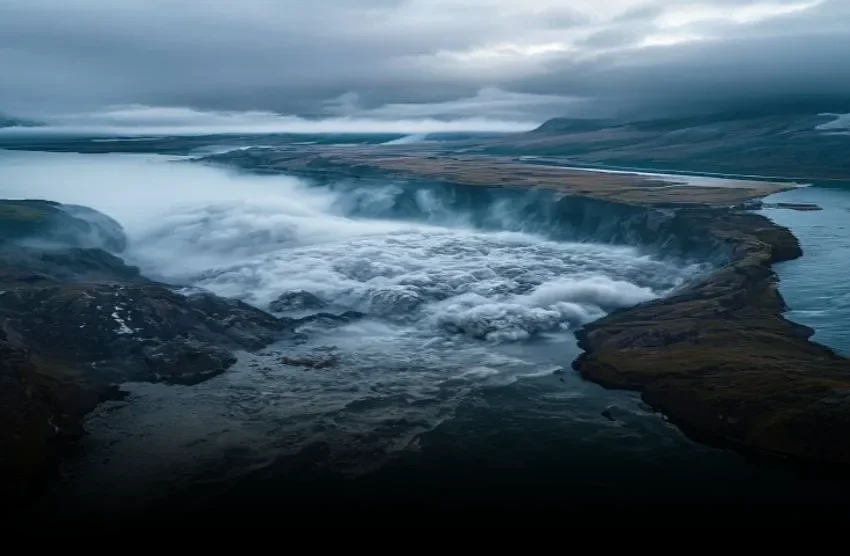
It was 5:26 AM on August 10, 2025. Just another morning in Southeast Alaska, one would assume. But in the deep, icy waters of Tracy Arm fjord, something extraordinary, and frankly, terrifying, unfolded. A slab of rock, a staggering 63.5 million cubic meters in volume – imagine a small mountain suddenly deciding it prefers swimming to standing – peeled off a cliff face above the South Sawyer Glacier. It plunged into the water, triggering a breaking wave that initially topped 100 meters. This wasn’t just a big splash; it was a localized, hyper-violent event tearing across the fjord at speeds north of 70 meters a second. When it smacked into the opposite shoreline, it surged an astonishing 481 meters up the steep rock face.
To put that in perspective, that’s roughly the height of the Empire State Building. And yes, it was the second highest tsunami ever recorded on Earth. But here’s the kicker, and what I find truly fascinating: almost nobody heard about it. No injuries, no fatalities. It was a near-miss, a geological anomaly that simply vanished into the early morning mist. Except, of course, it didn’t really vanish.
It was captured. Reconstructed. Analyzed. And that, for anyone watching the evolution of tech and its uneasy dance with our natural world, is where the real story begins. Because while we didn’t suffer a human tragedy, the data itself is screaming a warning about our observational gaps and the quiet vulnerabilities we’re building right into our future.
When Data Points to Disaster: Our Observational Blind Spots
Aram Fathian, a researcher at the University of Calgary, and his colleagues reconstructed this seismic ballet using everything from high-resolution satellite imagery (thank you, Planet Labs and your persistent orbiters) to advanced hydrological modeling. They pulled historical LiDAR data to understand the pre-event landscape and acoustic signatures from local seismic networks. What this tells me is that our ability to *retrospectively* understand these events is growing exponentially. We can piece together the puzzle with precision, almost like a digital forensics team investigating a system breach after the fact. We’re getting better at the autopsy.
But let’s be honest about this: the early detection, the real-time warning that could have saved lives if a tour boat had been sailing through or a remote research station had been active, that’s a different beast entirely. We’re deploying billions into AI that can recommend the next binge-watch or optimize ad placement, but the infrastructure for robust, real-time geological monitoring in remote, harsh environments? That’s still a patchwork. These are not the easy, sensor-rich environments of urban smart cities. Deploying robust, long-term sensor networks – think next-gen IoT nodes with edge computing capabilities for pre-processing seismic and acoustic data – in places like Tracy Arm is an operational nightmare. Power, connectivity, maintenance in sub-zero temperatures… the economics are brutal.
What I’ve watched companies try for years is to make the ‘unlikely’ profitable for tech solutions. But the truth is, the market for preventing a 1-in-100-year event in an uninhabited fjord remains incredibly niche. It takes a real disaster, a tragedy, to kickstart significant investment. That matters.
The Hidden Costs of ‘Near Misses’ and the Tourism Economy
Nobody’s talking about the real problem — which is our growing reliance on these pristine, often remote, natural areas for tourism, for resource extraction, and increasingly, as ideal locations for certain types of data infrastructure. Alaska, in particular, is a magnet for cruise ships and adventure tourism. Tracy Arm is a major tourist destination. Imagine that 500-meter wave hitting a fully loaded vessel, or wiping out a newly established eco-lodge powered by a localized microgrid. The loss of life would be horrific, yes, but the economic fallout – for the travel industry, for local communities, for the state – would be catastrophic.
The global market for natural disaster risk modeling software is projected to hit nearly $17 billion by 2027. That sounds like a lot, but how much of that is truly focused on granular, localized, low-frequency, high-impact events like a landslide megatsunami in a remote fjord? My bet? Not enough. Most of it is focused on hurricanes, floods, and earthquakes in populated areas where the *immediate* return on investment for risk mitigation is clear. The ‘near-miss’ data from Tracy Arm feeds into these models, sure, but it’s a single data point in an ocean of variables. The challenge of building robust AI models that can predict these black swan events, especially when the training data consists mostly of ‘nothing happened’ or ‘it happened once 60 years ago’ (like the 1958 Lituya Bay 530m tsunami), is immense. You can’t train a machine learning model effectively on scarcity.
This isn’t just about geology; it’s about our expanding digital footprint into fragile environments. As more people seek out remote experiences, and as the infrastructure to support them (from Starlink terminals to localized fiber optic nodes) stretches further, the risk exposure increases. And frankly, the regulatory bodies are often playing catch-up, relying on decades-old risk assessments when the underlying geological dynamics are shifting, thanks to climate change and other factors.
The Next Wave and Our Tech Blind Spots
Landslide-generated tsunamis are, as the study notes, often more localized but vastly more violent than their earthquake-driven cousins. Since 1925, scientists have documented 27 such events with runups exceeding 50 meters. That’s not a rare anomaly; it’s a recurring, if geographically specific, threat. And as glaciers retreat, destabilizing mountainsides that have been buttressed by ice for millennia, we’re likely to see more of these events. This isn’t just Alaska’s problem; it’s a global issue for anyone living near mountainous coastlines or fjords.
So, what do we do? We have the observational tech. We have the data science talent. We have the cloud computing power to crunch these models. What we lack, perhaps, is the collective will, or rather, the monetization model, to prioritize foresight over forensics for every single potential point of failure on the planet. I’ve watched this cycle repeat countless times: a terrifying event occurs, there’s a flurry of research and funding, and then the attention wanes until the next one hits. It’s human nature, I suppose, but it’s also a glaring Achilles’ heel for an industry that prides itself on predictive power and innovation. The Tracy Arm tsunami was a silent, 500-meter-high shout. It’s time tech listened before the next one isn’t a near-miss.
