
The Enduring Lesson of a Sprinkler: When Theory Meets Reality, Even for Feynman
- Tech
Arjun Vedanta
- 0
- 6 minutes read
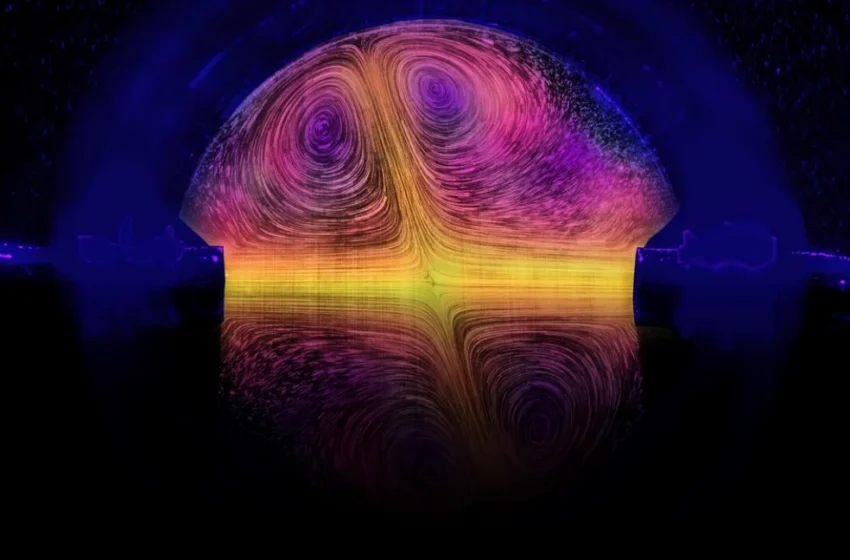
The persistent hum of a server farm or the intricate dance of algorithms often obscures a fundamental truth: even the most advanced technology ultimately bows to the immutable laws of physics. This isn’t just a philosophical musing; it’s a practical constraint Silicon Valley consistently underestimates, and a new paper from New York University’s Courant Institute serves as a potent reminder. What might seem like a mere academic curiosity — the decades-old “reverse sprinkler problem” – is a stark, tangible lesson in the chasm between theoretical elegance and messy, empirical reality.
From Thought Experiment to Hard Data
For decades, the reverse sprinkler problem, popularized by physicist Richard Feynman, remained a stubborn fixture in the annals of fluid dynamics. The puzzle itself is deceptively simple: if a sprinkler expels water and spins in one direction, what happens if it were to suck in water? Would it spin the same way, or reverse course, or simply remain stationary? Ernst Mach first conceived this thought experiment in 1883 within his textbook, The Science of Mechanics. Later, a vibrant debate among Princeton University physicists in the 1940s, including a young graduate student named Feynman, cemented its notoriety, underscoring the profound challenge of intuition when faced with non-linear systems.
Feynman, never one to shy from an experiment, even attempted to test his hypothesis in a cyclotron laboratory. His reflections, noted in 1985’s Surely You’re Joking, Mr. Feynman, highlighted the core of the problem: “The answer is perfectly clear at first sight,” he wrote, “The trouble was, some guy would think it was perfectly clear [that the rotation would be] one way, and another guy would think it was perfectly clear the other way.” This long-standing intellectual sparring match, often considered more philosophical than practical, perfectly illustrated the limits of abstract reasoning without real-world corroboration.
Now, researchers at NYU have finally delivered an experimental resolution, detailed in the Proceedings of the National Academy of Sciences. By conducting a series of experiments with various “silly sprinkler” designs — those playful garden devices that create amusing water patterns – they provided hard data where only conjecture once existed. This isn’t just an academic footnote for theoretical physics; it’s a vital re-affirmation of the scientific method’s reliance on empirical validation, even in an era where computational models and sophisticated simulations increasingly dominate scientific inquiry. The incentive for the Courant Institute is clear: to stake a prominent claim in solving a classic physics riddle, thereby demonstrating the enduring relevance and capability of hands-on experimental work in a world often distracted by digital abstraction.
The Limits of Intuition and the Value of Messy Reality
The tech industry, particularly its most ambitious corners, frequently operates on assumptions born from theoretical frameworks rather than exhaustive real-world testing. From the promises of fully autonomous vehicles to the energy efficiency claims of novel computing architectures, there’s a recurring pattern: a deep-seated belief that sufficiently sophisticated algorithms or elegantly designed systems will simply work as predicted. The reverse sprinkler problem’s solution serves as a stark counterpoint to this techno-optimism. What seemed intuitively “clear” to some of the brightest minds of the 20th century was, in fact, a complex interplay of forces that only careful, repeatable experimentation could fully elucidate.
This isn’t merely about complex fluid dynamics; it’s about the very nature of discovery itself. When physicists like Feynman grappled with the sprinkler paradox, they were confronting the inherent biases of human intuition and the boundaries of their theoretical frameworks. The solution wasn’t found in a blackboard derivation, nor in an elegant equation, but in observing actual jets of water under controlled conditions. This is a lesson that echoes across mechanical engineering and hardware development, where the interplay of components in a real-world system almost always produces unforeseen effects, often defying initial expectations. The sharpest skepticism should always be reserved for any grand vision, particularly in nascent technological fields, that lacks robust, real-world data to back its theoretical claims. Silicon Valley’s iterative approach, while powerful for software, often relies on fast failures and rapid adjustments; sometimes, however, the underlying physics demands a more foundational understanding from the outset, before costly prototypes are even built.
What Feynman’s Sprinkler Teaches Tech’s Grand Visionaries
The resolution of Feynman’s sprinkler problem might seem esoteric, far removed from the concerns of venture capitalists or software engineers. Yet, its implications for the global tech sector are surprisingly direct, particularly for those pushing the boundaries of AI hardware, robotics, and advanced materials. Consider the relentless pursuit of miniaturization in semiconductors, where quantum effects — once theoretical curiosities — become practical engineering challenges. Or the nascent fields of robotics and advanced materials science, where the physical properties of matter dictate the ultimate boundaries of innovation, demanding precision far beyond software logic. A fundamental misunderstanding of these physical realities, even subtle ones, can lead to monumental project failures and billions in wasted investment.
This isn’t to say that theoretical breakthroughs aren’t crucial; they are the bedrock of all scientific and technological progress. However, the international perspective offers a clearer view of how a Silicon Valley-centric narrative sometimes prioritizes software abstractions and digital models over the gritty realities of physical hardware. While the West Coast often celebrates the “move fast and break things” ethos, markets in Asia and Europe, particularly in industrial tech or deep science ventures, tend to demand higher upfront empirical validation and rigorous testing. The solution to the reverse sprinkler problem, arriving decades later, highlights a truth often overlooked in our rush towards digital solutions: some problems cannot be abstracted away or simulated into submission. They require getting one’s hands wet, metaphorically speaking, and confronting the empirical truth, however inconvenient. The lesson for tech’s grand visionaries is plain: no matter how elegant your computational model, how compelling your pitch deck, or how fast your code compiles, the real world always runs its own unique and often unforgiving debug cycle. Ignoring it is not innovation; it is expensive hubris.
