
The Unseen Labor Powering Physical AI’s “Brain Wave” Breakthrough
- Robotics
Arjun Vedanta
- 0
- 5 minutes read
Humanity’s Unseen Hand in Robotics’ Data Deluge
The frontier of ‘physical AI’ may be marketed as a triumph of machine autonomy, yet its most critical, and least acknowledged, ingredient remains deeply, stubbornly human. While Silicon Valley fixates on brain-computer interfaces for consumer tech, companies like Encord are quietly assembling a new class of specialized human labor, armed with bio-sensors and robot controls, to hand-feed the data required for robots to navigate the real world.
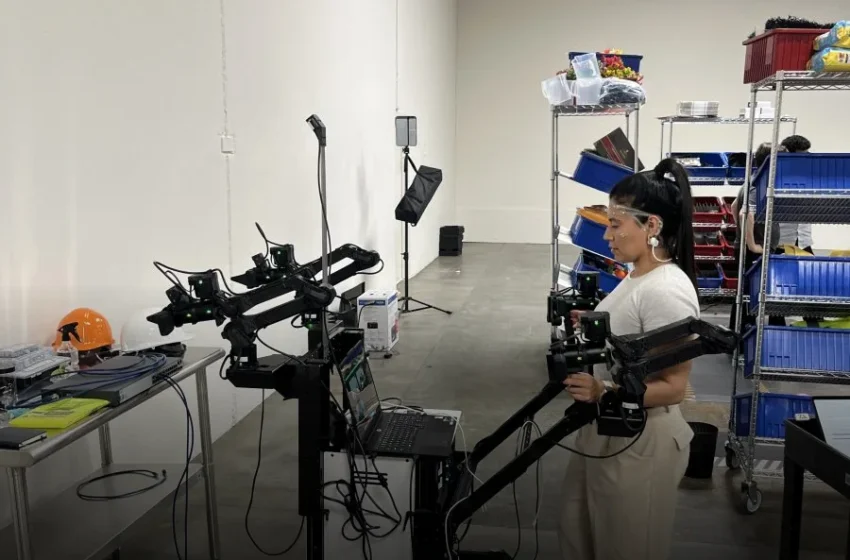
This isn’t just about collecting better data; it’s about manufacturing an entirely new kind of digital-physical ghost work at scale. It makes the human element more entangled, not less, in the very machines designed to replace human hands. In a San Leandro warehouse, Andrew Ceja, an Encord ‘pilot,’ carefully extracts Jenga blocks while a Zander Labs headset records his brain waves.
This isn’t just a quirky experiment; it represents Encord’s explicit bet that the fundamental bottleneck for humanoid and warehouse robotics isn’t model architecture, but the sheer scarcity of real-world physical training data. As Vineeth Velmurugan, Encord’s head of robot learning, bluntly puts it: “The data simply does not exist.”
Companies building machine-vision applications are finding that end-to-end learning for robotic manipulation tasks demands data sets far beyond anything easily collected. Velmurugan estimates a need for data five times the size of YouTube’s video corpus, a scale that forces data generation itself to become a complex, engineered business.
The Economics of Manufactured Cognition
The casual comparison of physical AI to large language models (LLMs) falls apart under economic scrutiny. LLM makers famously built their models on text scraped from the internet at virtually no cost. Physical AI, however, requires data to be meticulously manufactured, not merely collected, fundamentally altering the unit economics.
Encord’s pilots, like Sofia Infante, maneuver robotic arms to plug ethernet cables or pour coffee, creating ‘egocentric’ video data. This data is augmented with biometric inputs and detailed annotations, such as “right hand tightens bolt.” Velmurugan claims this densely annotated data is worth 100 times more than ‘junky ego data’ for specific tasks, even if it costs 20 times more to produce. On paper, it’s a good trade. In practice, ’20 times more’ is still a substantial investment, reflecting the profound cost difference between training a digital mind and a physical one.
The most sophisticated brainwave monitoring in the world won’t solve for fundamental limitations in robotic dexterity; it merely refines the human effort to bridge that gap. We are building digital muscles, but only with the constant, costly guidance of human proprioception and cognition. The incentive for companies like Encord to publicize such trials isn’t just about research; it’s about positioning themselves as the indispensable intermediary in this nascent, high-value market where data scarcity is the primary constraint, thereby attracting investment and cementing their role as a data-manufacturing hub.
Beyond the Hype: Who Benefits from “Bleeding Edge” Labor?
What’s often missed in the breathless coverage of ‘bleeding edge’ AI is the burgeoning human workforce beneath it. Ceja and Infante are part of a growing class of ‘pilots’ or ‘trainers,’ many migrating from other AI data annotation firms like Scale. They are the new linchpins of automation, tasked with performing the precise, repetitive, often challenging physical actions that robots cannot yet grasp.
This is where the international perspective offers a clearer lens. For years, offshore content moderation and data labeling operations have outsourced the cognitive burdens of AI. Now, the demand for physical dexterity and nuanced human understanding is pulling these tasks into highly specialized, often domestic, labor pools. We are effectively creating new job categories for what amounts to human-in-the-loop manufacturing of machine intelligence, directly tied to real-world physical manipulation.
These human pilots are performing tasks like stacking poker chips or manipulating fake flowers, the mundane yet critical actions that define our understanding of dexterity. Their unique vantage point—sitting between many robotics companies at once, spotting which data techniques gain traction—is Encord’s explicit market pitch, illustrating how the company monetizes this manufactured human insight. The promise of fully autonomous humanoid AI still feels a distant dream when its most advanced training relies so heavily on human ingenuity and, critically, human labor, often in novel and demanding ways. The question isn’t whether robots will take jobs, but what new, hidden jobs we are creating to teach them how to do so, and for whom.
