
Trump’s Ambitious Space Policy: A Thousand Launches and the Unseen Costs of Orbital Dominance
- Space
Arjun Vedanta
- 0
- 5 minutes read
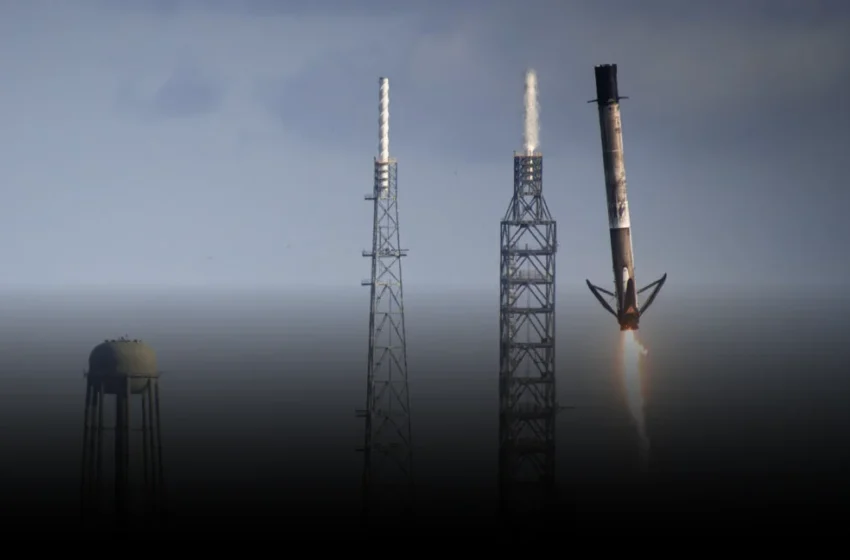
One thousand orbital launches and reentries every year. That is the explicit target set by President Donald Trump’s new national space transportation policy for the United States by 2030, a staggering figure that demands a launch almost every eight hours, every day. This isn’t a gradual increase; it’s an infrastructural and regulatory challenge on an unprecedented scale, replacing a 2013 Obama-era policy with one calibrated for an industry transformed not just by growth, but by singular commercial dominance.
While the stated goal is to secure America’s continued superiority in space, the policy’s implicit reliance on existing commercial momentum, particularly from one key player, raises more questions than it answers about sustainability, infrastructure, and the true cost of such an aggressive national ambition.
The Monopolist in Orbit: SpaceX’s Unrivaled Cadence
The Trump administration’s directive, signed on Thursday, arrives in a launch landscape utterly reshaped since the Obama policy of 2013. Back then, the US saw a mere handful of orbital attempts. Last year, that number soared to 176 orbital launch attempts from US soil, a nearly tenfold increase. The overwhelming majority, 165 to be precise, were SpaceX’s Falcon 9 rockets, alongside five suborbital Starship test flights. This isn’t diversification; it’s an effective commercial monopoly in high-cadence launch operations.
When a national policy sets targets like ‘more than 1,000 launches and reentries every year,’ it implicitly acknowledges, and perhaps strategically reinforces, the trajectory of this sole dominant player. While the policy speaks of supporting the commercial space industry broadly, it is SpaceX, and its reusable Falcon 9, that has demonstrated the capability and the intent to approach such numbers. The question is not just if the industry can meet this, but if it should, under the current regulatory and environmental frameworks.
A Thousand Launches: The Unspoken Environmental and Regulatory Burden
Achieving 1,000 launches annually presents a monumental logistical and environmental hurdle that the policy, in its public framing, barely acknowledges. Each launch is not an isolated event; it demands extensive airspace closures, generates significant carbon emissions, and contributes to noise pollution affecting coastal communities. Consider the sheer volume of sonic booms, the particulate matter from exhaust plumes at altitude, and the increasing challenge of managing orbital debris in Low Earth Orbit (LEO) if such a launch cadence is maintained, let alone amplified. This ambitious target feels less like a strategic roadmap and more like an aspiration disconnected from its physical and ecological realities.
Furthermore, the policy’s call for the development of new spaceports on federal land raises an eyebrow. Commercial spaceports, many of which are privately funded or state-supported, have already scaled significantly. Why divert resources and potentially create redundant infrastructure when existing facilities like Cape Canaveral, Vandenberg, and private sites in Texas are continuously expanding? This move suggests a desire for greater federal control or perhaps a pre-emptive measure to mitigate local opposition to intensified launch activity around existing sites, effectively externalizing the impact to less populated federal lands. The regulatory apparatus — the FAA, FCC, NOAA — already struggles to keep pace with rapid launch permitting and satellite constellation licensing. A thousand launches a year would demand a fundamental re-architecture of these systems, a cost neither detailed nor publicly estimated.
Geopolitics, Incentives, and the ‘Superiority’ Narrative
The explicit aim of securing America’s ‘continued superiority in space’ is the political engine driving this policy. This phrase is a clear nod to renewed geopolitical competition, particularly with China, which has significantly ramped up its own space program. In this context, raw launch numbers become a proxy for national power and technological prowess. This framing encourages private industry to push boundaries, knowing that their expansion aligns directly with perceived national security interests.
The incentive for the Trump administration to push this policy now is multifaceted: it burnishes a pro-business, ‘America First’ image, aligns with the burgeoning commercial space sector that has seen significant private investment, and reinforces a narrative of American dominance on the global stage. It allows political leaders to claim credit for industry growth while simultaneously offering the industry a clear, if immensely challenging, target to rally behind. The benefits accrue to the political figures who can tout such achievements, and to the primary commercial actors who would inevitably receive the bulk of contracts and operational permissions. However, the international community, particularly those grappling with the growing issue of orbital congestion and space sustainability, watches closely. Without robust international cooperation and clear regulatory evolution, America’s ‘superiority’ could quickly become an isolated, and perhaps unsustainable, burden.
