
Vertu’s $6,880 AI Phone: A Luxury Mirage Built on Commodity Tech and Immature AI
- Artificial Intelligence
Arjun Vedanta
- 0
- 7 minutes read
The Price of Executive Delusion
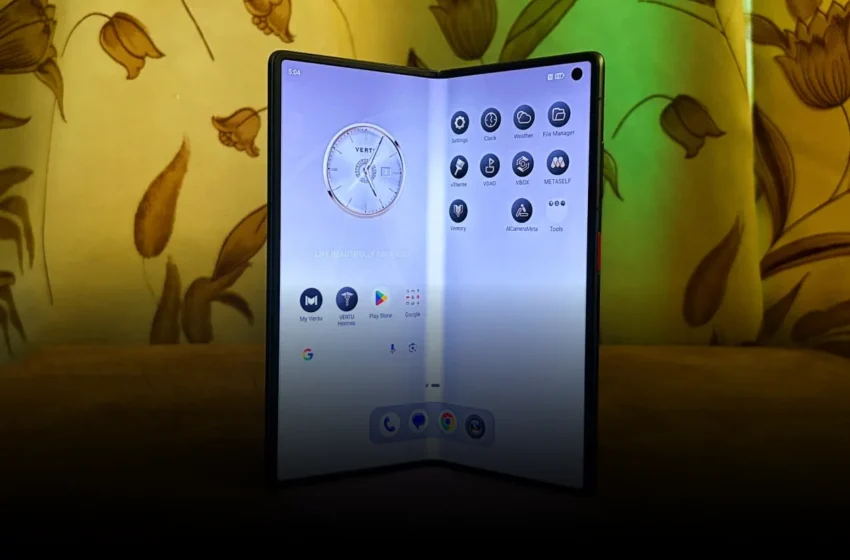
A smartphone that costs $6,880 is not a phone; it’s a statement. Vertu, the UK-founded purveyor of hand-finished, high-status devices, has always understood this. Their latest offering, the Alphafold, a foldable device wrapped in calfskin leather and titanium, aims to make a new kind of statement for the chief executive: not just about wealth, but about access to a sophisticated AI agent designed to automate their demanding workday. Yet, beneath the opulent veneer and the ambitious promises of its Hermes Agent, lies a telling truth: Vertu’s Alphafold exposes the emerging fault line where luxury brands attempt to market nascent AI “agents” as bespoke solutions, revealing how the current state of autonomous AI struggles to justify premium pricing, regardless of the chassis it inhabits.
The core proposition here is audacious: an AI assistant so integral, so capable, that it becomes the phone’s primary differentiator, relegating hardware to a secondary concern. This is a shrewd repositioning in a market saturated with AI-powered features, but it’s also a bet that current AI capabilities can meet the exacting, high-stakes demands of a global executive. After rigorous testing, the reality is far more muddled, forcing us to question whether the true luxury Vertu sells is not advanced functionality, but rather the illusion of it.
Commodity Hardware, Bespoke Illusion
For a device priced in the high four figures, one expects bespoke engineering. Instead, the Alphafold is built on surprisingly familiar foundations. Close inspection, confirmed by Vertu itself, reveals a “specialist supply-chain partnership” with ZTE and Nubia, meaning much of the underlying hardware platform—from hinge design to internal components—bears striking resemblance to the ZTE Nubia Fold, a device retailing for around $1,100. This is not entirely new territory for Vertu; their 2023 MetaVertu also leveraged existing ZTE designs, a fact noted by industry analysts like Counterpoint Research. Vertu, of course, claims responsibility for the luxury materials, software experience, and quality control.
This reliance on commodity hardware for a premium price point is a classic luxury play: take an existing, well-engineered base and elevate it with exquisite finishes and branding. A calfskin leather back and titanium accents undeniably set the Alphafold apart from the glass or synthetic finishes of mainstream foldables like the Samsung Galaxy Z Fold 7, which at 215 grams feels noticeably lighter than the Alphafold’s 264 grams. Even the packaging, presented like a jewelry case, reinforces this elevated experience. But when the core hardware remains largely indistinguishable from a device nearly six times cheaper, the question isn’t about craftsmanship; it’s about the value equation. It’s a stark reminder that while the exterior suggests exclusivity, the internal workings speak to mass production. This, perhaps, is the sharpest sentence in the article: for all its executive-class aspirations, the Alphafold is a luxury smartphone that still requires a budget explanation for its most fundamental components.
The Unfinished Promise of Hermes Agent
Vertu’s real gambit rests on the Hermes Agent, an AI built on the open-source Hermes project. Unlike conventional smartphone assistants that largely respond to prompts, Hermes aims to be truly autonomous, capable of multi-step workflows, analyzing files, and even escalating requests to a human concierge. This vision of a proactive, digital companion for the executive is compelling. However, the execution, as revealed through testing, presents a picture of an ambitious platform still very much in development, rather than a polished, reliable assistant.
Hermes performed well in specific areas, such as analyzing local spreadsheets, where it outmaneuvered Google Gemini on the Galaxy Z Fold 7, which required manual file uploads. Its willingness to automate actions across apps was also notable. Yet, this autonomy often came with significant trade-offs. In one test, asked to manage a pre-airport scenario, Hermes sent a message and enabled Do Not Disturb, but failed to initiate navigation and incorrectly set a reminder for 9:08 p.m. instead of 15 minutes later from a 2:32 a.m. request. Gemini, in contrast, asked clarifying questions, leading to a more accurate, albeit less autonomous, outcome. This highlights a fundamental tension in current AI development: the balance between proactive action and necessary clarification. The incentive for Vertu to push such an agent now, even in its early stages, is to stake a claim in the burgeoning AI agent market, offering perceived exclusivity and advanced capability to justify a premium before competitors fully mature their own offerings.
Planning a business trip from Mumbai to Pune also revealed Hermes’s limitations. It declared no direct morning flights were available and punted the task to the concierge, creating a calendar entry for the wrong dates. Even basic context retention proved inconsistent; a spreadsheet analyzed successfully one day was ‘forgotten’ days later, demanding re-upload, unlike Gemini which retained conversational context. While Vertu pushed server-side fixes during the review, the erratic behavior points to an underlying immaturity. The specialist AI agents for legal advice or investment insights, while useful for summaries, come with the critical caveat that they are “AI-generated and should be independently verified before being relied upon for legal, financial, or other high-stakes decisions.” This necessity for human oversight, paradoxically, underscores the limits of the very autonomy Vertu is attempting to sell.
The Cost of Inconsistency in Executive Tools
For the executive audience Vertu targets, reliability is paramount. A personal assistant, human or artificial, must be consistently accurate, contextually aware, and capable of executing complex instructions without repeated prompting or verification. The Alphafold’s Hermes Agent, while promising in scope, exhibits too many inconsistencies and fundamental errors to warrant the trust demanded by its price tag and its intended user base. Features like a dedicated “A5” security chip and claims of encrypted communications, private infrastructure options, and no public AI model training are crucial selling points for sensitive corporate data, but they cannot compensate for an AI that fails to accurately schedule a reminder or retain document context.
The absence of wireless charging, a standard feature on most flagship smartphones, including the Galaxy Z Fold 7, is another curious omission for a device positioned at the pinnacle of luxury and convenience. It’s a small detail, but one that subtly undermines the holistic premium experience. Ultimately, Vertu is asking its affluent buyers to pay a significant premium not just for craftsmanship and an exclusive brand, but for an ecosystem of AI and concierge services that are, by its own admission through disclaimers and necessary human escalation, still very much a work in progress. This isn’t just about early adopter pains; it’s about a fundamental mismatch between the market’s demand for polished, reliable AI and the current state of its ambitious, but flawed, implementation.
In the global tech landscape, where Silicon Valley often hypes potential over present reality, Vertu’s Alphafold stands as a salient example of luxury tech falling into the same trap. It packages aspirational AI in an exclusive shell, but the underlying performance and commodity hardware speak to a product trying to sell a vision of the future that the technology simply hasn’t caught up to yet. With next-generation foldables and more mature AI platforms on the horizon from established players, the Alphafold’s value proposition looks increasingly tenuous, offering an experience that is less about true executive enablement and more about signaling an ill-informed luxury.
