
500 Meters of Water, No Headlines: The Story of Alaska’s Forgotten Tsunami
- Special
Arjun Vedanta
- 0
- 9 minutes read
The Roar That Nobody Heard
There are days when you read a scientific paper, and something just… sticks. Something that ought to have screamed from the headlines, demanded attention, yet slipped by almost entirely unnoticed. For me, that moment came recently, poring over a new study in Science detailing an event in a remote Alaskan fjord. And what an event it was.
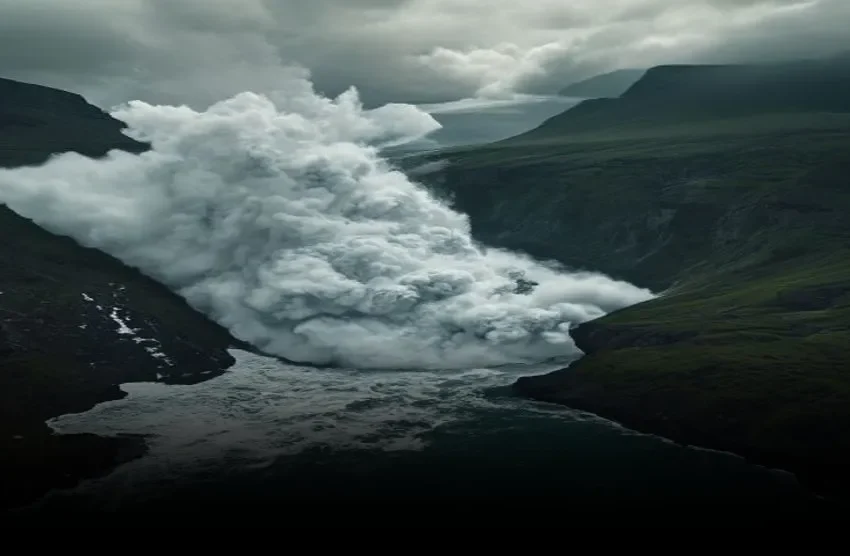
At 5:26 AM local time on August 10, 2025, a chunk of mountain—a truly staggering 63.5 million cubic meters of rock, the equivalent of 25,000 Olympic swimming pools—detached itself. It didn’t just fall; it plummeted into the deep, glacial waters of Tracy Arm. The immediate impact generated a 100-meter-high breaking wave, a monstrous wall of water tearing across the fjord at over 70 meters per second. When it slammed into the opposite shoreline, it didn’t just splash. It surged. It climbed. It ran up the sheer rock face to an astounding 481 meters above sea level.
Let’s be clear: 481 meters. That’s nearly 1,600 feet. For scale, that’s taller than the Empire State Building’s architectural height. This was, as researcher Aram Fathian from the University of Calgary rightly pointed out in the study, the second highest tsunami ever recorded on Earth. Second highest ever. And yet, I’d wager you haven’t heard a damn thing about it.
Why? Because it was a near miss. It happened early. No fatalities. No viral video. No immediate humanitarian crisis to galvanize the 24/7 news cycle. And what I find truly fascinating here isn’t just the raw power of nature, but the profound silence that followed such a monumental event. It’s a silence that speaks volumes about what we deem newsworthy in our hyper-connected, yet strangely selective, world.
When Gigatons Drop: The Unseen Mechanics of Mayhem
We typically associate tsunamis with earthquakes – tectonic plates grinding, displacing vast amounts of ocean. Those can be devastating, no doubt, often reaching tens of meters in runup height. But landslide-generated tsunamis? They’re a different beast entirely. More localized, certainly, but also exponentially more violent. Imagine millions of tons of solid rock suddenly displacing an equally massive volume of water in a confined space like a narrow fjord. The physics of it, the sheer kinetic energy transfer, is brutal.
Since 1925, scientists have documented 27 such events with runups exceeding 50 meters. The highest, the infamous 1958 Lituya Bay tsunami, hit 530 meters. This Tracy Arm event nearly topped it. What does this tell us? These aren’t freak occurrences; they are a known, albeit rare, natural phenomenon with catastrophic potential. And frankly, we’re often flying blind.
Nobody’s really talking about the systemic problem here: the massive gaps in our real-time monitoring infrastructure for these kinds of events. We’ve got satellites tracking weather patterns and global seismic networks, sure. But predicting precisely when and where 63.5 million cubic meters of mountain will decide to become a projectile? That’s an entirely different level of challenge. It requires granular geological surveys, continuous ground-based radar interferometry, or even acoustic sensors deployed deep within these fjords. The capital expenditure for a comprehensive, real-time warning system across every vulnerable fjord would be astronomical. The economics are brutal.
I’ve watched companies try to build early-warning systems for everything from forest fires to financial market crashes. The data streams are immense, the algorithms complex, and the false-positive rates can be a nightmare. But the fundamental question remains: where is the line between an acceptable risk and a critical failure of foresight, especially when the planet’s geology is demonstrably becoming more unstable?
We have researchers meticulously reconstructing these events after the fact—using high-resolution drone imagery, bathymetric surveys, and sophisticated computational fluid dynamics models. This is brilliant science, don’t get me wrong. But it’s forensic work. It’s analyzing the crime, not preventing it. What about a future where persistent surveillance satellites, perhaps from Planet Labs or Maxar, feed real-time topographical changes into AI models trained to detect subtle shifts in glacier walls or mountain slopes? We have the foundational tech. We just haven’t applied it at scale to this high-impact problem.
The Attention Economy: What Gets Seen, What Gets Buried
Here’s where my journalist’s hat really comes on. We’re in an attention economy, pure and simple. Information isn’t just abundant; it’s aggressively competing for your eyeballs and clicks. A record-breaking tsunami that caused no immediate harm, in a remote location, simply doesn’t stand a chance against the latest celebrity scandal, political skirmish, or the newest AI chatbot promising to revolutionize everything. And yes, I’ve been on the editorial desks making those tough calls myself. It’s a zero-sum game.
What I find particularly telling is the disconnect. We have the capability to gather and analyze mind-boggling amounts of data – from detailed geological shifts to global climate models. But the pathway from critical scientific insight to mainstream public awareness often looks less like a superhighway and more like a barely-there goat trail. The “meta-data” of this event – the sheer scientific significance of a near-500-meter wave – got trapped within academic circles because the “story” lacked human tragedy, which, if you think about it, is the whole point of why it should have been a warning.
I remember the dot-com bust. Everyone was chasing the next big thing, pouring money into concepts with no revenue model. We’re doing something similar now, only with our collective attention. We chase the immediate, the sensational, the easily digestible. A complex story about geological instability, the physics of water displacement, and the slow-burn threat of climate change-induced landslides? That’s hard. It requires context. It requires sustained interest. And it certainly doesn’t fit into a viral TikTok clip.
This isn’t just about media outlets, either. It’s about the platforms, the algorithms, the entire digital infrastructure that governs what we see. Would Google News prioritize a peer-reviewed study on a near-miss tsunami over a breaking geopolitical crisis? Unlikely. Does X (formerly Twitter) amplify warnings from remote sensing experts or from the latest outrage merchant? We know the answer. The very systems designed to inform us often inadvertently obscure the most critical, long-term threats that lack immediate virality.
What happens when the next megatsunami hits an inhabited fjord? Because data tells us these events are not isolated, and with glacial retreat accelerating due to climate change, the risk profile in these areas is demonstrably increasing. Scientists like Fathian are giving us vital data, effectively screaming into the void. And our digital attention spans, fragmented by a thousand notifications, are barely registering the echo.
We’ve seen this pattern before. Hype cycles come and go. Remember the frantic push for AI in healthcare a decade ago that promised to cure everything overnight? Many of those foundational technologies were brilliant, but the implementation was messy, the data integration complex, and the public’s attention quickly moved on to the next shiny object. This isn’t about a lack of tech. It’s about a lack of sustained, strategic application, and perhaps a deeper, more troubling issue of collective societal prioritization.
Beyond the Headlines: Investing in the Unseen Future
So, what’s the takeaway here? It’s not just that a massive tsunami happened in Alaska. It’s that we, as a digitally advanced society, failed to notice it, failed to register its profound implications for future risks. This isn’t a unique failing for just this event. It’s a recurring theme in an era where data is everywhere, yet critical insights often remain siloed or ignored.
Perhaps it’s time we re-evaluated our metrics for what constitutes “breaking news.” Maybe a 481-meter wave, even without immediate casualties, deserves more than a footnote in a scientific journal. It should spark conversations about investment in early warning systems, the ethics of data dissemination, and how we prioritize long-term, existential risks over short-term, viral content. Consider the infrastructure challenge alone: deploying a robust network of geodetic GPS sensors, tiltmeters, and synthetic aperture radar (SAR) systems across Alaska’s vast, often inaccessible coastline. The initial capital outlay would likely run into the hundreds of millions, if not billions, of dollars—a figure few governments or private entities are eager to front without immediate, tangible ROI. That’s a political hot potato, not a media darling.
I’m not naive enough to think this single article will suddenly shift the paradigm. The gravitational pull of the attention economy is too strong. But as someone who has watched every tech trend since the days of dial-up, I know one thing: the real breakthroughs, and the real problems, often emerge from the quiet corners. They are found in the data nobody is looking at, or the events nobody is talking about. This silent tsunami, roaring in the past but whispering its warning to the future, should be one of them.
