
Astronaut Hall of Fame Inductions: A Belated Echo in the Age of Commercial Space
- Tech
Arjun Vedanta
- 0
- 5 minutes read
The Quiet Passing of an Era
The annual induction of astronauts into the US Astronaut Hall of Fame consistently feels like a quiet nod to history, often years, if not decades, removed from the public’s immediate attention. This year, the May 16, 2026 ceremony honoring space shuttle veterans Tom Akers and Joe Tanner arrives at an inflection point: a moment where the rigorous, often unglamorous work of orbital construction and repair from NASA’s foundational decades risks being overshadowed by the siren call of lunar colonies and private space tourism.
Akers and Tanner, inducted as the class of 2026, flew their last missions twenty years prior. Their careers, marked by critical extravehicular activities (EVAs) to repair the Hubble Space Telescope and assemble the International Space Station, represent the zenith of NASA’s orbital engineering prowess. Akers, famed for his unprecedented three-person spacewalk on STS-49 in 1992, accumulated almost 30 hours of spacewalk time across his nearly 34 days in space, while Tanner logged 46.5 hours during his 43 days. These were missions of precision, patience, and often improvisational problem-solving in a harsh vacuum.
Yet, the celebratory context—a Hall of Fame induction at the Kennedy Space Center Visitor Complex—highlights a curious temporal disconnect. While thoroughly deserved, these recognitions arrive at a moment when NASA itself is heavily invested in a forward-looking narrative centered on the Artemis program and Mars. The sustained, complex engineering efforts of the space shuttle era, once the cutting edge of human spaceflight, now feel like echoes from a distant past, celebrated quietly rather than serving as foundational pillars for public engagement with future endeavors.
Redefining Astronauts in a New Space Race
The Hall of Fame, managed by the Astronaut Scholarship Foundation, honors those embodying “excellence, leadership, and service.” But what happens to this definition as the landscape of human spaceflight rapidly diversifies? The Akers and Tanner inductions underline the traditional career path: military test pilots turned NASA mission specialists, enduring rigorous selection (Tanner, for instance, waited from 1984 to 1992 to join the astronaut corps, after Akers was selected ahead of him).
Today, the notion of an astronaut is far broader. Commercial spaceflight ventures like SpaceX and Blue Origin are launching private citizens, government-funded researchers, and international partners into orbit. The Artemis program, targeting the moon, envisions a return not just for a select few, but for a diverse crew, including the first woman and person of color. One has to wonder if these belated honors serve the legacies of the individuals more than they serve NASA’s quiet struggle to remind a TikTok generation that deep space exploration isn’t merely about the next rocket launch or moon landing, but decades of painstaking, unglamorous orbital infrastructure work.
The incentive for institutions like the Astronaut Scholarship Foundation to maintain this lineage is clear: to preserve a specific heroic narrative and draw philanthropic support by celebrating a traditional view of astronaut. However, as the definition of an “astronaut” expands beyond government-trained career specialists, the Hall of Fame will inevitably face increasing pressure to adapt its criteria. Will future classes include private mission specialists, or only those who flew under national flags?
The Imperative of Historical Context
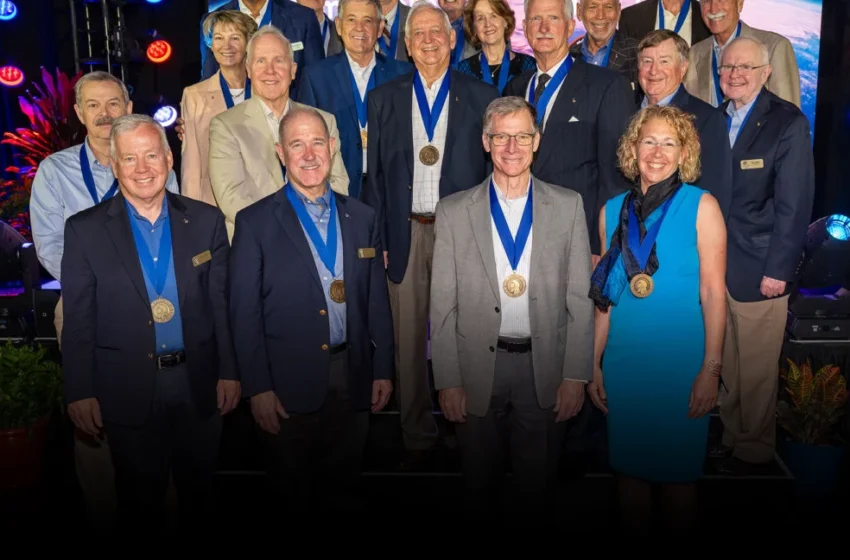
The quiet solemnity of Akers and Tanner’s induction, surrounded by 18 past honorees, stands in stark contrast to the often bombastic announcements emanating from today’s private space sector. This isn’t a critique of the inductees, whose contributions to space exploration are undeniable; rather, it’s an observation on how history is curated and presented to a public whose attention spans are increasingly fragmented. The technical distinctions Tanner articulated between Hubble and ISS EVAs – one demanding manual dexterity, the other sheer physical effort over long distances – are precisely the granular details that rarely penetrate mainstream discourse today.
The implicit structural implication here is that NASA, and the broader space community, faces an ongoing challenge in historical archiving and public education. Without a concerted effort to connect these past achievements directly to current ambitions, the rich tapestry of human spaceflight risks fraying. The public, naturally drawn to the novel and the immediate, needs more than delayed tributes; it needs a compelling, continuous narrative that threads the ingenuity of the space shuttle era directly into the promises of Artemis and beyond.
The danger is not that these astronauts will be forgotten, but that their era’s specific lessons—about persistent incremental progress, international collaboration on complex orbital mechanics, and the sheer grit of engineering at the frontier—will be lost in the rush towards the next headline-grabbing launch.
