
Cosmic Revelations: Gravitational Waves and the Overlooked Tech Revolution in Science
- AI Infrastructure
Arjun Vedanta
- 0
- 4 minutes read
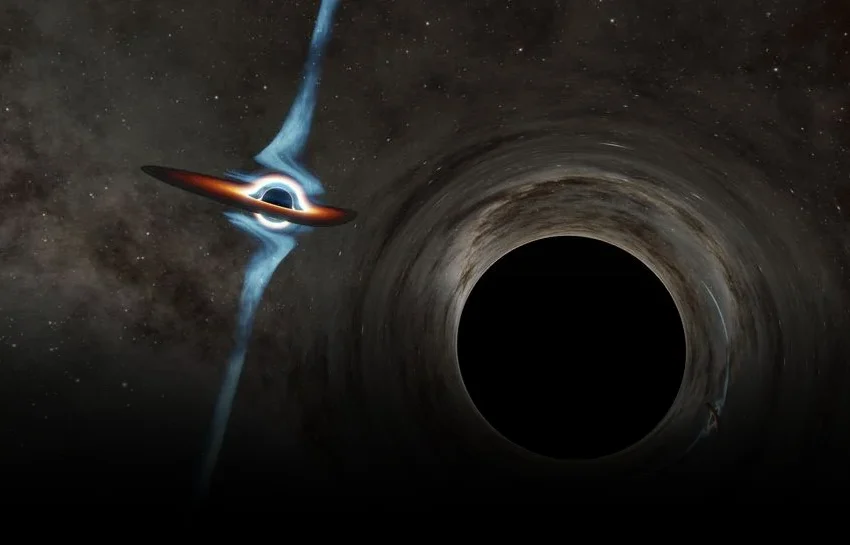
The Unseen Infrastructure Reshaping Fundamental Physics
An international team of astrophysicists has confirmed the existence of a previously inexplicable class of black holes, those weighing between 40 and 100 solar masses. These objects, dubbed ‘impossible’ by conventional stellar physics, are not born from collapsing stars nor are they supermassive galactic cores. Instead, evidence from gravitational wave observatories like LIGO, Virgo, and Kagra points to a startling conclusion: these behemoths are forged through successive mergers of smaller black holes within dense stellar clusters.
This isn’t merely an astronomical curiosity; it’s a direct consequence of a silent, profound technological revolution in how fundamental science is conducted and validated. While much of the tech media remains fixated on iterative app updates and the latest consumer gadgets, the real story of innovation lies in the globally distributed sensor networks and the vast computational power required to unravel such cosmic mysteries.
Beyond Silicon Valley: The Global Data Factories of Discovery
The core insight comes from an analysis of 153 reliable gravitational wave detections, with 34 involving exceptionally heavy objects. What the data revealed was a distinct spin signature: lighter black holes (up to 40 solar masses) exhibited small, aligned spins, consistent with their stellar birth. Heavier black holes (above 45 solar masses), however, showed rapid, chaotic spins. As Isobel M. Romero-Shaw, a coauthor, noted, this is the exact statistical signature of objects formed through repeated mergers, not singular stellar collapse.
This is where the technological story truly begins. Detecting a gravitational wave is an almost incomprehensible feat of engineering. These instruments measure distortions in space-time so minuscule they are equivalent to detecting a change in distance smaller than the width of a proton over a 4-kilometer baseline. It demands laser interferometry at its absolute limits, shielded from all conceivable environmental noise, and synchronized across continents. This global orchestra of detectors, a true marvel of distributed sensor networking, functions as a single, planet-sized instrument.
The processing of this torrent of raw, noisy data is equally monumental. It’s a continuous, real-time computational challenge, sifting through terabytes of information for the faint, transient ripples that signal a cosmic collision. This isn’t just about faster processors; it’s about sophisticated signal processing algorithms, machine learning models, and a global compute grid that allows researchers to collaboratively analyze and validate these incredibly subtle events.
The Incentive for Global Collaboration and Data-Driven Science
The incentive driving the creation and sustained operation of these multi-billion-dollar observatories and their data pipelines is simple: the pursuit of knowledge that cannot be obtained any other way. Traditional astronomy relies on electromagnetic radiation; gravitational waves offer an entirely new spectrum through which to observe the universe, revealing phenomena that are optically invisible. This new window, however, comes at an extraordinary technological and financial cost, demanding international cooperation and long-term investment in infrastructure far removed from typical venture capital cycles.
This study, published in Nature Astronomy, didn’t just reclassify black holes; it underscored a fundamental shift in scientific methodology. The era of individual genius and localized experiments is increasingly supplemented, if not supplanted, by mega-science projects—a confluence of cutting-edge hardware, advanced algorithms, and distributed data analysis. It represents a subtle yet profound structural implication: that the universe’s deepest secrets are now unlocked not just by brilliant minds, but by the relentless advancement of global computational and sensing infrastructure.
What the Silicon Valley echo chamber often misses is the scale and ambition of these non-consumer tech endeavors. While debates rage about the next generation of social media or the latest AI chatbot, the quiet deployment of technologies capable of discerning quantum-level distortions across light-years is redefining what it means to push the boundaries of knowledge itself. The discovery of these ‘second-generation’ black holes serves as a stark reminder: the most impactful technological progress isn’t always about what’s in your pocket, but what’s enabling a handful of scientists to rewrite the fundamental laws of the cosmos, one incredibly precise data point at a time.
