
Exoplanet Magnetic Reconnection Rewrites Planetary Evolution Models
- Tech
Arjun Vedanta
- 0
- 6 minutes read
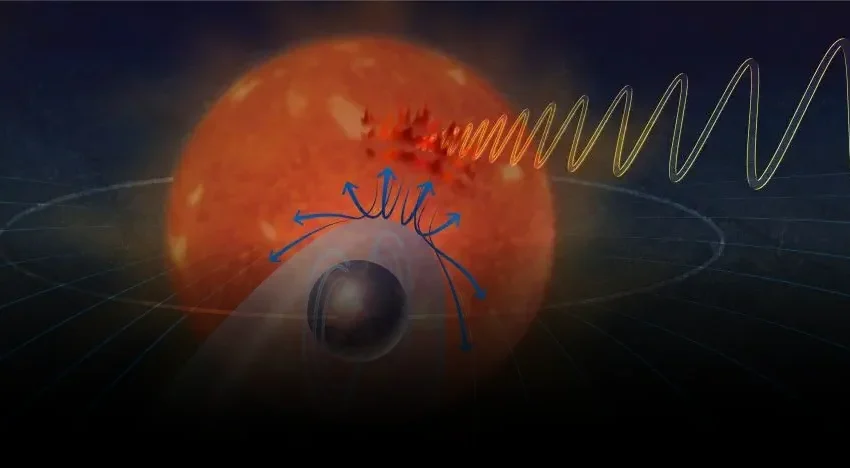
The periodic brightening of a distant star, previously a mere flicker in astrophysical data, now screams a profound truth: our galaxy is far more violent and intimately connected than our sedate solar system suggests. This isn’t merely another exoplanet discovery; it’s a direct observation of stellar magnetic fields merging with those of an orbiting world, a phenomenon that fundamentally redefines planetary evolution and the very concept of a “habitable zone” in ways few Silicon Valley reporters, focused on terrestrial tech, truly grasp.
What does it mean for a planet to orbit so close to its parent star that their magnetic fields connect? It implies a direct conduit for energy, a cosmic short-circuit where the raw power of a star can directly ablate, distort, and even reconstruct a world. This is far beyond the familiar, if still intense, effects of stellar radiation or high-energy particles; this is the universe tearing down and rebuilding on a scale previously confined largely to theoretical models.
Beyond the Goldilocks Zone: The Star’s Grasp
For twelve years, I have seen the narrative around exoplanets shift from pure speculation to detailed, if often remote, observation. We quickly moved past the idea that our Solar System was typical, with its orderly procession of planets at relatively safe distances. The ubiquity of “hot Jupiters” and ultra-short-period planets, completing orbits in just a few Earth days, shattered that illusion early on. These worlds are already extreme: atmospheres laced with metal vapor, or so puffed out by stellar heat that their densities barely register.
Now, we add direct magnetic coupling to this already brutal litany. While the original article refers to this as an “additional oddity,” that framing misses the larger point entirely. Astrophysicists theorized such interactions for decades; the “news” is less about the existence of the phenomenon and more about our observational capabilities finally catching up to it. This specific detection validates a deeply unsettling truth: many of the planets we are discovering, particularly those closest to their stars, exist in environments of constant, violent engagement, where their very existence is a precarious dance with destruction.
This isn’t merely about intense stellar winds stripping an atmosphere over eons, as happens with Mars. It’s about a more immediate, catastrophic interaction. A star’s magnetic field isn’t just a shield; it’s a dynamic, powerful entity that, when it connects with a planetary field, facilitates an extraordinary transfer of energy and matter. The periodic brightening observed in this distant star is the visible tremor of a far more fundamental and destructive process underway.
The Silent Erasure of Worlds: Magnetic Flux Transfer
Imagine a planetary core, generating its own protective magnetic field, suddenly finding that field not merely deflecting, but intertwined with the colossal magnetic dynamo of its parent star. This is what direct magnetic reconnection entails. It’s a process where magnetic field lines from two distinct bodies merge, break, and then reconfigure, releasing immense amounts of stored magnetic energy in the process. On the sun, these events drive flares and coronal mass ejections; on an exoplanet, the impact is likely even more profound.
This direct interaction represents a relentless, corrosive force on a planet’s atmosphere and even its internal structure. Atmospheric escape, already rapid for close-orbiting worlds due to extreme UV radiation and stellar winds, becomes exponentially accelerated by this magnetic siphoning. What little remains of a planetary atmosphere is not just heated, but actively pulled away along the connecting field lines, like an invisible vacuum cleaner from the sky. This challenges long-held models of how these planets might retain any volatiles, let alone develop complex atmospheric chemistry.
Over geological timescales, such an intimate stellar connection could also exert significant forces on a planet’s internal dynamo, potentially altering its core’s magnetic field generation or even contributing to tidal heating in ways we don’t fully model. The notion of a stable, long-lived planet in such an embrace becomes difficult to reconcile with the observed physics. The universe, it seems, has little patience for the tidy narratives we craft from our own planetary backyard.
Reframing Habitability and the Hunt for Life
The implications for astrobiology are severe. If planets are regularly experiencing such magnetic bombardment and flux transfer, the conventional definition of a “habitable zone” — a region where liquid water could exist on a planet’s surface — becomes woefully insufficient. The presence of water means little if the planet itself is being slowly, or rapidly, disassembled by its star’s magnetic embrace. Even a strong planetary magnetic field, typically considered a prerequisite for long-term habitability on Earth, could in these extreme scenarios become the very mechanism of its destruction.
This specific detection offers a critical incentive for refining our exoplanet search strategies. It provides essential empirical data to validate and improve decades-old theoretical models of star-planet interaction, driving further investment in next-generation telescopes capable of detecting subtler magnetic signatures and atmospheric compositions. We now have a more precise, albeit grimmer, understanding of the criteria for genuine planetary resilience. For researchers using instruments like the James Webb Space Telescope or ground-based extremely large telescopes, this shifts the focus not just to where to look for biosignatures, but what kind of planets could possibly retain them against such overwhelming odds.
The pursuit of life beyond Earth must therefore contend with a cosmos far more dynamic and destructive than previously appreciated. This new understanding forces a re-evaluation: perhaps the true “Goldilocks Zone” is not just about temperature, but also about a delicate magnetic détente, a peaceful coexistence between star and world, where one’s field protects rather than consumes the other. The challenge now is to find out just how rare such peaceful orbits actually are, and what that means for the cosmic lottery of life.
