
Google’s AI-Powered Declaration Ad: A 250-Year Leap or a Modern Marketing Misstep?
- Artificial Intelligence
Arjun Vedanta
- 0
- 4 minutes read
The AI Collaboration Fantasy Meets 1776
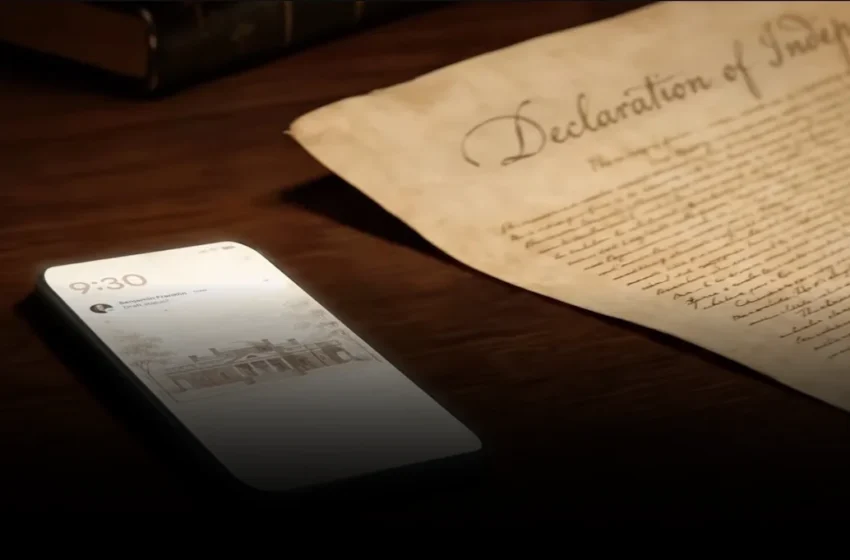
Google’s new commercial, framing the drafting of the Declaration of Independence with AI tools and cloud collaboration, inadvertently reveals the tech giant’s enduring struggle to articulate a compelling argument for AI’s truly transformative role in complex human endeavors. For its 250th anniversary in 2026, the company imagines Founding Fathers like Thomas Jefferson, Ben Franklin, and Sam Adams using Google Workspace, from Docs for edits to Meet for remote discussions, all culminating in e-signatures. The setup is whimsical, certainly. Yet, beneath the powdered wigs and the tagline “Group project, but make it 1776,” lies a promotional effort that speaks volumes about generative AI’s current PR predicament.
The ad showcases a Google “help me visualize” AI tool suggesting animals for the national seal, and Gemini dutifully taking meeting notes and offering King George III boilerplate refusal advice. The AI is largely peripheral, a convenient assistant rather than a core architect of thought. This almost apologetic integration of AI—where the core text of the Declaration remains untouched by algorithmic suggestion—is, perhaps, the sharpest observation: even in a lighthearted fantasy, Google cannot quite bring itself to position AI as a truly invaluable partner for political organizing, writing, or the kind of human collaboration that shapes nations.
The Uncanny Valley of Utility
Public reception has been bifurcated, much like the AI debate itself. While comments on YouTube and Instagram lean positive, the discourse on Bluesky swiftly deemed the ad “cringey” and “stunningly tone deaf.” The AI angle bore the brunt of this criticism, with historian Angus Johnston succinctly noting, “amazing how little of this is actually AI.” He further elaborated that “Even in a corny fantasy joke, it’s impossible to make the case that AI is a useful tool for political organizing, writing, or human collaboration.” This sentiment is precisely where the commercial falters, exposing the gap between Silicon Valley’s ambition and the technology’s current, often superficial, real-world application.
This isn’t the first time Google has stumbled in its AI evangelism; recall the infamous ad where Gemini allegedly wrote a fan letter for a daughter, generating an immediate backlash over its potential to diminish genuine human connection. The latest commercial, while careful to avoid AI writing historical texts, still floats in an uncanny valley of utility, where the AI’s contributions are either trivial or, in the case of the potentially AI-generated video footage itself, almost imperceptibly synthetic. The implicit message is that AI can help, but only in the most anodyne of ways, avoiding any suggestion of intellectual heavy lifting or profound creative input. This cautious framing reveals less about AI’s strength and more about public skepticism and Google’s struggle with user adoption.
The Peril of Pervasive Promotionalism
Why this particular campaign now? The incentive is transparent: Google, like every major tech player, needs to normalize AI, to integrate it into the public’s everyday imagination. As competition heats up from rivals like OpenAI and Microsoft Copilot, presenting AI as an innocuous, if not quirky, aid to collaboration becomes a crucial conditioning exercise. This isn’t merely about selling Google Workspace; it’s about positioning AI as a seamless, non-threatening extension of human effort, even when the practical benefits are demonstrably minor for tasks of historical gravity.
The Declaration of Independence is a monument to human intellect, debate, and the arduous process of consensus. To insert a benign, note-taking chatbot and a seal-visualizing AI into its creation isn’t a celebration of progress; it’s a telling symptom of an industry desperate to find a compelling narrative beyond efficiency gains. I find it particularly telling that Google, after years of “AI-first” rhetoric, still resorts to such an anachronistic and frankly unconvincing setup to sell its capabilities. The commercial highlights a persistent challenge for tech giants: making AI indispensable without making it intimidating, a goal that often leads to marketing efforts that overpromise abstractly and underwhelm concretely, especially when applied to the complexities of human ingenuity and ethical decision-making.
