
SpaceX Starship Scrub: The Enduring Challenge of Ultra-Heavy Lift and Commercial Space Realities
- Space
Arjun Vedanta
- 0
- 5 minutes read
Beyond the Scrub: The Scale of Ambition Meets Reality
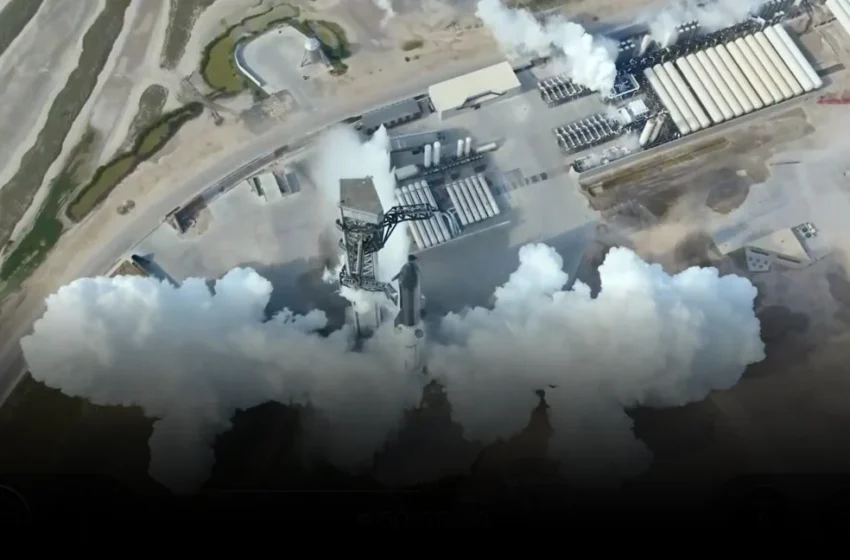
Another Starship scrub, another delay for the rocket that promises to redefine humanity’s reach beyond Earth. As the countdown for SpaceX’s behemoth — a 400-foot-tall stack of stainless steel and ambition — halted at Starbase, Texas, with 11.5 million pounds of liquid methane and oxygen left undelivered, the official line was a routine technical issue. But beneath the calm pronouncements and the inevitable rescheduling, this seemingly minor hiccup speaks to a far larger, often overlooked truth about the new space race: the sheer, brutal difficulty of ultra-heavy lift engineering, a challenge that even SpaceX’s ‘move fast and break things’ ethos struggles to fully override. What we witnessed was not merely a postponed launch; it was a potent reminder that the physics of orbital mechanics remain a stubbornly unforgiving master, quietly pushing back on the narrative of an effortlessly accelerating commercial space sector.
For years, the industry narrative has celebrated the rapid cadence and disruptive innovation of private companies like SpaceX. And for good reason: the Falcon 9, a workhorse by any measure, has indeed transformed access to low Earth orbit. But Starship is an entirely different beast, a super heavy-lift launch system with aspirations of full reusability and Martian colonization. Each attempt to launch this scale of hardware, pushing beyond the capabilities of even NASA’s Saturn V or SLS, reveals a complexity that far outstrips previous generations. These scrubs are not failures in the traditional sense, but they are symptoms of a system at the very edge of current engineering capability, where every valve, sensor, and engine start sequence represents a cascade of potential issues. It’s a scale of logistical and mechanical integration previously only undertaken by state-backed entities over decades, not by a commercial entity on an iterative, almost agile, development schedule.
The Unforgiving Arithmetic of Mass and Momentum
The Starship program’s public, iterative development is its hallmark, but it also lays bare the inherent tension between rapid prototyping and the unforgiving laws of physics. We often hear about the software-like development cycles SpaceX employs, but a rocket is not an app that can be patched over the air. A faulty igniter or a pressure anomaly in one of the 33 Raptor engines on the Super Heavy booster can cascade into catastrophic failure. This isn’t a matter of code optimization; it’s a matter of materials science, thermodynamics, and the precise choreography of millions of pounds of propellant and thrust. The persistent reality is that while simulations and CAD models can get you far, the final arbiter is always the hardware itself, under extreme duress. Every test, every scrub, generates invaluable data, certainly, but it also underlines the enormous cost — in time, resources, and engineering focus — of pushing these boundaries. This constant battle against the ‘unforgiving arithmetic of mass and momentum’ is a core challenge for any entity, public or private, aiming for true interplanetary capability. The incentive to push these boundaries, despite the delays, lies in the singular vision of deep space access that promises to unlock unprecedented economic and scientific opportunities, driving continued investment and public interest even through the setbacks.
Consider the broader context. While China pushes ahead with its own heavy-lift Long March program and state-backed entities like ESA and Roscosmos develop their next-generation launchers, SpaceX’s Starship is unique in its ambition for rapid, full reusability for *interplanetary* missions. The technical hurdles for a system that must survive reentry from space, be quickly refueled, and launched again are orders of magnitude greater than for expendable rockets. This isn’t just about getting to orbit; it’s about making space travel routine, affordable, and scalable enough to sustain a moon base or Martian colony. The delays, then, are not just about a single launch window missed; they represent the friction encountered when audacious goals meet the fundamental constraints of engineering at the extreme. These aren’t the minor bugs of a nascent industry; they are the deep-seated complexities of a mature physical domain, stubbornly resistant to easy solutions.
The Long Game: Why Patience Matters More Than Pacing
The Silicon Valley mindset often champions speed above all else, seeing every delay as a sign of inefficiency. Yet, the history of spaceflight teaches a different lesson: patience, meticulousness, and robust testing are not luxuries, but necessities. The Apollo program, for all its urgency, was built on years of incremental tests and design refinements, each step taken only after exhaustive analysis. While SpaceX has undeniably compressed these timelines, the Starship scrubs remind us that some processes simply cannot be rushed beyond a certain point without courting disaster. This is where the international perspective offers a clearer lens: many global space agencies, often slower moving but deeply risk-averse, watch SpaceX’s public learning curve with a mix of admiration and quiet vindication. Their more conservative approaches, while criticized for lacking commercial agility, often underscore the sheer scale of the engineering challenges involved in getting hardware off Earth reliably.
Ultimately, the story of Starship isn’t just about a company and its founder; it’s about the collective human endeavor to extend our presence beyond our home planet. The delays, while frustrating, are an integral part of that story, not a deviation from it. They highlight that even with billions of dollars, unparalleled engineering talent, and a visionary leader, the path to making humanity truly multi-planetary is paved not just with innovation, but with persistent, sometimes tedious, problem-solving. This is the enduring lesson of every scrub: the future of heavy-lift space exploration will be built not just on ambition, but on the hard-won victories over countless, minute technical details, patiently and painstakingly resolved.
