
Ukraine’s Robotic Leap: The Unseen Ethical Fallout of Drone-on-Robot Warfare
- Artificial Intelligence
Arjun Vedanta
- 0
- 5 minutes read
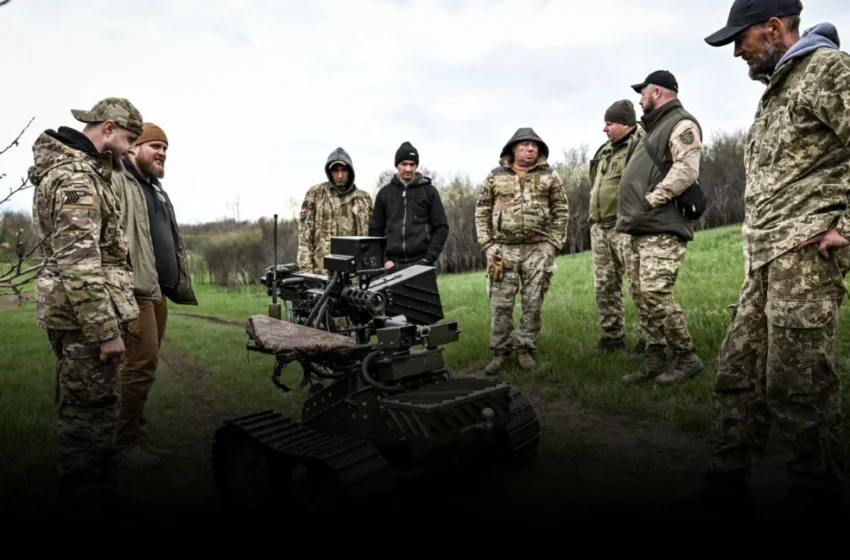
A hexacopter drone suspended an ARK-1 ground robot, laden with anti-tank mines, over Russian positions on July 19, according to reports from United24 and a Russian military Telegram channel. This wasn’t merely a tactical deployment; it represented a significant, under-explored escalation in the development of multi-domain robotic warfare, demonstrating Ukraine’s capacity to deploy unmanned ground vehicles (UGVs) via unmanned aerial vehicles (UAVs) and even drone boats.
The innovation goes beyond merely bypassing tough terrain or Russian defenses, or executing a robotic amphibious assault. What’s truly happening is a profound, rapid recalibration of the ethical and strategic boundaries governing autonomous weapons systems, pushed by the crucible of war. The original news, while highlighting ingenious battlefield tactics, inadvertently understates the long-term implications of normalizing such sophisticated, multi-layered robotic engagement.
The Blurring Lines of Autonomous Combat
For years, the debate around lethal autonomous weapons (LAWS) focused on the ‘human-in-the-loop’ — the idea that a human operator must always make the final decision to engage a target. Ukraine’s current battlefield applications, driven by necessity, are subtly but definitively shifting this paradigm. By using drone carriers to deliver weaponized ground robots, the layers of human oversight become increasingly abstract, stretching the ‘human-on-the-loop’ model to its breaking point.
Consider the ARK-1 robot, described as carrying explosive anti-tank mines. While an operator likely controls its movement, the delivery system—the hexacopter or drone boat—is inherently autonomous in its navigation and deployment sequence. This creates a distributed network of AI-powered agents, some controlled, some pre-programmed, all working towards kinetic effect. The impetus for accelerating this technological integration is clear: to offset a significant Russian military advantage in manpower, thereby preserving Ukrainian lives and sustaining the fight against a larger aggressor.
Yet, this tactical advantage comes with a significant price in normative terms. When a ground robot, itself potentially capable of target identification, is delivered by an autonomous aerial platform, the chain of command and accountability fragments across multiple layers of software and hardware. This isn’t just about saving lives; it’s about rewriting the rules of engagement in a way that prioritizes speed and scale over established ethical guardrails, a path that has historically led to unintended escalations.
Global Implications of Unmanned Multi-Domain Systems
The Silicon Valley bubble often misses how swiftly theoretical military tech leaps into practical, brutal application on the global stage. While American defense contractors and DARPA labs debate the nuances of artificial intelligence in warfare, Ukraine is already field-testing a future where autonomous aerial and naval drones become force multipliers for unmanned ground assets. This isn’t an R&D project; it’s a desperate, live-fire demonstration of a new military doctrine.
The geopolitical fallout extends far beyond the immediate conflict. Nations observing Ukraine’s innovations, particularly those with less ethical qualms or greater geopolitical ambitions, will undoubtedly interpret these advancements as a template. The tactical gains, however marginal in the grand scheme of a long war, disproportionately legitimize systems that nations previously hesitated to fully embrace, setting a dangerous precedent for future conflicts far beyond Ukraine. Imagine how nations like China or Iran might adapt these tactics in their own spheres of influence.
This dynamic creates an immediate arms race in unmanned systems, pushing for greater autonomy and more complex robotic process automation in combat. The international community’s slow-moving deliberations on lethal autonomous weapons are being outpaced by battlefield realities. What begins as a defensive innovation in Ukraine risks becoming a global standard for offense, fundamentally reshaping the balance of power and increasing the risk of miscalculation in future flashpoints.
The Human Cost Beyond the Frontline
The deployment of drone-borne robots is presented, understandably, as a means to spare human lives, but this narrative overlooks the insidious nature of increased automation in warfare. By removing humans from immediate danger, the psychological and political barriers to initiating and sustaining conflict are subtly lowered. War becomes more antiseptic, more distant, and potentially more frequent.
This isn’t to say Ukrainian ingenuity isn’t commendable in its immediate context. Their use of unmanned aerial vehicles (UAVs) and unmanned ground vehicles (UGVs) to counter a larger, better-equipped foe demonstrates remarkable adaptability. However, as international journalists, our role is to look beyond the immediate tactical brilliance to the structural implications. What happens when every mid-sized military can acquire and deploy these interconnected autonomous systems, pushing them further down the chain of command?
The trajectory suggests a future where autonomous decision-making increasingly influences, if not dictates, the initiation of engagement. The current debate on accountability for actions taken by such systems is already complex; adding layers of autonomous delivery only exacerbates it. We are witnessing not just a new chapter in military technology, but a fundamental redefinition of what it means to wage war, and critically, who is ultimately responsible when things inevitably go wrong. This is the conversation that should truly follow Ukraine’s latest robotic maneuver, far more urgently than mere praise for ingenuity.
