
Fruit Fly Navigation: A Humbling Lesson for Autonomous AI Development
- Artificial Intelligence
Arjun Vedanta
- 0
- 5 minutes read
Beyond Simple Algorithms: Nature’s Sophisticated Sensors
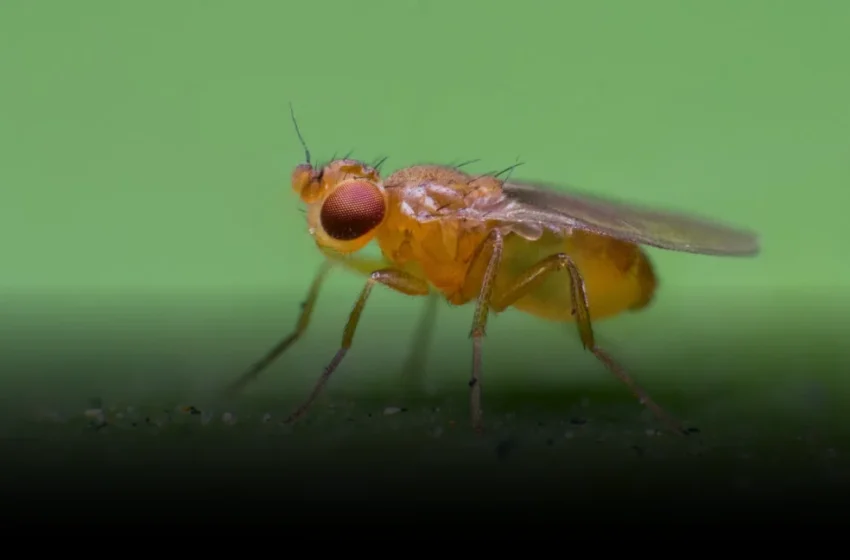
The fruit fly, with a brain no larger than a pinhead, navigates complex, chaotic odor plumes with a sophistication that should humble any engineer working on autonomous systems. Scientists at Rockefeller University, led by neuroscientist Vanessa Ruta, recently presented compelling evidence that overturns the long-accepted ‘surge and cast’ model of insect smell navigation. This isn’t merely an arcane biological footnote; it’s a direct challenge to how the tech world often approaches sensor fusion and autonomous perception in dynamic, unpredictable environments.
For years, the conventional wisdom suggested that when a fruit fly caught a whiff of, say, rotting fruit, it would simply fly upwind until the scent was lost, then ‘cast’ side-to-side to pick it up again. It was a reflex-driven explanation, simple and elegant in its perceived economy. Ruta’s team, however, has demonstrated that these tiny insects employ a “far more advanced” mechanism, actively interpreting sparse and unreliable chemical cues that are swirled into invisible, turbulent ribbons by airflow. The implications for our heavily sensor-reliant AI systems are profound.
Consider the environment: natural odor plumes are not neat, continuous signals. They are, as Ruta describes, “invisible, and often they’re carried along by turbulent airflow,” creating a broken, stuttering landscape of dense chemical filaments interspersed with stretches of clean air. This is a real-world data stream that many of our current autonomous systems would struggle to process reliably, often requiring perfect sensor coverage or statistical extrapolation that breaks down under true chaos.
The Unseen Challenge for Autonomous Systems
Silicon Valley, and indeed much of the global tech industry, has largely approached autonomous navigation through brute force. More cameras, more LiDAR, more radar, more processing power, more data fed into ever-larger neural networks. This approach has yielded impressive results in structured environments, from self-driving cars on well-mapped roads to warehouse robots. Yet, when confronted with truly unstructured or chaotic conditions – think navigating dense smoke, underwater currents, or a dynamic crowd in low light – even advanced systems often falter.
The fruit fly’s secret isn’t more sensors; it’s a more elegant *interpretation* of sparse, noisy data. It’s about what the brain *does* with limited information, rather than how much information it can gather. This is the critical distinction missed when the focus is exclusively on hardware specifications or the sheer volume of training data. Our algorithms are often designed for linearity and signal continuity, struggling with the erratic, intermittent nature of real-world phenomena like wind-borne odors.
The prevailing incentive in AI development often pushes towards incremental improvements on existing paradigms, prioritizing speed to market or leveraging established hardware supply chains. This sometimes means overlooking fundamental biological insights that might necessitate a complete rethink of computational architectures or sensor processing. Why pursue complex bio-inspired solutions when another iteration of a deep learning model *might* get us 5% better? This question underpins a structural inertia within the industry.
A Bio-Inspired Path to Resilient AI
The skeptical observation here is that the tech industry’s obsession with brute-forcing perception problems with more data or larger models often misses fundamental elegance found in biology, particularly when dealing with truly chaotic inputs. The discovery by Ruta’s team serves as a sharp reminder: a creature with a nervous system orders of magnitude simpler than any modern AI cluster is solving a dynamic environmental perception problem that still largely eludes our best engineers.
This isn’t to say we should abandon current methods, but rather to question the assumptions baked into them. The fruit fly’s mechanism points towards a future where bio-inspired AI could lead to more robust, resilient autonomous navigation. Imagine swarm robotics for environmental monitoring, where drones track chemical spills in turbulent airflows, or search-and-rescue robots navigating debris fields based on faint thermal or acoustic signals. These applications demand a qualitative leap in *sensor fusion* and real-time inference, not just quantitative increases in data throughput.
The path forward for advanced autonomous navigation, particularly in truly chaotic environments, might not lie in simply adding more gigahertz or petabytes. It might instead involve a deeper engagement with computational neuroscience and the elegant, low-power solutions perfected by millions of years of evolution. Understanding how a pinhead-sized brain sifts coherent navigation cues from incoherent noise could unlock a new generation of *resilient AI* capable of operating reliably where today’s highly engineered systems still struggle.
