
The Space Race for Human Vision Is Redefining Earth’s Health Tech
- Artificial Intelligence
Arjun Vedanta
- 0
- 5 minutes read
The New Gravity Well of Medical Innovation
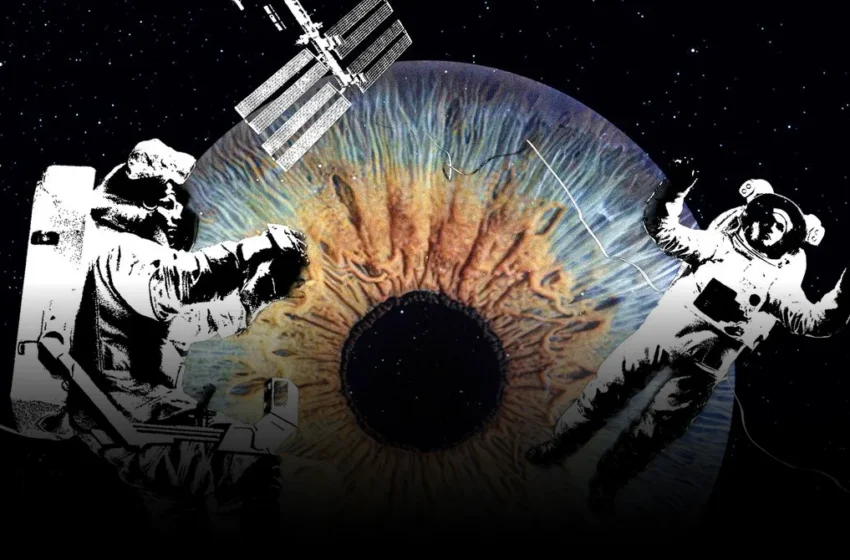
John Phillips launched into orbit with 20/20 vision in 2005. Six months later, the NASA astronaut returned to Earth with his sight degraded to 20/100, a moderate visual impairment directly caused by his time aboard the International Space Station. This wasn’t a freak accident; it was Spaceflight-associated neuro-ocular syndrome, or SANS, a condition affecting nearly 70 percent of astronauts on long missions. What often gets missed in the pursuit of understanding SANS is how the urgent, niche demands of deep-space medical autonomy are not just leveraging existing health tech, but are now actively driving and refining mainstream terrestrial healthcare solutions, reversing the traditional flow of innovation from space to Earth.
The European Space Agency (ESA) faces a critical challenge for its ambitious Artemis flights to the Moon and beyond: how to safeguard astronaut vision when Earth-bound medical support is days, not minutes, away. Prolonged exposure to microgravity causes bodily fluids to shift upwards, squashing eyeballs, swelling optic nerves, and pushing retinas forward. While some damage can be reversed upon return, the operational risks and long-term health implications are profound. This is why the ESA has commissioned Siloton, a British eye-scanning startup founded by physicists in 2020, to develop a solution.
Siloton’s core innovation is a quantum technology that miniaturizes complex eye-testing equipment onto a photonic chip smaller than a coin. This isn’t just about making things smaller; it’s about making them self-sufficient. Current orbital solutions, like modified optometry devices on the ISS, require real-time remote guidance from ground experts – a luxury rendered impossible by the lengthening communication delays inherent in deep space missions. The push for astronaut autonomy is becoming an unexpected catalyst for groundbreaking medical miniaturization.
Reversing the Spin-Off Narrative
For decades, the narrative around space exploration’s terrestrial benefits has focused on “spin-offs”: technologies developed for space, like memory foam or scratch-resistant lenses, finding applications on Earth. This relationship is undergoing a subtle but significant reversal. Siloton’s work for the ESA is not merely adapting an existing product for space; the extreme environmental constraints and the absolute necessity for robust, automated diagnostics are forcing fundamental improvements that will directly benefit its primary, Earth-bound market.
Consider the company’s existing partnership with the UK’s National Health Service (NHS), where Siloton is developing a home device for octogenarians with retinal conditions. The challenges of maintaining an astronaut’s head still in zero gravity without a chin rest, or powering a device without fire-risk batteries in a confined spacecraft, translate directly into design breakthroughs for ease of use and safety in a domestic setting. While Silicon Valley often fawns over consumer-grade wellness gadgets, the real innovation in autonomous medical diagnostics is being forged in the unforgiving vacuum of orbital mechanics and the pragmatic demands of public healthcare systems.
This isn’t just a convenient synergy; it’s a structural incentive. Siloton gains crucial funding and an unparalleled testing environment from the ESA. The stringent requirements for spaceflight — reliability, minimal power consumption, automation, and robustness against radiation — push the technology far beyond what would typically be required for a home health device. This rigorous development cycle validates and refines the core product, making it inherently superior and more reliable for a much larger, Earth-bound market. The company benefits, the ESA benefits, and ultimately, patients on Earth benefit from a higher standard of diagnostic technology.
Beyond the Astronaut: The Unseen Beneficiaries
Euan Allen, Siloton’s cofounder and CTO, acknowledges this dual benefit explicitly: “Lots of the stuff that we’re doing for space will bleed through and make our home device better, and vice versa as well. All this research and development work, in principle, is making our products that are going to go into the NHS much better.” This isn’t just a hopeful sentiment; it’s a testament to the brutal efficiency of necessity. Innovations in edge computing for real-time analysis on a spacecraft, for instance, translate directly into faster, more private, and more efficient remote diagnostics for telemedicine services.
The lessons learned in ensuring a device can be used by a highly trained astronaut under extreme stress and without external guidance are invaluable for designing interfaces for elderly patients who may have limited mobility or cognitive impairment. The quantum sensors enabling precise, frequent retina scans in space set a new benchmark for diagnostic accuracy and early detection for everyone. This reciprocal development model, driven by the unique confluence of deep space exploration and public health demands, challenges the conventional wisdom that space tech is a one-way street of innovation.
Space, it turns out, is no longer just a recipient of advanced technology. In critical areas like biomedical engineering and autonomous medical devices, it has become a high-stakes proving ground. The solutions forged to protect astronauts from conditions like SANS are not merely adapted; they are fundamentally sharpened by the unforgiving environment, creating a cascade of benefits that elevate the standard of telemedicine and remote health monitoring for billions of people who will never leave Earth’s atmosphere. This ongoing exchange promises a future where the health tech we rely on in our homes is implicitly qualified by the cosmos.
