
The Extreme Orbit of S301: Beyond Einstein’s Spacetime Warps
- Space
Arjun Vedanta
- 0
- 5 minutes read
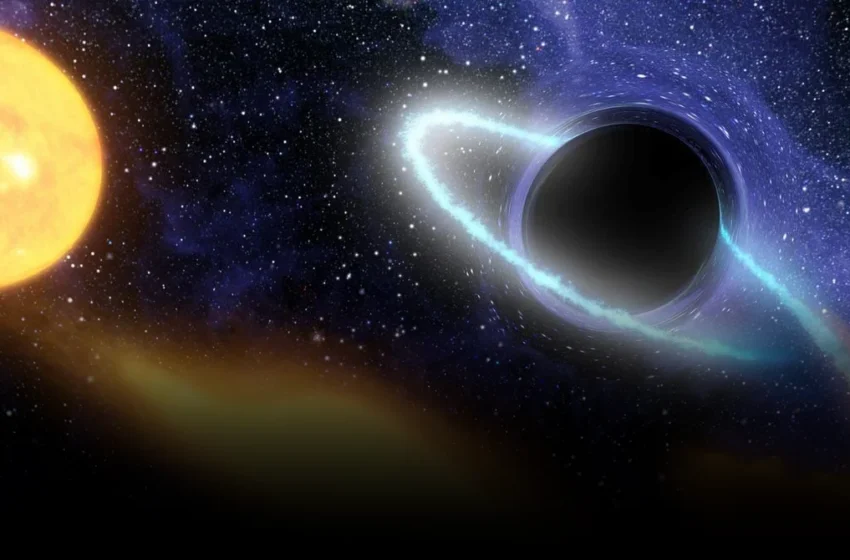
The Galaxy’s Gravitational Crucible
At 25,000 kilometers per second, the star S301 doesn’t merely orbit the Milky Way’s central supermassive black hole, Sagittarius A* (Sgr A*); it streaks through its gravitational well at 8 percent the speed of light, charting a path that could redefine our understanding of cosmic mechanics. While the astronomical community celebrates the detection of this fastest known galactic star and its 8.7-year journey around an entity four million times the Sun’s mass, the real story isn’t just about what S301 *is* doing, but what it could *undo* about our current models of the universe. The unprecedented precision offered by S301’s orbit promises to challenge the current limits of General Relativity in the universe’s most extreme gravitational field, revealing potential deviations that could hint at new physics beyond Einstein.
For decades, instruments like the European Southern Observatory’s (ESO) VLTI in Chile, powered by the GRAVITY instrument, have allowed astronomers to observe stars like S2, confirming the immense mass of Sgr A* and providing crucial tests for General Relativity. These observations have largely affirmed Einstein’s century-old theory in strong gravitational fields. Yet, these successes also highlight a growing tension: General Relativity, for all its predictive power, is known to break down under certain extreme conditions, particularly at the quantum level. The very precision now attainable with S301, observed since 2017 and its closest approach in early 2023, pushes the observational boundary into a regime where theoretical cracks might finally become visible.
Mapping the Black Hole’s Inner Gyre
The core proposition from the ESO is that S301’s incredibly close approach—its periapsis is comparable to the distance between Saturn and the Sun—will enable astronomers to measure the spin, or rotation, of Sagittarius A* within a decade. This is no mere academic exercise. Mass and spin are the two fundamental descriptors of a black hole in astrophysics. Without a precise measurement of its spin, Sgr A* remains an incomplete portrait, a colossal shadow whose inner workings are only vaguely understood. A spinning black hole, as predicted by General Relativity, drags the very fabric of spacetime around it, an effect known as frame-dragging. This phenomenon should subtly but measurably alter S301’s orbit.
The incentive here extends beyond simple confirmation. Determining Sgr A*’s spin isn’t just about adding a number to a cosmic datasheet; it’s about providing an anchor point for models trying to reconcile gravity with quantum mechanics. Why is this announcement happening now? It’s a clear signal to the global physics community that a new observational frontier is open, ripe for theoretical exploration. The current data, tracing S301’s movement since 2017 and its earliest 2023 close pass, is a strong foundation. The subsequent pass, expected in 2031, will further refine these measurements, offering a unique opportunity to directly observe spacetime dynamics in a way that would take decades longer with less extreme stellar orbits.
The standard narrative implies a confirmation of existing theory, but the truly skeptical eye wonders if the sensitivity required to detect these minuscule orbital deviations might just reveal something unexpected. What if the warp isn’t exactly as predicted? That small, overlooked discrepancy could be the thread pulling at a larger, hidden tapestry of physics. This isn’t just about frame-dragging; it’s about probing the spacetime metric itself in conditions where our understanding is weakest.
What if Einstein Was (Slightly) Wrong?
The origin story of S301, likely a star torn from a binary pair by the tidal forces of Sgr A*, with its companion ejected from the galaxy, underscores the sheer violence and transformative power of this cosmic maw. But its future trajectory holds even greater significance. For years, physicists have grappled with the limits of General Relativity, particularly when confronted with phenomena like dark energy, dark matter, or the quantum nature of gravity. While General Relativity has passed every experimental test with flying colors, these tests have largely occurred in less extreme environments or with less precise instruments.
S301 offers a natural laboratory at the absolute extreme. Detecting a subtle deviation in its predicted orbit, one that cannot be accounted for by the standard model of General Relativity, would be nothing short of a scientific earthquake. Imagine if the spacetime warp around a spinning black hole isn’t perfectly described by Einstein’s field equations. Such a finding wouldn’t necessarily invalidate General Relativity entirely, but it would strongly suggest the need for modifications, perhaps pointing towards alternative theories of gravity like modified gravity (MOG) or extensions to string theory. This isn’t about proving Einstein wrong; it’s about pushing physics forward where the known laws struggle. The race to measure Sgr A*’s spin isn’t just about cataloging properties; it’s a direct assault on the fundamental assumptions governing our universe.
