
Beyond the Headlines: The Global Implications of Political Intervention at NASA
- Space
Arjun Vedanta
- 0
- 5 minutes read
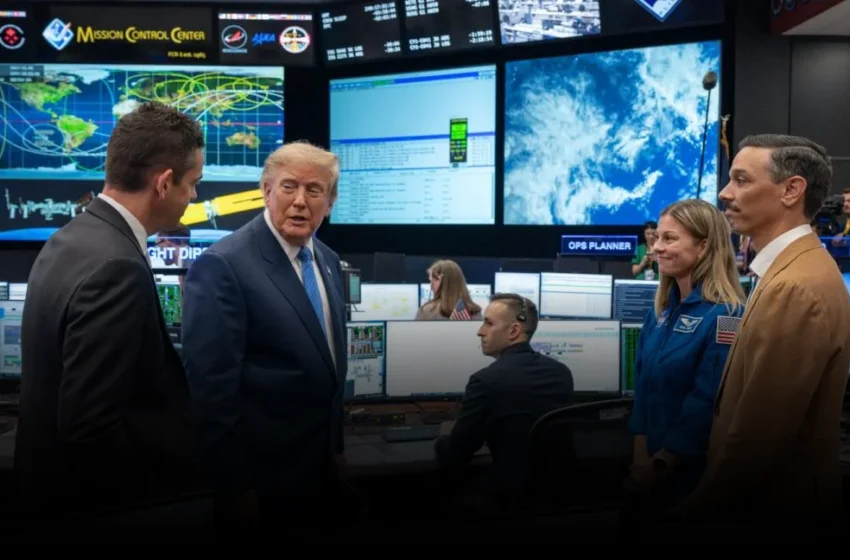
When President Trump unexpectedly dialed into a NASA press conference this Sunday, it wasn’t merely an unusual interruption; it was a potent, if subtle, statement about where the lines of scientific institutional autonomy and political performance now lie. For those outside the Washington D.C. orbit, observing such events from a distance reveals a deeper structural implication: the increasing politicization of what has traditionally been considered a sphere of apolitical scientific achievement and international collaboration.
The Unscripted Call and Domestic Optics
The scene itself was striking. Less than half an hour into a standard post-launch briefing for the Nancy Grace Roman Space Telescope, NASA Administrator Jared Isaacman abruptly rose from the dais. Returning moments later, phone in hand, he apologized for interrupting NASA’s chief of science, Nicky Fox, to announce that the President of the United States wanted to offer congratulations. This unscheduled interjection, diverging sharply from established protocol for mission updates, instantly shifted the focus from the technical marvels of the telescope—its cutting-edge optics and groundbreaking celestial survey capabilities—to a moment of political theater.
Domestically, such an intervention offers immediate political upside. It links the administration directly to a national triumph in space exploration, harnessing the public’s awe for scientific success. The timing, particularly as the Nancy Grace Roman Space Telescope embarks on its ambitious mission to explore dark energy and exoplanets, ensured maximum association with success. For the political machinery, associating with a successful, high-profile scientific endeavor provides a tangible boost, offering a simple narrative of American leadership and achievement, irrespective of the administration’s actual role in the mission’s conception or long-term funding.
A Global Lens on Scientific Autonomy
From a global vantage point, this incident carries a different weight. Scientific achievements, like those promised by the Roman Space Telescope, are not just domestic bragging rights; they are the bedrock of space diplomacy and international partnerships. Agencies like NASA typically navigate a delicate balance, maintaining a perception of non-partisanship to foster collaborations with organizations like ESA, JAXA, or ISRO. An unscheduled presidential interjection into a technical briefing risks blurring the lines between scientific endeavor and political agenda.
When a Head of State intercedes in what should be a fact-based scientific update, it can imply that scientific progress is a direct extension of political will, rather than an independent pursuit driven by peer review and institutional integrity. Such unprompted intrusions, however well-intentioned on the surface, often serve less as genuine scientific celebration and more as opportunistic attempts to co-opt the glow of discovery for immediate political capital. This is a crucial distinction, one frequently overlooked by domestic reporting too close to the national narrative. It frames scientific success as a political commodity, rather than a shared human achievement.
The world’s leading scientific institutions thrive on trust and predictability. Interrupting a briefing, even for a congratulatory message, can be interpreted as a subtle assertion of executive control over the agency’s messaging. This dynamic can complicate future *international space station* collaborations or joint missions, where partners rely on NASA’s consistent, unpoliticized communication channels. The implications for *geopolitical soft power*, often enhanced by scientific prowess, are subtle but profound when the underlying autonomy of the scientific body appears compromised.
Eroding Public Trust and Scientific Integrity
The long-term consequence for an institution like NASA, which relies heavily on perceived objectivity, cannot be overstated. While increased visibility can theoretically benefit *scientific funding* or garner broader public support, the cost might be a subtle erosion of *public trust in science* when its messengers appear to be on a political leash. The public, already navigating a complex information landscape, needs clear boundaries between scientific fact and political performance. When those lines blur, skepticism can fester, undermining the very authority of expert institutions.
What precedent does this set for future interactions? How will information about critical missions, or even sensitive data, be presented if the expectation of direct political intervention becomes normalized? The delicate balance required for sustained global scientific inquiry demands that agencies operate within a clear, non-partisan framework. Politicizing the communication around scientific milestones, even inadvertently, undermines the very scientific integrity that makes these achievements universally celebrated. This isn’t about praising or criticizing a specific administration; it’s about the institutional norms that uphold the global scientific enterprise and its enduring credibility.
For Silicon Valley, where innovation often relies on untainted scientific progress, the implications are equally pertinent. The perceived independence of foundational scientific research directly impacts investor confidence and talent attraction. If the wellspring of discovery becomes a stage for political posturing, the downstream effects on technological advancement and the entrepreneurial spirit could be significant, casting a shadow over future endeavors from quantum computing to advanced materials science.
