
BepiColombo’s Quiet Odyssey: Europe’s $2 Billion Bet Beyond the Hype Cycle
- Space
Arjun Vedanta
- 0
- 4 minutes read
The Relentless Physics of Interplanetary Travel
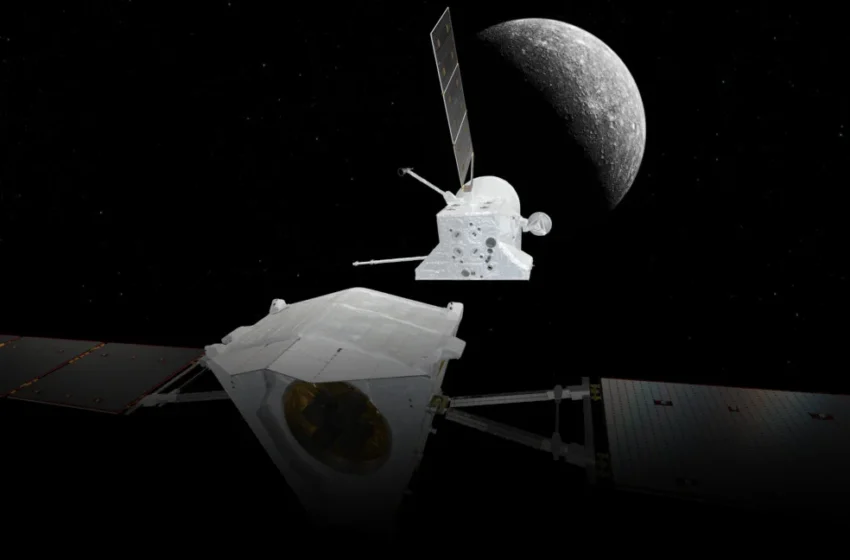
A $2 billion robotic mission, BepiColombo, has just completed another critical flyby, marking the penultimate step in its eight-year journey to Mercury. This isn’t a flashy announcement of a new satellite constellation, nor is it a private rocket company launching tourists into orbit. Instead, it’s a quiet, methodical march across the Solar System, led by the European Space Agency (ESA) and Japan, destined for an iron world notorious for its gravitational challenges and blistering heat.
This prolonged voyage to our innermost planet offers a potent counter-narrative to the prevailing short-termism that defines much of the global technology sector. While public discourse and venture capital frequently fixate on rapid iteration, immediate returns, and the next quarterly earnings report, BepiColombo embodies a different, far slower calculus: one of fundamental scientific inquiry, international collaboration, and an unwavering commitment to a payoff nearly a decade in the making.
This particular mission—its immense cost, its protracted timeline, and its sheer engineering audacity—underscores a profound structural implication rarely explored by US tech journalists. It reveals how Europe and Japan are quietly investing in science that transcends commercial expediency, prioritizing knowledge over market share in an era dominated by rapid-fire technological disruption.
The Economics of Eternity: $2 Billion, 8 Years, Zero Immediate ROI
Getting to Mercury, it turns out, is harder than it sounds, and significantly more challenging than reaching even distant Pluto. The source article notes that NASA’s New Horizons spacecraft took nearly ten years to reach the dwarf planet, yet traveling to fleet-footed Mercury and then entering its orbit requires considerably more energy, or delta-v, due to its proximity to the Sun’s massive gravitational well. To overcome this, BepiColombo, launched in 2018, has relied on a complex ballet of plasma propulsion and multiple gravitational assists from Earth, Venus, and Mercury itself.
This is not an incidental detail; it is the core constraint. The orbital mechanics dictate a slow, spiraling approach, shedding velocity relative to the Sun, rather than simply launching directly. This methodical approach highlights a crucial difference in how different regions frame their ambitions in space: some chase immediate commercial viability in low-Earth orbit, while others are content to play a longer, more expensive game for pure scientific advancement.
The $2 billion price tag for BepiColombo is an investment in fundamental planetary science, aiming to understand Mercury’s formation, its magnetic field, and its interaction with the solar wind. Unlike the rapid return cycles often promised by private space ventures focused on communications or earth observation, the ‘return’ here is pure knowledge, delivered years after launch. This lack of immediate, quantifiable commercial return, combined with the sheer duration of the project, often explains why such missions receive less mainstream media attention than, say, a new venture to mine asteroids or establish lunar tourism.
Europe’s Unseen Play in the Global Space Stakes
The popular narrative of space exploration has, for too long, conflated low-Earth orbit logistics with the true, brutal physics of interplanetary travel, creating an expectation gap that obscures the monumental efforts of missions like BepiColombo. This mission is a direct assertion of European and Japanese scientific and engineering leadership, distinct from the American and Chinese narratives often focused on lunar bases or Mars colonization. While those efforts dominate headlines, BepiColombo quietly pushes the boundaries of our understanding of the Solar System’s origins.
The very existence of BepiColombo, an initiative conceived and funded well before the recent private space boom, serves to remind us who still underwrites the truly fundamental, long-horizon science. In doing so, it quietly asserts Europe’s and Japan’s enduring strategic roles in deep space exploration beyond the commercial clamor. This isn’t about competition for launch contracts or satellite internet market share; it’s about pushing the frontier of human knowledge, irrespective of the timeline or direct profit.
This enduring commitment to painstaking, international deep-space missions reveals a subtle but significant divergence in strategic priorities. While the world’s tech press fixates on the latest AI startup valuations or the newest smartphone, agencies like ESA are executing on decades-long plans that, by their very nature, demand a patience and investment profile alien to much of Silicon Valley. They are building the foundational knowledge that underpins all future space endeavors, a quiet but profound wager on the timeless value of discovery.
