
Venus’s Cosmic Dust Haze: What It Means for Future US Missions
- Space
Arjun Vedanta
- 0
- 8 minutes read
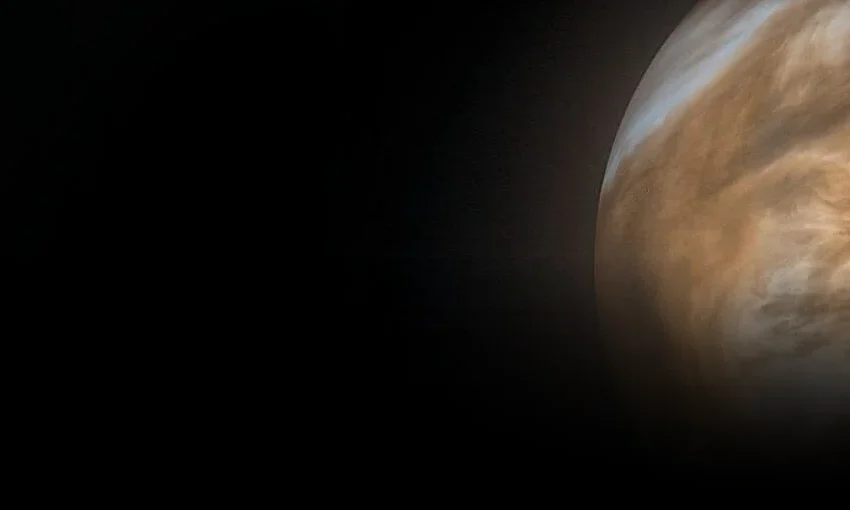
The longstanding mystery of Venus’s yellowish “lower haze” has been definitively solved, with scientists now confirming it to be an accumulation of cosmic dust particles interacting with sulfuric acid. This groundbreaking discovery, led by Japanese researcher Hiroki Karyu, provides crucial data for upcoming US-led missions like NASA’s DAVINCI+ and VERITAS, offering unprecedented insights into atmospheric dynamics, spacecraft engineering challenges, and the potential for life on Earth’s enigmatic sister planet.
For decades, the dense, corrosive atmosphere of Venus has posed one of planetary science’s most enduring puzzles. Probes from the 1970s, including the Soviet Venera series and NASA’s Pioneer Venus, first observed a distinct, opaque layer of haze low in the Venusian atmosphere. Its composition and formation mechanism remained a subject of speculation, hindering a complete understanding of Venus’s extreme climate and geological history. This new understanding fundamentally reshapes our atmospheric models, directly impacting how US scientists plan to explore this hellish world.
Unveiling Venus’s “Lower Haze”: The Cosmic Dust Mechanism
Planetary scientist Hiroki Karyu and his team at Tohoku University in Japan finally cracked the code using an advanced microphysical model. Their research, published in Nature Astronomy, reveals that the haze is formed when microscopic particles of cosmic dust – the remnants of “shooting stars” burning up in the atmosphere – act as condensation nuclei. When these dust particles encounter the abundant sulfuric acid vapor present in Venus’s atmosphere, they catalyze the formation of the persistent lower haze layer.
“The continuous influx of cosmic dust is sufficient to sustain this lower haze layer with the particle size distribution observed by the entry probes,” Karyu stated in the study. This means the planet is constantly being bombarded by micrometeoroids, providing a steady supply of these foundational particles. Crucially, Karyu added that “These haze particles of cosmic origin act as efficient condensation nuclei, promoting cloud formation in the main cloud deck even far from their initial source.” Planetary scientists now understand that Venus’s perplexing lower haze is fundamentally a cosmic dust cloud, catalyzed by the planet’s sulfuric acid atmosphere, highlighting a fundamental interaction between extraterrestrial material and Venusian atmospheric chemistry.
Critical Insights for US Venus Exploration: Engineering and Atmospheric Science
This revelation arrives at a pivotal moment for US space exploration, particularly as NASA prepares for ambitious missions back to Venus. The agency’s DAVINCI+ (Deep Atmosphere Venus Investigation of Noble gases, Chemistry, and Imaging, Plus) mission, set for launch in the late 2020s, includes a descent probe designed to plunge through the Venusian atmosphere, measuring its composition from top to bottom. Simultaneously, the VERITAS (Venus Emissivity, Radio Science, InSAR, Topography, and Spectroscopy) orbiter will map the planet’s surface and gather data on its geology.
Understanding the precise nature of the lower haze – its particulate size, density, and chemical interactions – is paramount for these missions. The presence of cosmic dust mixed with sulfuric acid poses specific challenges for hardware. US engineers must design probes and instruments capable of withstanding not only extreme temperatures and pressures but also abrasive dust and highly corrosive acidic aerosols, which can degrade sensitive electronics and optical systems. Understanding the composition and dynamics of Venus’s lower atmosphere is paramount for engineering robust spacecraft and accurately interpreting scientific data from future probes.
Engineering Robust Probes for a Hostile Environment
The lessons from previous missions underscore the fragility of technology in Venus’s environment. While the Venera probes provided invaluable data, their operational lifespans on the surface were measured in minutes due to the crushing pressure, searing heat, and corrosive atmosphere. Future US missions must innovate. Designing materials and coatings resistant to sulfuric acid and micrometeoroid-derived dust becomes a central engineering focus. This includes developing advanced heat shields, durable sensor windows, and robust filtration systems to protect vital components.
Refining Atmospheric Models and Unpacking Astrobiological Potential
The identification of cosmic dust as a key component significantly refines our Venus atmosphere models. Previously, the exact mechanisms for cloud and haze formation were based on theoretical assumptions; now, there’s a concrete, externally sourced particulate foundation. This improved modeling allows US planetary scientists to more accurately predict atmospheric dynamics, heat transfer, and the planet’s overall energy budget.
Furthermore, this discovery has subtle but important implications for the ongoing discussion about potential life in Venus’s clouds. While the surface is undeniably inhospitable, some hypotheses suggest microbial life could exist in the more temperate cloud layers, perhaps utilizing sulfuric acid. The cosmic dust particles, acting as condensation nuclei, play a direct role in creating these cloud structures. Understanding their origin and interaction with sulfuric acid is crucial for evaluating the chemical pathways and energy sources available, or indeed the challenges, for any hypothetical Venusian biota. It helps complete the picture of the environment where such life might hypothetically survive.
Broader Implications for Planetary Science and Exoplanet Research
The insights gained from Venus extend beyond our immediate solar system. The discovery of cosmic dust influencing Venus’s atmosphere offers a valuable analog for understanding exoplanet atmospheres. Many exoplanets, particularly those categorized as “super-Earths” or “mini-Neptunes,” are thought to possess dense, hazy atmospheres. Data from Venus helps refine theoretical models of atmospheric processes on distant worlds, allowing scientists to better interpret observations from telescopes like the James Webb Space Telescope.
This research also reinforces the understanding that extraterrestrial material, in the form of cosmic dust, plays a pervasive role in planetary evolution. From delivering water to early Earth to seeding cloud formation on Venus, these tiny particles are crucial, often underappreciated, drivers of planetary environments across the cosmos. For US-led scientific endeavors, integrating this understanding into broader planetary formation and atmospheric evolution theories will be key.
The definitive identification of cosmic dust as the primary driver behind Venus’s mysterious lower haze marks a significant leap in planetary science. This finding, brought to light by Hiroki Karyu and his team, provides invaluable, tangible data that directly informs the strategic planning and engineering challenges of forthcoming US space missions to Venus. For US scientists and engineers, this isn’t just an academic curiosity; it’s a foundational piece of the puzzle, critical for unlocking Venus’s secrets and potentially enhancing our understanding of exoplanets.
- Key Takeaways:
- Venus’s lower haze is formed by cosmic dust particles interacting with sulfuric acid, acting as condensation nuclei.
- This discovery from Tohoku University directly impacts NASA’s upcoming DAVINCI+ and VERITAS missions by informing atmospheric models and engineering requirements.
- Future US probes must contend with a more thoroughly understood hostile environment, necessitating advancements in material science and protective systems.
- The research provides new context for astrobiological hypotheses regarding potential life in Venus’s cloud layers.
- Insights gained from Venus’s cosmic dust haze contribute to a broader understanding of planetary atmospheres, including those of distant exoplanets.
What is the newly discovered cause of Venus’s lower haze?
Scientists, led by Hiroki Karyu, have determined that Venus’s persistent lower haze is caused by cosmic dust particles, remnants of meteorites, interacting with the planet’s abundant sulfuric acid. These dust particles act as condensation nuclei, initiating cloud formation.
Why is understanding Venus’s atmosphere important for US space missions?
Precise knowledge of Venus’s atmosphere, including the composition and dynamics of its haze layers, is crucial for US missions like NASA’s DAVINCI+ and VERITAS. This data informs the design of robust spacecraft, improves atmospheric models, and helps scientists accurately interpret collected scientific data.
How will this discovery impact the search for life on Venus?
While not directly proving or disproving life, the discovery of cosmic dust’s role in cloud formation provides a clearer picture of the chemical and physical environment within Venus’s atmosphere. This enhanced understanding is vital for refining astrobiological hypotheses concerning the potential for microbial life within the planet’s cloud layers.
What US missions are planned for Venus?
NASA currently has two major missions planned for Venus: DAVINCI+ (Deep Atmosphere Venus Investigation of Noble gases, Chemistry, and Imaging, Plus), which includes an atmospheric descent probe, and VERITAS (Venus Emissivity, Radio Science, InSAR, Topography, and Spectroscopy), an orbiter focused on surface mapping and geology.
