
James Webb Telescope’s Little Red Dots Challenge Theories of Early Black Hole Formation
- Space
Arjun Vedanta
- 0
- 13 minutes read
James Webb Telescope’s Little Red Dots Challenge Theories of Early Black Hole Formation
The James Webb Space Telescope’s detection of ubiquitous, ultrabright “little red dots” in the early universe has sparked a contentious debate among astronomers regarding the formation of supermassive black holes. These mysterious objects challenge established cosmological models, potentially representing a new class of celestial body called “black hole stars” that incubate black holes within vast gaseous envelopes. This re-evaluation of cosmic origins could fundamentally alter our understanding of the universe’s formative years and the search for cosmic origins by US scientific institutions.
Initial Webb observations in 2023 revealed these enigmatic pinpricks of light, glowing as brightly as entire galaxies, yet spanning only a single pixel. Their consistent red light, long wavelengths, and widespread appearance across Webb images immediately made them an anomaly. As the Webb telescope, a joint project led by NASA with contributions from the European and Canadian space agencies, peered further back into the first billion years after the Big Bang, the prevalence and peculiar characteristics of these “universe breakers” hinted at a phenomenon far more complex than initially assumed, prompting intensive follow-up surveys like the Red Unknowns: Bright Infrared Extragalactic Survey (Rubies) and Mirage or Miracle (MOM).
Unpacking the Enigma of the Little Red Dots
Initially, astronomers theorized these little red dots might be exceptionally distant, oversized galaxies. However, their sheer brightness implied a colossal size that seemed impossible for galaxies to attain within just hundreds of millions of years of the Big Bang, earning them the moniker “universe breakers.” This quickly led researchers to consider more exotic explanations.
Attention soon shifted to supermassive black holes (SMBHs), which reside at the heart of most galaxies. While black holes themselves are dark, their formidable gravity creates scorching accretion disks that outshine their host galaxies. Observations of the little red dots showed broad spectral lines of hydrogen, a signature of gas being whipped around at furious rates, often seen around exposed black holes. This led many astronomers to conclude that these were massive black holes, with surrounding dust absorbing their blue light, making them appear red.
However, this interpretation faced its own puzzles. Most supermassive black holes exhibit flickering as they irregularly consume gas, and they beam powerful X-rays across the universe. Crucially, most of the observed little red dots seemed to do neither. While some attributed this strangeness to the pandemonium of the early universe, these anomalies fueled further investigation.
The Rise of the “Black Hole Star” Hypothesis
A pivotal moment arrived in the spring of 2025, when two teams, one led by Anna de Graaff of Germany’s Max Planck Institute for Astronomy and another co-led by Rohan Naidu of the University of Hawai’i, unveiled observations of two unprecedented little red dots. These objects were exceptionally red, showing almost no light in bluer hues, and displayed an abrupt surge in brightness at a particular red shade—a feature known as a Balmer break. This break is typically associated with hot hydrogen gas surfaces, like those found in stars or galaxies.
The combination of extreme brightness, extreme redness, and a Balmer break baffled scientists. The objects were too bright to be conventional stars, yet their spectral signatures didn’t align with typical black holes, which usually lack a Balmer break and the uniform 5,000 degrees Kelvin surface temperature suggested by the red, hump-shaped curve. This led de Graaff and Naidu to propose a truly novel astronomical object: a black hole star.
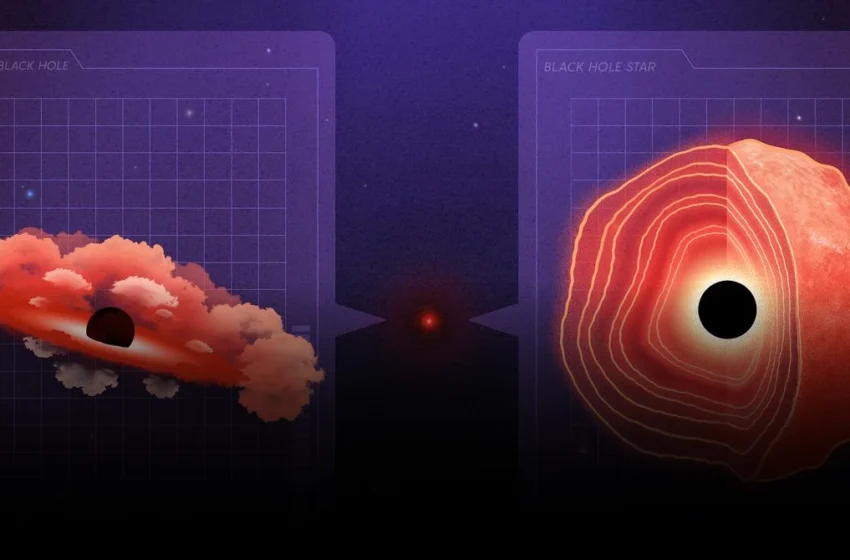
A black hole star, as theorized, would be a colossal agglomeration of hydrogen gas. If our Sun were replaced by one, it would extend a dozen times farther than the orbit of Pluto, with its outer layers boiling unstably and ejecting mass. At its invisible core, a black hole would serve as the “engine,” pulling in gas, dramatically heating it, and pushing light and energy outward. This outward pressure would prevent the vast hydrogen layers from collapsing inward, while the hydrogen near the surface would block bluer light, allowing only redder light to pass through. This stellar-like surface, shining at about 5,000 Kelvin, would also create the observed Balmer break.
Furthermore, this gassy “cocoon” would explain the earlier mysteries: it would block X-rays and prevent the black hole’s internal flickering from being visible. The broad hydrogen lines, initially attributed solely to fast-moving gas around a black hole, also found a new explanation. Vadim Rusakov of the University of Manchester and his team suggested that electron scattering could account for much of the observed spectral spread. When this effect was digitally removed, the lines more closely resembled light passing through a sluggishly churning shell of hydrogen gas, consistent with a black hole star.
As Rohan Naidu put it, “We are seeing the seed. This is the birth of potentially every massive black hole in the universe.” This bold interpretation suggests black hole stars represent an early, incubation stage in the development of supermassive black holes.
A Polarized Field: The Counter-Arguments and Ongoing Debate
Despite the compelling nature of the black hole star hypothesis, the astronomical community remains deeply divided. “The field has gotten very polarized,” noted Anna-Christina Eilers, an astrophysicist at the Massachusetts Institute of Technology, reflecting the intensity of the scientific discussion. Dale Kocevski of Colby College recounted an April 2026 conference in Aspen, Colorado, where a discussion on little red dots quickly “erupted into argument.”
Roberto Maiolino of the University of Cambridge, a prominent voice in the debate, acknowledges the data is compelling but remains “a little bit more dubious about the interpretation.” He and Piero Madau of the University of California, Santa Cruz, argue that existing models of standard supermassive black holes can explain the observations without needing a new class of object.
| Observation | Standard SMBH Theory (Maiolino/Madau) | Black Hole Star Theory (de Graaff/Naidu) |
|---|---|---|
| Extreme Brightness | Powerful accretion disk of supermassive black hole. | Black hole engine radiating energy through a vast hydrogen envelope. |
| Extreme Redness & Balmer Break | Thick gas/dust “doughnut” or puffy clouds blocking blue light; viewing angle. | Hydrogen envelope surface filters blue light, lets red through, mimicking a stellar surface around 5,000 Kelvin. |
| Lack of Flicker | Steadier food supply for early universe black holes. | Gas “cocoon” prevents flickering from being observed. |
| Lack of X-rays | Thick gas/dust doughnut blocks most X-rays. | Gas “cocoon” blocks X-rays. |
| Broad Hydrogen Lines | Fast-moving gas around black hole; also electron scattering. | Electron scattering combined with light passing through a sluggishly churning hydrogen shell. |
Maiolino offers rebuttals for each point favoring black hole stars. The lack of flickering, he suggests, could be due to a steadier food supply for black holes in the gas-rich early universe, making them “tidier eaters.” The absence of X-rays, he argues, could be explained by a standard thick, dusty torus (doughnut) around a galactic black hole, which would block most X-ray emissions. The striking redness, while agreed upon, could stem from the angle at which we view these objects; edge-on views through a dusty torus would appear red, while “little blue dots” seen by Webb could be the same exposed black holes viewed top-down. Both sides, ironically, appeal to Occam’s razor, the principle of choosing the simplest explanation.
Mauro Giavalisco, an astronomer at the University of Massachusetts, Amherst, encapsulates the current impasse, stating, “I don’t think that there is a compelling reason to prefer one or the other” theory based solely on the current data.
Tracing Origins: Quasi-Stars and the Evolution of Supermassive Black Holes
To further test these interpretations, astronomers need a clearer theoretical framework for how black hole stars might form and what their precise observable signatures would be. This is where earlier theoretical work finds new relevance.
Mitchell Begelman of the University of Colorado, Boulder, recognized the little red dots as a potential manifestation of “quasi-stars,” objects he proposed in 2006 with collaborators Marta Volonteri and Martin Rees to explain impossibly massive black holes. The quasi-star theory posits a scenario where the core of a vast gas cloud directly collapses into a black hole, with the remainder of the cloud gathering around it. “Suddenly the switch flipped, and I realized that this is what quasi-stars should look like,” Begelman said.
In 2025, Begelman and Jason Dexter applied the quasi-star model to the little red dots, estimating that quasi-stars could assemble rapidly within a few million years and endure for tens of millions of years—a timeframe long enough for Webb to detect them. Giavalisco later collaborated on a team to further flesh out the quasi-star model as an origin for black hole stars. He finds this a natural way to explain how a feeding black hole’s signs could be masked, drawing an analogy to our own Sun: “We have billions and billions of hydrogen bombs exploding every second, and yet we see none of them,” he stated, highlighting how a star’s surface hides its powerful core processes.
Crucially, observational evidence is beginning to emerge. An August 2026 census of both red and blue dots, compiled by Kocevski of Colby College and his collaborators, found that little red dots become rarer as the universe ages, particularly as it approaches 2 billion to 3 billion years old. This preliminary finding supports the black hole star hypothesis, suggesting that these objects might represent a “puberty-like phase” for many supermassive black holes before they break free from their gaseous shells.
Further analysis, published on September 8 by Naidu, de Graaff, Eilers, and their collaborators, indicated that the hidden black hole “seeds” within these black hole stars appeared far less massive than standard, exposed black holes. This supports the idea that the James Webb Space Telescope is catching supermassive black hole stars—up to 1 million times the mass of the Sun—in the act of incubating the universe’s very first big black holes. While the debate rages on, the Webb’s data continues to push the boundaries of our cosmic understanding, keeping scientists like Kocevski open to the possibility that “we’re both right.”
The James Webb Space Telescope continues to deliver groundbreaking data, fueling essential scientific debate among American and international researchers. The “little red dots” controversy underscores the dynamic nature of astrophysics and the profound impact of advanced space observational capabilities, funded by agencies like NASA, on our quest to understand the universe’s most fundamental processes.
- The James Webb Space Telescope (JWST) has observed mysterious, ultrabright “little red dots” from the early universe, sparking a major astronomical debate.
- Two primary theories contend: these objects are either conventional supermassive black holes or a new class of celestial body called “black hole stars.”
- The “black hole star” hypothesis suggests a black hole is cloaked within a vast, shining hydrogen envelope, potentially representing the “seeds” of all massive black holes.
- Proponents of standard supermassive black holes argue that viewing angles and early universe conditions can explain the peculiar observations.
- Preliminary evidence, including the decreasing rarity of little red dots in later cosmic eras, supports the “black hole star” concept as an early developmental phase for supermassive black holes.
What are James Webb Telescope’s “little red dots”?
The “little red dots” are ubiquitous, extremely bright, red-emitting celestial objects observed by the James Webb Space Telescope in the first billion years after the Big Bang. They appear as tiny, single-pixel points of light, shining as brilliantly as entire galaxies.
What is a “black hole star”?
A “black hole star” is a theoretical new class of astronomical object proposed to explain some of the little red dots. It describes a supermassive black hole hidden deep within a colossal envelope of hydrogen gas, where the black hole acts as an engine radiating energy that makes the vast gaseous sphere shine with stellar-like properties.
Why is there a debate about these objects?
The debate stems from the little red dots’ unique combination of extreme brightness, redness, and specific spectral features like the Balmer break, which do not perfectly align with established models of either conventional stars or typical supermassive black holes. Astronomers are divided on whether these anomalies indicate a new phenomenon or can be explained by existing theories under early universe conditions.
How do these findings impact our understanding of the early universe?
These findings could fundamentally reshape our understanding of how supermassive black holes form and evolve. If black hole stars are confirmed, it suggests a new pathway for the rapid growth of black holes in the early universe, challenging existing cosmological models and opening new avenues for research into the origins of galactic structures.
