
Agility Robotics Navigates the Paradox of Pragmatism and Generative AI
- Robotics
Arjun Vedanta
- 0
- 5 minutes read
Industrial Ascent Meets Generative Dreams
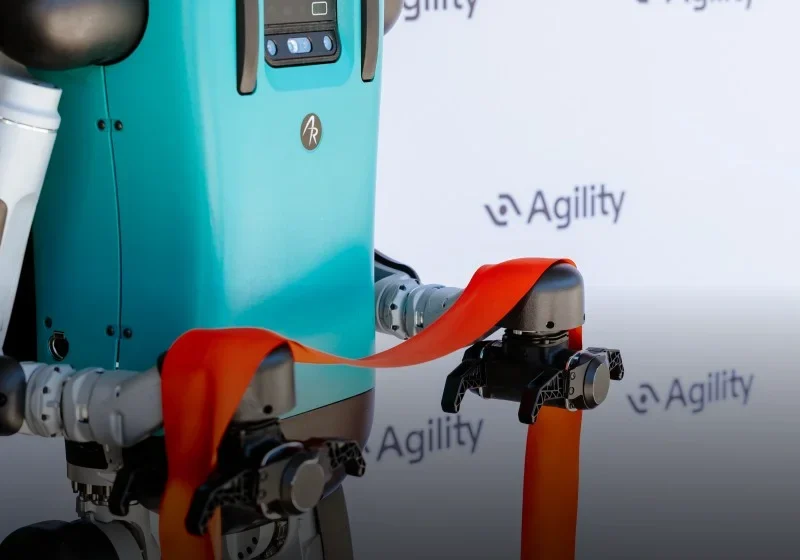
The immediate reality of humanoid robotics is not a seamless AI ballet, but a meticulous, often tedious process of getting machines to safely lift bins. Agility Robotics, the decade-old pioneer in bipedal locomotion, has planted a 60,000-square-foot facility in Fremont, California, a mere stone’s throw from where Tesla plans to mass-produce its Optimus robots. This isn’t just a geographical coincidence; it’s a calculated statement of intent that simultaneously embraces a pragmatic, revenue-generating present and a future deeply reliant on the very generative AI paradigms its safety-first philosophy questions.
Agility’s move into a substantial new training facility signals an aggressive scale-up. The company boasts $300 million in contract orders for its Digit robots, machines already integrated into operations for industrial giants like Amazon and GXO. These aren’t futuristic concepts; they are six-foot-tall automatons that have moved 100,000 totes within a single logistics facility, performing repeatable tasks in controlled environments. CEO Peggy Johnson’s assessment is starkly clear: “We have commercialized. We now know what it takes to walk into these facilities and meet their safety bars, their regulatory bars, compliance, plug into their IT infrastructure, plug into their warehouse management system.” This isn’t just a technical achievement; it’s a hard-won lesson in industrial deployment that newer entrants like Figure or 1X are yet to fully absorb. The incentive for this public flexing of commercial muscle, particularly in Tesla’s shadow, is obvious: to solidify Agility’s position as the credible, revenue-generating leader ahead of its anticipated reverse-merger, making it the first pure-play humanoid company on public markets.
Yet, amidst this grounded narrative of industrial integration, Agility simultaneously pivots towards the very AI paradigms that its pragmatic approach often implicitly critiques. Co-founder Damion Shelton highlights the scaling dilemma, noting that “the number of things you can imagine a robot doing is far larger than the number of engineers who can program robots.” His solution, unreservedly, is generative AI. This intellectual embrace of large language models and transformer-based neural networks for scaling application development is a profound conceptual shift, positioning the company as both a cautious engineer and an AI visionary.
Safety First, Until Scale Demands More
The core tension within Agility’s strategy lies in its bifurcated view of artificial intelligence. On one hand, Shelton cautions against putting fundamental safety functions under generative AI control, drawing parallels to anti-lock brakes in self-driving cars. “You don’t want to get creative with your safety stack,” he asserts, emphasizing predictable, deterministic programming for critical functions. This reflects a deeply ingrained robotics engineering philosophy, one that prioritizes safety and reliability above all else in industrial settings. It’s a necessary stance when robots operate alongside human workers, albeit currently in segregated zones for Digit.
However, the company’s vision for future growth directly contradicts this cautious framing by leaning into generative AI for skill acquisition and broader applicability. The forthcoming Digit Version 5, expected this fall, promises enhanced human-sensing capabilities, enabling it to operate in shared spaces. This advancement, while technical, implicitly relies on sophisticated, adaptive intelligence that blurs the lines of “deterministic” operation. The cynical observation here is that the industry is trying to solve a hard safety problem with an even harder autonomy problem, then dressing it up as innovation.
The ambition articulated by chief robot officer Jonathan Hurst — from “bins and totes” to “100 million robots” and a “trillion-dollar company” — requires an explosion of capabilities that deterministic programming cannot deliver at speed. It demands precisely the kind of rapid, context-aware learning and generalization that generative AI, with its inherent unpredictability, is designed to provide. This creates a fascinating internal conflict: how does a company maintain stringent safety protocols and regulatory compliance while simultaneously leveraging the experimental, often opaque, nature of large AI models to achieve hyper-scale?
The Silicon Valley Hype Cycle’s Pull
Agility’s measured approach, particularly its focus on manufacturing and logistics over in-home consumer robots, aligns with the consensus among independent robotics experts. They rightly argue that today’s powerful robots are not yet safe enough for domestic use, a stark contrast to the narratives often pushed by tech evangelists. Yet, the gravitational pull of Silicon Valley’s AI gold rush is undeniable. The presence of Tesla’s Optimus project, with Elon Musk’s grand pronouncements about it becoming “the biggest product ever,” injects a different kind of pressure into the market. While Agility’s CEO Peggy Johnson welcomes “others in the humanoid space” after “a long time alone,” the subtext is clear: the influx of AI-inspired robotic startups like Figure and 1X, fueled by venture capital, is altering market expectations and valuation metrics.
Agility’s strategic emphasis on its commercial lead and practical deployment expertise is a direct counter-narrative to the hype surrounding generalized AI humanoids. However, their simultaneous embrace of generative AI for future application scaling reveals that even the most pragmatic players cannot entirely escape the current AI discourse. It’s a pragmatic paradox: to secure its place in the market and on the public exchanges, Agility must demonstrate concrete, revenue-generating utility today, while also convincing investors it has a credible, scalable path to tomorrow’s expansive AI-powered robotic workforce. This dual message risks diluting the very “safety-first” credibility it painstakingly builds, caught between the certainty of its established commercial base and the intoxicating uncertainty of advanced AI’s promise.
