
Anthropic’s Voice AI Update: A Strategic Integration Play Amidst LLM Trust Issues
Arjun Vedanta
- 0
- 6 minutes read
The App Integration Mirage
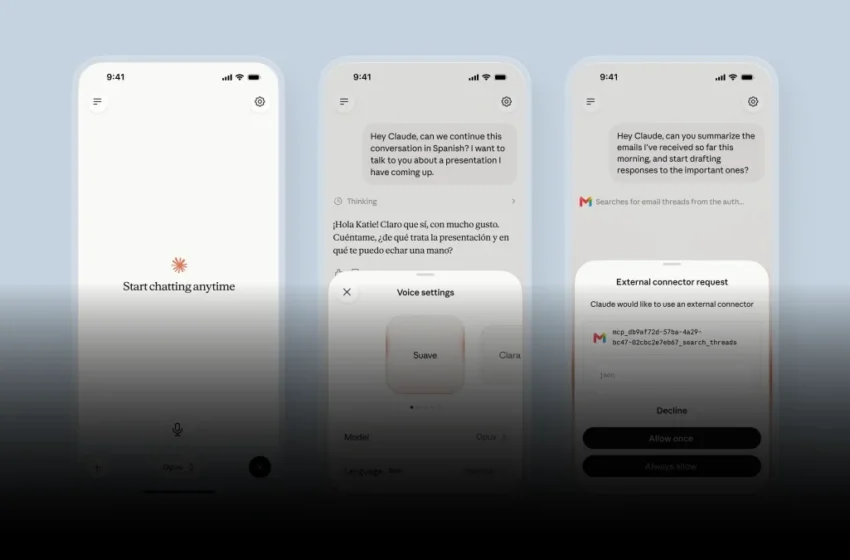
A wave of immediate digital action now flows through Claude’s voice mode, allowing users to verbally command emails in Gmail, update meetings in Google Calendar, or draft documents in Notion. This new capability, rolled out by Anthropic, appears on the surface to be a significant leap in productivity, moving conversational AI from mere chat into the operational heart of the modern workflow. Yet, this rapid push for seamless integration across the enterprise stack risks creating a dangerous illusion: that the underlying large language models have suddenly become infallible, rather than merely more interconnected.
The headline feature is the ability for users to choose between Claude’s Opus, Sonnet, and Haiku models directly within the voice interface. While the previous Haiku-powered voice mode offered speed, it lacked the sophistication for complex tasks, limiting its utility beyond quick queries. Now, with the option to leverage Opus for intricate problem-solving or Sonnet for balanced performance, Anthropic frames this as a tailored experience for a user’s diverse needs, from giving feedback on communication style to brainstorming product market research.
However, the real differentiator, and perhaps the riskiest, is the integration with external applications. Enabling voice commands to interact with platforms like Slack or Canva transforms Claude from a mere chatbot into an active agent within an individual’s digital ecosystem. This move directly contrasts with OpenAI’s voice mode, which has focused primarily on refining conversational style without delving into external tool utilization. The convenience is undeniable: imagine verbally dictating an email or scheduling a meeting without touching a keyboard. The question remains, at what cost?
The incentive here is clear: Anthropic needs to differentiate itself and match perceived capabilities against formidable rivals. By emphasizing deep integrations, they frame themselves as the practical, enterprise-ready alternative to OpenAI’s more generalist approach. This strategy aims to capture market share, particularly among businesses looking to streamline operations, benefiting both Anthropic’s platform adoption and the wider API economy that powers these connections. It’s a compelling narrative for investors and early adopters, but the underlying mechanics warrant closer scrutiny.
The Deeper Flaw in Conversational AI’s Foundation
This rush to integrate LLMs into critical, action-oriented workflows tends to gloss over the persistent, fundamental limitations of the technology itself. While models like Opus represent the cutting edge of AI, they are not immune to semantic misunderstandings or, crucially, producing confidently incorrect information. These ‘hallucinations’ are a well-documented challenge across all large language models, regardless of their impressive scale or intricate architectures.
When an LLM is merely conversing, a factual error might be an annoyance; when it is drafting an email to a client or updating a project brief on Notion, such an error becomes a direct business liability. The shift to a voice interface, rather than mitigating these risks, could inadvertently exacerbate them. Voice interactions often lack the visual cues and immediate opportunities for correction inherent in text-based interfaces. A user might not immediately register a subtle error in a dictated instruction or a generated response, especially when multitasking or in a fast-paced environment.
Furthermore, Anthropic has stated it hasn’t made changes to the underlying voice model itself, implying that aspects like interruption handling or nuanced conversational improvements, which OpenAI recently highlighted, might be absent. This means that while the intelligence behind the voice mode is greater, the voice *experience* could still suffer from latency or conversational rigidity. The rush to embed confidently inaccurate algorithms into the command layer of our digital lives is not innovation; it’s a liability amplified by convenience. This competitive sprint for feature parity often prioritizes the perception of capability over actual, robust reliability.
Enterprises adopting these integrated solutions must grapple with the inherent computational overhead and data privacy implications of connecting their core applications to third-party AI systems. Each new API connection introduces another potential point of failure, another vector for data exposure, and another layer of complexity for compliance and security teams to manage. The ease of setting a meeting via voice might be alluring, but the cost of a misinterpretation or a data breach remains significant.
Competing on Noise, Not Signal
The current landscape of conversational AI is becoming a feature race driven by announcements more than foundational breakthroughs. Companies like Anthropic and OpenAI are locked in a public battle to demonstrate superior capabilities, and integration with common workplace tools is the latest frontier. This constant one-upmanship trains the market to expect ever-expanding feature lists, often at the expense of genuine progress in areas like verifiable accuracy, ethical guardrails, or deep contextual understanding.
The announcement from Anthropic comes weeks after OpenAI’s own updates to ChatGPT’s voice capabilities, underscoring the fierce competitive pressure to respond in kind. This dynamic often pushes developers to integrate existing, sometimes imperfect, LLM technology into new applications rather than investing heavily in the arduous, less glamorous work of fundamentally improving the models’ reliability and reducing their propensity to hallucinate. It’s a race to the most impressive demo, rather than the most dependable system for real-world enterprise adoption.
While multilingual support, now in beta across ten languages including Japanese, French, and Spanish, broadens Claude’s reach, the caveat of manually specifying the language adds a cognitive load that detracts from the promised seamless user experience. Similarly, the restriction of free users to the less capable Haiku model with only one connected app clearly outlines Anthropic’s monetization strategy, segmenting user access based on perceived value and a tiered approach to computational power.
Ultimately, the true value of these advanced voice modes will not be measured by the sheer number of applications they can control, but by the unwavering trust users can place in their semantic understanding and factual accuracy. Without robust mechanisms to ensure correctness and prevent misinterpretation, particularly in critical business contexts, these integrations will remain sophisticated toys rather than indispensable tools. The industry needs to shift its focus from the superficial allure of multimodal interaction to the foundational integrity of the AI’s core reasoning.
