
When Earth Burns: Climate Threatens Deep Space Communications
- Space
Arjun Vedanta
- 0
- 5 minutes read
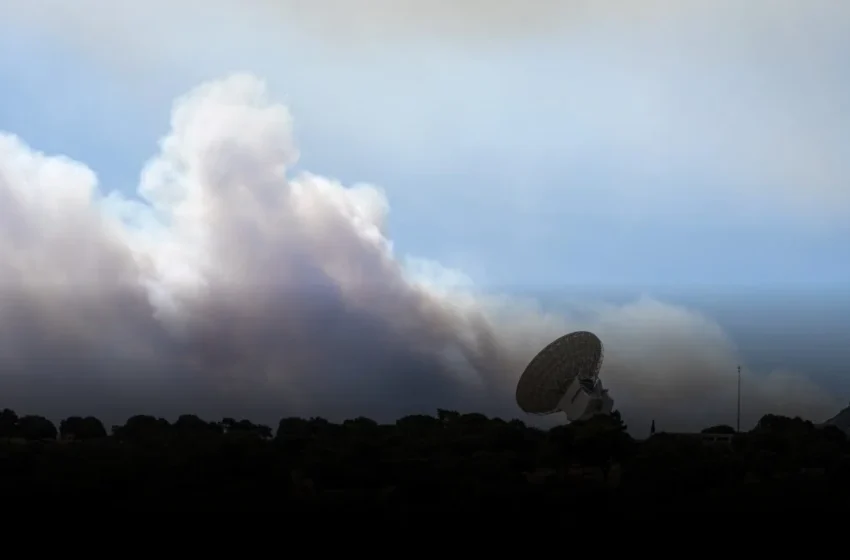
A fast-moving wildfire forcing the evacuation of NASA’s Madrid Deep Space Communications Complex last Friday was more than just a local emergency. It was a stark, almost poetic collision of humanity’s furthest reach and its most pressing terrestrial failure. While the immediate crisis involved flames licking at facilities crucial for missions like Artemis and the James Webb Space Telescope, the broader implication is clear: the very ground infrastructure underpinning our extraterrestrial ambitions is increasingly vulnerable to escalating, climate-driven environmental disruptions.
This isn’t merely about a single facility in Spain temporarily halting communications with the Voyager spacecraft or other critical missions. It’s a fundamental re-evaluation of what ‘redundancy’ means in the age of climate volatility. The Deep Space Network (DSN) was engineered with three globally separated sites – Goldstone, California; Canberra, Australia; and Madrid – precisely to ensure continuous coverage as Earth rotates. That design was brilliantly conceived to mitigate technical failures or localized weather events. But it wasn’t built to withstand a global pattern of simultaneous, compounding environmental threats.
The Growing Climate-Infrastructure Collision
For decades, the narrative around critical infrastructure resilience focused on technical robustness, cybersecurity, and geopolitical stability. We built space communications arrays with massive 70-meter dishes, protected by layers of security, designed to last. Yet, the Madrid complex, located in the hills 65 kilometers west of the Spanish capital, found itself directly in the path of a wildfire that has incinerated thousands of hectares across the region. This isn’t an isolated incident; it’s a symptom of a larger, systemic problem.
Consider the DSN’s other primary locations. California is no stranger to devastating wildfires, a recurring nightmare that has seen entire communities razed. Australia battles its own seasonal bushfire crises, often on an unprecedented scale. What happens when the distributed resilience of the Deep Space Network — or indeed, any global scientific or communication grid — is tested by climate events that are no longer localized anomalies but widespread, predictable, and intensifying threats across multiple nodes simultaneously? This isn’t about one site going down; it’s about the very concept of geographic diversification being challenged by a homogenizing environmental risk.
The incentive here for NASA and similar global operators is no longer just about maintaining operational uptime, but about a rapid, costly re-assessment of physical site resilience and the potential need for even more distributed or perhaps entirely new forms of communication infrastructure. The short-term optics might suggest a successful evacuation and quick return to service, but the underlying vulnerability remains — and intensifies.
Redefining Planetary Science’s Terrestrial Roots
The irony is profound. As we launch more sophisticated instruments to explore the cosmos, pushing the boundaries of human knowledge with missions like the James Webb Space Telescope unveiling new galaxies, our ability to connect with them is being compromised by issues rooted firmly on Earth. It’s a stark reminder that even the most advanced space technology remains tethered to a fragile planet. The Madrid incident, while resolved without permanent damage, forces a reckoning with how interconnected our planetary health is with our space aspirations.
This isn’t just a challenge for space agencies. It’s a blueprint for the future challenges facing all global infrastructure: undersea fiber optic cables vulnerable to extreme weather, data centers at risk from flooding, energy grids buckling under heatwaves. The implicit assumption that our terrestrial environment remains stable enough to reliably support our most ambitious technological endeavors is crumbling. The core design principles of the DSN — redundancy through geographic spread — are now being stress-tested by a variable for which they were not originally optimized: an increasingly unstable global climate system.
Beyond the Immediate Threat: A Strategic Recalibration
The immediate consequence for the missions supported by the DSN — more than 40 spacecraft from lunar orbit to the heliosphere’s edge — was likely a rerouting of communications to Goldstone or Canberra, or a temporary blackout if critical windows were missed. For sophisticated orbital mechanics, even brief interruptions can complicate operations, requiring meticulous planning and potentially delayed data transmission. This is a solvable problem in the short term, testament to the DSN’s inherent flexibility and expert operations.
However, the long-term strategic implications extend far beyond momentary disruptions. How does NASA, or ESA, or any organization relying on such critical ground stations, plan for a future where ‘wildfire season’ is effectively year-round in multiple crucial locations? Does this necessitate entirely new concepts for deep space relay, perhaps leveraging more orbital assets or even moon-based ground stations to reduce reliance on Earth’s surface? The immediate cost of fighting a wildfire is one thing; the immense, often uncalculated, cost of continuously fortifying or relocating irreplaceable global scientific infrastructure is another.
The Madrid incident serves as a visceral, undeniable signal. For all our technological prowess in exploring distant worlds, the most pressing engineering challenge might just be ensuring our own world remains stable enough to support that endeavor. The question isn’t whether deep space communication will be interrupted again by climate events; it’s how quickly and comprehensively we adapt to an uncomfortable reality where our grandest cosmic ambitions are increasingly shadowed by earthly vulnerability.
