
Beijing’s Humanoid Robot Games: A Geopolitical Spectacle Masking Deeper Ambitions
- Robotics
Arjun Vedanta
- 0
- 5 minutes read
The Theatricality of Speed and Failure
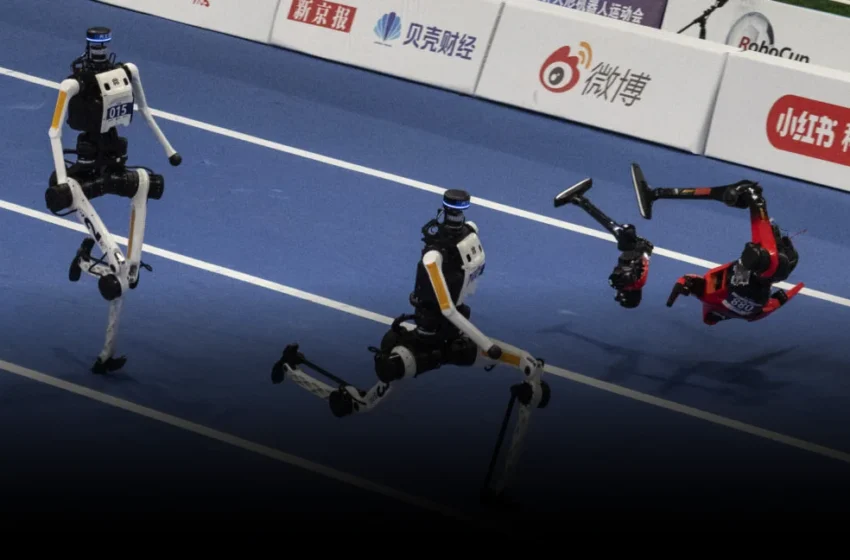
The sight of a humanoid robot scorching past Usain Bolt’s 100-meter sprint record is precisely the kind of techno-spectacle engineered to ignite the popular imagination. But beyond the viral clips of impossible speed — and equally viral clips of robots disintegrating in sparks and flames — lies a carefully orchestrated narrative about a nascent technology whose true drivers are far more complex than simple market demand. These “games” in Beijing are not merely a showcase of engineering prowess; they are a calculated declaration of intent, revealing a global robotics arms race driven as much by national prestige and geopolitical positioning as by commercial viability.
Footage from the second World Humanoid Robot Games, held in Beijing from August 22-26, captured both breathtaking advancements and striking limitations. Robots performed complex kung fu routines, engaged in kickboxing bouts, and navigated soccer fields with a fluidity that few predicted just years ago. Yet, the same robots, having demonstrated unparalleled acceleration, proved hilariously unable to stop, careening into barriers or simply toppling over in a shower of sparks—some even catching fire at the waist.
This public display of both triumph and dramatic failure is not an accident. The sheer theatricality of these “games” serves a dual purpose: to both impress and distract, to set a high bar for public perception while allowing room for controlled failure that still generates buzz. It’s less a scientific competition and more a carefully choreographed tech-drama, designed to capture eyeballs globally and signal a country’s growing dominance in advanced AI-driven mechanics.
Beyond the Track: China’s Robotics Statecraft
The explicit involvement of Chinese state media and the Beijing city government as event organizers is the clearest signal that these competitions serve as a strategic platform to project technological leadership, galvanize domestic industry, and attract investment, rather than just an organic demonstration of readiness for global markets. This isn’t merely about developing new industrial robotics for factories or logistics, though that remains a significant push. This is about establishing a foundational capability in a domain seen as crucial for future economic and military power.
China’s rapid acceleration in humanoid robot development since the inaugural games in 2025 points to a concerted national effort. While Silicon Valley often prioritizes rapid commercialization and venture capital cycles, Beijing’s approach appears more akin to a national moonshot, investing heavily in fundamental research, bipedal locomotion, and autonomy systems that may not see immediate returns. This approach allows for a longer-term vision, unburdened by quarterly earnings calls, enabling breakthroughs that could eventually reshape global supply chains and labor markets.
The emphasis on high-performance athletic tasks, rather than immediate utility, suggests a different kind of metric is at play. The viral appeal of a robot outrunning Usain Bolt generates significant national pride and international attention, effectively serving as a powerful propaganda tool. It subtly positions China as a leader in frontier technologies, a narrative that carries considerable weight in an era of escalating technological competition.
The Mirage of Commercial Readiness
For all the headline-grabbing sprints and martial arts displays, the true measure of a technology’s maturity often lies in its ability to handle the mundane. The World Humanoid Robot Games also included challenges like washing and hanging laundry, where the robots performed noticeably slower than typical human speeds. This stark contrast between spectacular athleticism and pedestrian domestic utility highlights the significant gap between laboratory-level demonstration and actual commercial readiness.
While companies like Boston Dynamics have shown remarkable progress in robust mobility and manipulation, the market for general-purpose humanoid robots outside of highly controlled environments remains largely theoretical. The costs, complexity, and safety concerns associated with deploying these sophisticated mechatronics in unstructured human environments are immense. Emphasizing impressive but impractical feats risks creating a mirage of imminent commercial deployment, when the reality is far more complex and distant.
This isn’t to say the engineering isn’t impressive; it absolutely is. However, the narrative around these “games” often conflates potential with present capability, particularly when it serves a national agenda. Western observers, accustomed to the immediate market-driven pressures of their own tech ecosystems, often miss this underlying strategic layer, mistaking a geopolitical flex for a product launch preview. The question isn’t whether these robots can eventually fold laundry efficiently, but why such a visible, high-stakes display of their current limitations and their extraordinary future potential is being orchestrated now by state actors.
