
Beyond the Breach: The Dark Web’s New Industrial-Scale ID Cloning Threat
- Cybersecurity
Arjun Vedanta
- 0
- 5 minutes read
The Anatomy of a Modern Cyberattack
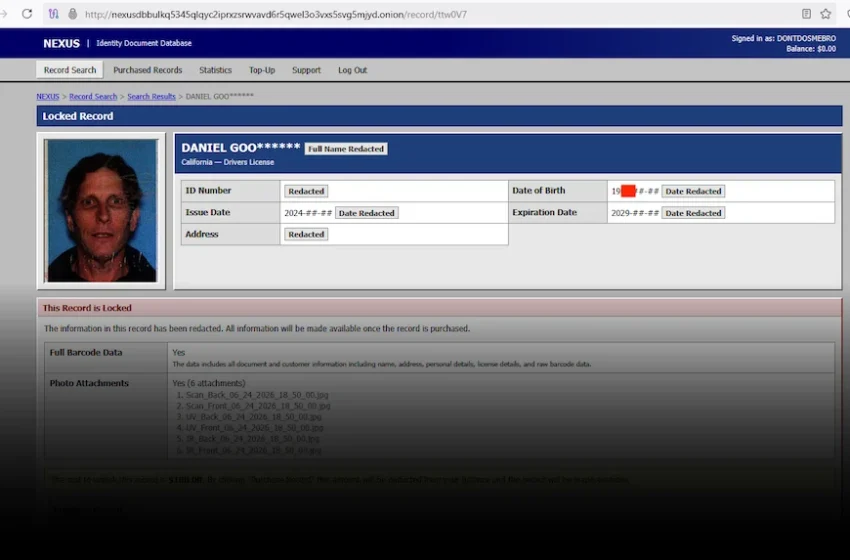
When an ID theft service named Nexus surfaced on the dark web this week, offering access to more than 153 million driver’s license scans, the immediate headlines focused on the sheer scale of the data and its likely provenance from a ‘well-known car rental company.’ Yet, Silicon Valley’s typical response — a focus on data volume and breach source — misses the more profound and insidious development: the criminal underworld is now replicating the very security features designed to protect physical identification, at an industrial scale.
This isn’t merely about personal information being exposed. We’ve seen that for two decades. This is about the sophisticated capture and replication of biometric-adjacent data – specifically, scans in infrared and ultraviolet spectrums – making it possible for forged documents to bypass standard authentication methods. Imagine presenting a cloned driver’s license at a border crossing or a financial institution, where existing hologram tests or security checks rely on these specific spectral signatures. That is the new frontier Nexus represents, a direct assault on the integrity of physical identity verification itself.
The KrebsOnSecurity exposé detailed how licenses, including those belonging to prominent figures like journalist Brian Krebs and an FBI assistant director, were available with these advanced spectral images. This suggests a systemic vulnerability that extends far beyond a simple database leak. It implies either the compromise of high-fidelity scanning equipment or the systematic collection of data points previously considered too complex for mass-market identity theft.
The Unseen Data Collection Ecosystem
This level of data exfiltration doesn’t just happen. It requires an ecosystem. Consider the mundane act of renting a car, or signing up for a new mobile plan, or even undergoing identity verification for banking apps. Each interaction often involves a clerk or a system scanning a physical ID. For years, the industry’s focus has been on securing the storage of the resulting digital records. What Nexus reveals is that the acquisition and transmission of these high-fidelity scans, including those rich with forensic detail, are equally – if not more – vulnerable.
Why is this announcement happening now, and who benefits from this specific framing? The timing of such a public exposé often serves to alert the public and, crucially, to push for improved cybersecurity standards in sectors that have historically lagged. The beneficiaries, beyond investigative journalists, are the security vendors and consultants whose expertise is now demonstrably more critical. Conversely, the car rental industry, already struggling with post-pandemic recovery, now faces a fresh crisis of trust. The core incentive here is to shift public perception and regulatory pressure towards the pervasive, often unnoticed, data collection points in our daily lives.
It highlights a critical paradox: companies are mandated to collect and verify identity documents for compliance and fraud prevention. Yet, many lack the robust infrastructure to protect the ultra-sensitive, high-resolution digital copies they generate. The very act of compliance, therefore, becomes a vector for a new class of crime. This isn’t just about a PII breach; it’s about the weaponization of the compliance process itself.
The Global Repercussions of Digital Identity Fraud
From a global perspective, this threat landscape is far more concerning than what often dominates US tech headlines. While American media might fixate on specific breaches, the implications for international travel, financial markets, and even national security are profound. A forged ID, capable of passing advanced spectral checks, could allow individuals to cross borders, open bank accounts, or establish shell corporations with unprecedented ease, impacting global anti-money laundering and counter-terrorism efforts.
The most skeptical observation here is that the entire digital identity verification industry has been building castles of data security on foundations of physical ID capture that were never designed for this level of digital fidelity. We have been so focused on securing the cloud perimeter that we forgot the weakest link might be the retail scanner at the front desk, or the third-party kiosk where your identity data is first digitized.
This emerging threat will necessitate a complete overhaul in how industries handle identity documentation. It’s no longer sufficient to simply encrypt databases; the entire chain of custody, from the physical scanning event to the long-term storage, needs forensic-level security and auditing. This includes investing in secure hardware for scanning, implementing zero-trust principles for internal data access, and perhaps most importantly, re-evaluating the necessity of retaining ultra-high-resolution, multi-spectrum copies of IDs for every transactional interaction. The alternative is a future where physical identity is increasingly meaningless, undermined not by sophisticated hacking, but by the mundane processes of everyday commerce.
