
China’s Glueball Breakthrough: A Silent Signal for Global Tech Leadership
- Tech
Arjun Vedanta
- 0
- 4 minutes read
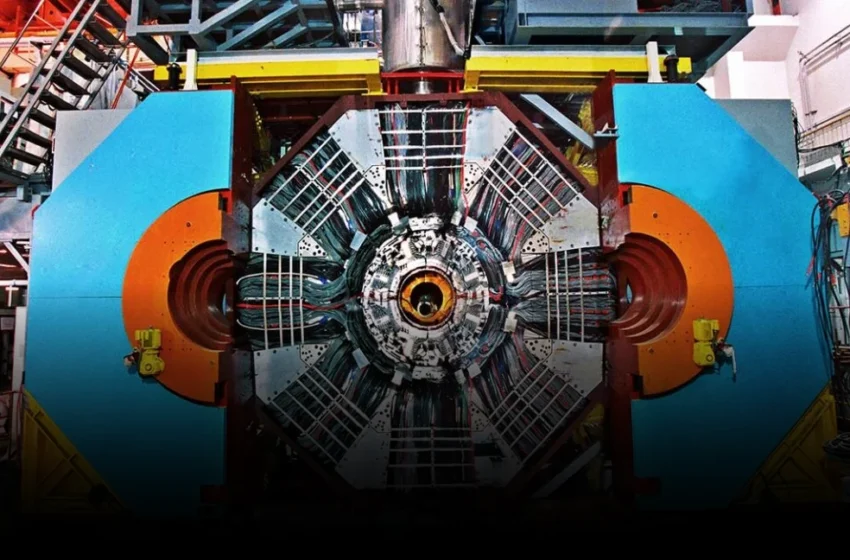
Beyond the Standard Model, China Builds a New Standard
While the West obsesses over the next generative AI model or consumer app, China is quietly laying groundwork for an entirely different future, one built on the bedrock of particle physics. The recent announcement from physicists at the Beijing Spectrometer III (BES III) experiment, detailing compelling new evidence for the existence of glueballs, isn’t just a win for theoretical physics. It’s a flashing red light on the global tech radar, signaling a strategic commitment to foundational science that goes largely unexamined by Western tech media.
Glueballs, these elusive composite particles made entirely of gluons, are a direct prediction of quantum chromodynamics and the Standard Model. Their confirmed existence, presented last month on arXiv and at the International Conference on High Energy Physics (ICHEP), solidifies our understanding of the universe’s fundamental forces. But the truly significant takeaway isn’t merely the physics; it’s the location. This wasn’t CERN, nor Fermilab. This was Beijing.
This underscores a crucial geopolitical and technological divergence. Silicon Valley, perpetually caught in the hype cycles of immediate commercialization, often overlooks the immense, state-backed investments in ‘deep tech’ that define a nation’s long-term scientific and industrial capacity. China’s persistent funding of projects like BES III is not an academic whim; it’s a calculated geo-economic move, designed to secure scientific independence and, ultimately, to dictate the terms of tomorrow’s advanced technology landscape, from advanced materials to next-generation quantum computing architectures.
The Patient Pursuit of Preeminence
The discovery of the Higgs boson in 2012, after decades of searching, demonstrated the sheer scale of international scientific collaboration and infrastructure required for such breakthroughs. That monumental achievement, largely a European-American endeavor, showcased an era of shared scientific ambition. China’s glueball finding, however, reflects a unilateral capacity building, a dedicated national effort that requires decades of sustained investment in both human capital and highly specialized scientific infrastructure.
This kind of long-horizon research is expensive, complex, and yields no immediate product. It demands government support unwavering by quarterly earnings calls or venture capital whims. Beijing understands that mastering the most fundamental aspects of physics, from high-energy particle accelerators to advanced detector technologies, positions them uniquely for breakthroughs in diverse fields. Think novel energy sources, revolutionary sensor designs, or entirely new paradigms for data storage and processing that are yet to be imagined.
The Silicon Valley mindset, fixated on agile development and immediate ROI, fundamentally misunderstands the patience required for true scientific and technological hegemony. They build on existing foundations; China is building the foundations themselves. This is the critical distinction many US-based reporters, too close to the startup beat, consistently miss. They celebrate the branches while Beijing cultivates the roots.
A World Shaped by Unseen Forces
The implications for global technology extend far beyond the abstract world of subatomic particles. Consider the ripple effect. The scientific tools and computing power necessary to conduct experiments like BES III drive innovation in semiconductor manufacturing, precision engineering, and large-scale data analytics. These are the very pillars of modern technological prowess, essential for everything from artificial intelligence to aerospace.
As Matthew Francis wrote for Ars back in 2015, the hunt for particles like glueballs is about filling in the blanks of our fundamental understanding. But from an international technology analyst’s perspective, the story is about who is doing the hunting, where, and why. The West’s focus on applied research and quick returns creates a vacuum in fundamental science, a vacuum China is methodically filling. I’ve observed this pattern play out across different sectors globally; a nation invests in foundational research, and decades later, it possesses an unassailable advantage in specific high-tech industries.
The glueball discovery is a technical footnote for most, but it’s a strategic headline for anyone tracking the shifting sands of global technological power. While the immediate implications for commercial tech are non-existent, the long-term strategic value of such deep scientific capability cannot be overstated. It reveals a nation investing not just in today’s digital economy, but in the fundamental physics that will underpin the next century of innovation.
