
Cosmic Mysteries Deepen: Is a ‘Dark Dimension’ Undermining Our Standard Model?
- Tech
Arjun Vedanta
- 0
- 6 minutes read
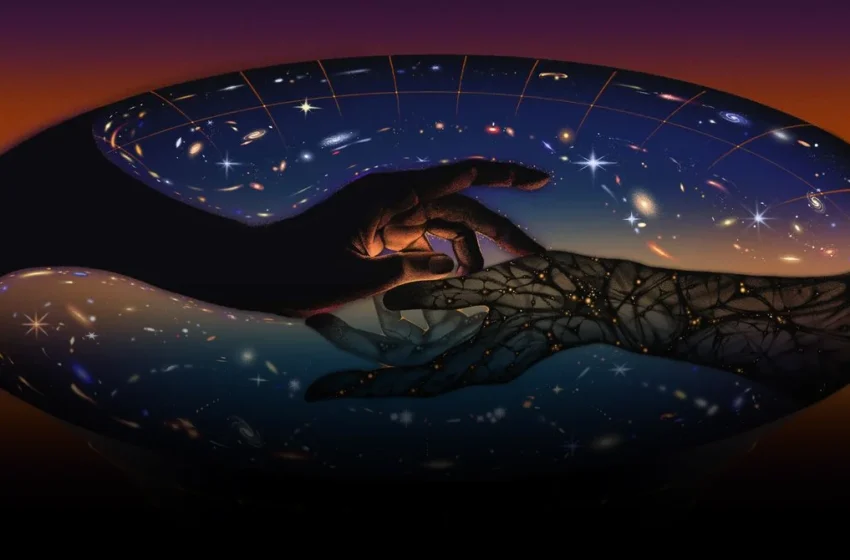
The Universe’s Unseen Architect: A New Kind of Complexity
For decades, the standard model of cosmology has reigned, built on the premise that roughly 70 percent of the cosmos is dark energy—a mysterious force accelerating expansion—and another 25 percent is dark matter, the unseen glue holding galaxies together. This elegant framework, however, is beginning to fray at the edges, not with a quiet hum, but with the discordant notes of contradictory observations. The notion that our two greatest cosmic enigmas operate independently has always been a convenient fiction, one now directly challenged by empirical data that forces physicists into an uncomfortable, yet fascinating, corner: resolving cosmic discrepancies by introducing even more layers of unobservable complexity, potentially an entire new dimension.
The Dark Energy Spectroscopic Instrument (DESI) collaboration first fired a warning shot in 2024, presenting evidence that dark energy’s strength might not be the immutable “cosmological constant” we assumed. A follow-up study in 2025, leveraging twice as much data, only solidified this heresy: dark energy appears to change over time, perhaps even having entered a “phantom regime” where it strengthened before weakening after its peak about two billion years ago. This observation directly contradicts the standard model’s assumptions, forcing the scientific community to ask whether their foundational edifice is merely incomplete, or fundamentally miscategorized.
The easiest path to reconcile this is to hypothesize that what we labeled separately as dark energy and dark matter are, in fact, not so separate. As particle physicist Tim Tait from UC Irvine mused, “it would not be surprising if [they] were manifestations of a kind of unified theory of the dark universe.” This isn’t merely academic hair-splitting; it represents a significant pivot in fundamental physics, moving from two distinct, albeit invisible, forces to a complex, interacting “dark sector,” with profound implications for the very fabric of reality.
Rewriting the Cosmic Rules: Interacting Dark Forces and Hubble’s Tension
This pivot isn’t entirely new. Justin Khoury, a physicist at the University of Pennsylvania, explored interacting dark energy and dark matter as early as 2005, finding that such coupling could produce phantom behavior without violating energy conservation. What was once a theoretical thought experiment has now become an urgent necessity, spurred by DESI’s data and another persistent headache for cosmologists: the Hubble tension.
The Hubble constant, measuring the universe’s expansion rate, presents a baffling 9 percent discrepancy. Measurements based on the early universe clash with those derived from recent phenomena like supernovas. Elsa Teixeira, a cosmologist at the University of Montpellier, and her colleagues published a model in January in Physical Review D, proposing that an interaction where dark matter transfers energy to dark energy could cause the universe’s expansion to accelerate, thus smoothing over this tension. This is a common thread in new theoretical work: David Andriot, a physicist at CNRS, also presented his coupled dark energy-dark matter model in May 2025, essentially stating that any perceived evolution of dark matter’s mass has simply been misattributed to dark energy.
What’s truly remarkable is the shift in perspective articulated by Cumrun Vafa of Harvard University: “The notion that you can compute dark energy independently of dark matter is wrong.” This is a direct indictment of the foundational assumptions underpinning decades of cosmological calculations. The incentive for these proposals is clear: to reconcile disparate observational data within a scientific framework that, while increasingly complex, aims to preserve an overarching explanatory power. It allows researchers to move forward, to secure funding, and to offer new avenues for exploration rather than admit an intractable impasse.
The Dark Dimension: A Leap of Faith or a New Frontier?
The most audacious, and perhaps most speculative, proposition to emerge from this crisis of models involves an actual extra dimension. Building on string theory, Vafa and collaborators proposed in 2019 that if dark energy naturally varies, then dark matter particle masses might also fluctuate. This led them to a startling 2022 hypothesis: dark matter and dark energy could be intrinsically linked through a so-called dark dimension.
String theory has long posited six or seven extra dimensions, but typically at the infinitesimally small Planck scale (10-35 meters). Vafa’s team, including Georges Obied of the University of Chicago and Alek Bedroya of Princeton, suggests this dark dimension could be dramatically larger—on the order of a micron (10-6 meters). The idea is that gravitons, theoretical particles mediating gravity, could leak into this enlarged dimension, gain mass to become “dark gravitons,” and then exert gravitational effects that we interpret as dark matter.
In this scenario, a changing dark dimension size would directly affect both dark energy and dark matter, offering a natural coupling. A July 2025 paper by Obied, Vafa, Bedroya, and David Wu found this model consistent with DESI’s data. While undeniably elegant in its reconciliation of disparate observations, the introduction of a new, unobservable dimension to explain existing anomalies feels like a substantial theoretical leap. It’s tempting to wonder if we’re not so much discovering new physics as we are constructing ever more elaborate narrative structures to avoid admitting that our universe might simply be less amenable to elegant, four-dimensional explanations than we once hoped.
The good news is that these highly theoretical constructs are not entirely untestable. Obied noted that “there could be astrophysical ways of testing this.” For instance, Marc Kamionkowski and Michael Kesden’s 2006 work on galactic tidal tails—extended streams of stars, gas, and dust formed by gravitational tugs—offered an indirect test for a stronger dark matter interaction. Their observational bounds for an extra attractive force were twenty times larger than what Vafa’s team predicts, meaning the new theoretical value falls comfortably within what observations allow. This correspondence, while not confirmation, offers a glimmer of hope that experimental verification, however indirect, might eventually bridge the gap between theoretical speculation and empirical fact in this increasingly complex cosmic narrative.
