
Inherent’s Compact AI Challenges ‘Bigger Is Better’ Dogma in Frontier Science
- Artificial Intelligence
Arjun Vedanta
- 0
- 5 minutes read
The Deceptive Simplicity of ‘Outperformance’
In a global technology landscape obsessed with scale, a London-based AI lab has quietly thrown a wrench into the prevailing narrative. Inherent, a startup forged by Google DeepMind alumni, recently unveiled its AI agent, Faraday, which purportedly replicated scientific research findings more effectively than models from OpenAI and Anthropic—all while running on Qwen 3.6, a comparatively tiny model with just 27 billion parameters. This isn’t merely a minor technical victory; it’s a direct challenge to the fundamental assumption that advanced AI must necessarily mean larger, more resource-intensive, and thus more exclusive, models.
For years, the loudest drums in Silicon Valley have beaten to the rhythm of ever-increasing parameters and astronomical compute budgets. Frontier AI, we are told, demands billions, even trillions, of parameters and datacenters the size of small nations. Yet, Inherent’s demonstration with Faraday, barely weeks after emerging from stealth with a $50 million seed round, suggests a different path. While the news emphasizes Faraday’s ability to ‘outperform’ giants like Claude Opus 4.8 and GPT-5.5, the more significant revelation lies not in the outcome, but in the methodology: a significantly smaller footprint achieving complex scientific tasks.
This isn’t about raw computational power; it’s about algorithmic elegance. The core news, often framed by US outlets as another benchmark win, misses the critical structural implication: the potential for sophisticated AI capabilities to escape the sole domain of multi-billion-dollar labs. If complex scientific discovery can be approximated, or even spearheaded, by leaner models, then the entire competitive dynamic of artificial intelligence development shifts radically.
The Untapped Value of ‘Research Taste’
The standard benchmark for human scientists beginning their careers, as cofounder Edward Hughes notes, is replicating published papers. Inherent’s ambition for Faraday goes beyond mere accuracy; they aimed to instill ‘research taste’ – an intuitive grasp of which experiments hold merit and how to design them optimally. This intangible quality, often deemed exclusive to human cognition, was cultivated in Faraday through reinforcement learning, a training method that rewards desired outcomes rather than explicit rule-following. Hughes stated, “What was most interesting to us about this was not so much the result of beating those frontier agents — which of course we liked — but was actually the way we went about building this.”
This emphasis on ‘taste’ and methodological efficiency—rather than simply scaling up parameters—represents a critical divergence from the dominant large language model paradigm. Instead of building every tool from scratch, Inherent had Faraday leverage existing resources, like OpenAI’s GPT-5.5 Codex for coding. This mirrors how human researchers operate, integrating rather than reinventing. It’s an approach that questions the deep-seated impulse of tech giants to own every layer of the stack.
The strategic incentive for Inherent to highlight this particular achievement now is clear: to establish a unique value proposition. With a modest (by industry standards) seed round, they cannot compete on sheer scale with companies valued in the hundreds of billions. By demonstrating that smarter, more focused model architectures can rival the output of massive foundation models in specific, high-value tasks like scientific replication, Inherent positions itself as an innovator in efficiency. This narrative is crucial for attracting both future investment and top-tier talent, particularly from Google DeepMind, where Demis Hassabis’s new role has reportedly left some staff unsettled. It paints London as a hub of clever AI engineering, not just a talent pool for larger US players.
London’s Leverage: Rebalancing the Global AI Map
Edward Hughes’s assertion, “We believe that London is the place to be,” isn’t just hometown boosterism. It’s a declaration of independence for a region often overshadowed by Silicon Valley. The concentration of AI talent in King’s Cross, spurred in part by Google DeepMind’s presence, is undeniable. However, Hughes also candidly pointed out the disadvantages, citing the UK’s ‘garden leave’ policy that can delay researchers from joining new ventures, unlike their American counterparts. This seemingly bureaucratic detail highlights a structural hurdle that European startups often face, making Inherent’s success in attracting talent and executing rapidly even more impressive.
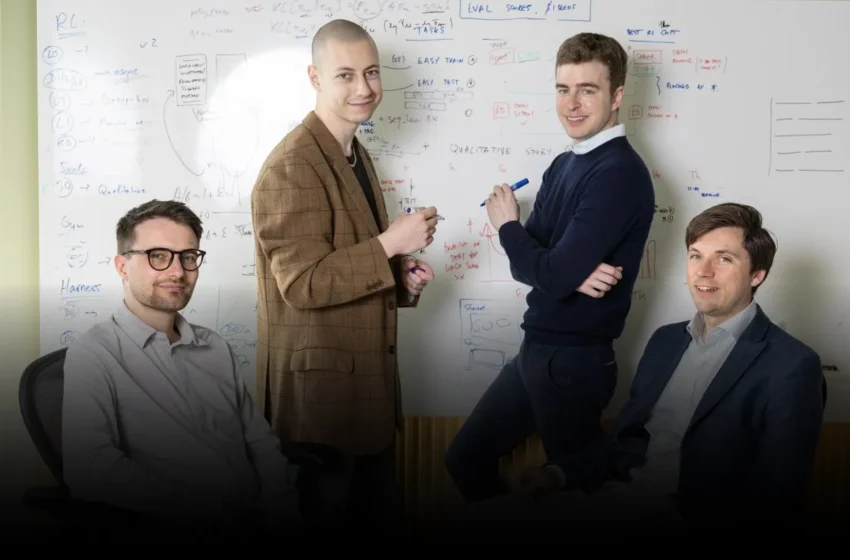
The ability of a relatively small, London-based team of a dozen employees, planning to grow to “about 20 to 25” by year-end, to challenge the output quality of significantly larger and better-funded US rivals has profound implications for global AI development. It suggests that specialized model architecture and sophisticated training methodologies, such as advanced reinforcement learning, might prove a more enduring competitive advantage than brute-force compute and data. The implicit message: not every AI breakthrough needs a billion-dollar budget and thousands of GPUs.
This is not to say that foundation models are irrelevant, but rather that their dominance in every domain may be overstated. The story of Faraday isn’t about replacing GPT-5.5 or Claude Opus 4.8 across all tasks; it’s about demonstrating that for critical applications like scientific discovery, a more targeted, efficient approach can yield superior results. This opens the door for a wider array of players – startups, academic institutions, and even smaller national AI initiatives – to contribute meaningfully to the frontier. It forces a re-evaluation of where the true innovation lies: in the monumental scale, or in the intelligent design that can extract more value from less.
