
NASA’s Quiet Supersonic Dream: A Luxury Fantasy or Genuine Innovation?
Arjun Vedanta
- 0
- 4 minutes read
The Quiet Thump and a Looming Question
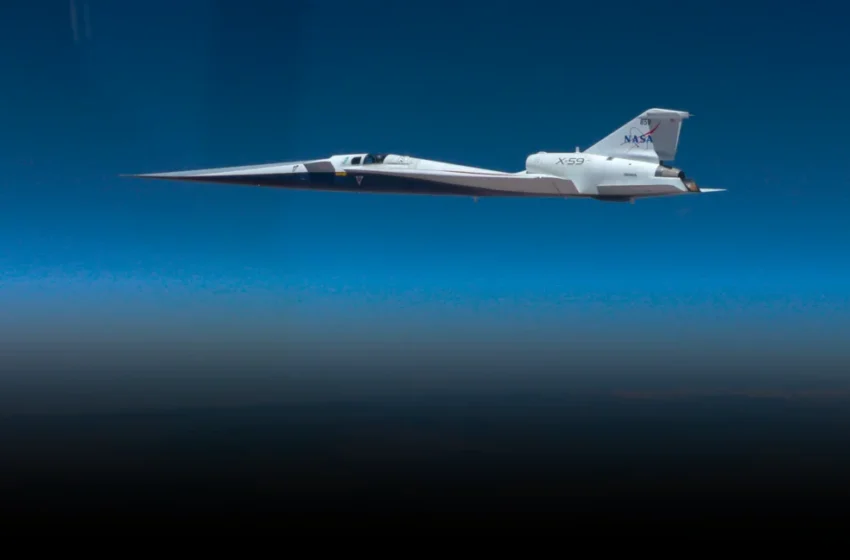
NASA’s X-59 Quesst, a project over two decades in the making since the Concorde last graced the skies, has begun supersonic test flights. The audacious goal: transform the ear-splitting sonic boom into a mere ‘thump’ — a sound equivalent, NASA claims, to a car door shutting twenty feet away. This technical feat, pioneered by Lockheed Martin and championed by NASA test pilot Jim “Clue” Less, promises a future where supersonic airliners could traverse overland routes without rattling nerves or buildings, unlike their loud predecessors.
Yet, behind the impressive engineering and the ambition to collect public feedback across various U.S. cities, lies a persistent, unanswered question that US-centric tech reporting frequently overlooks: Does solving the sonic boom actually unlock a viable commercial market, or is this a publicly funded venture into a luxury fantasy, disconnected from broader aviation needs?
The X-59’s capability to mitigate acoustic shockwaves is undeniably a triumph of aerospace design, built robustly enough, as Less noted, to gather crucial data across diverse environments. But the assumption that this technical hurdle alone clears the path for a supersonic renaissance ignores a raft of economic and environmental challenges that grounded the Concorde and continue to plague modern efforts like Boom Supersonic.
The Ghost of Concorde: Commercial Realities Beyond Noise
The Concorde’s story wasn’t simply one of noise restrictions. It was a saga of exorbitant operating costs, limited passenger capacity, astronomical ticket prices, and a ravenous fuel consumption profile that made it economically unfeasible for mass market adoption. Even with a quieter ‘thump,’ these fundamental economic realities persist for any future supersonic commercial jet. The X-59, while an engineering marvel, sidesteps this inconvenient truth by focusing solely on a single, albeit significant, constraint.
One might ask: why is NASA, a publicly funded agency, investing so heavily in a project whose primary commercial beneficiaries appear to be niche luxury carriers and the ultra-wealthy seeking to shave a few hours off transatlantic flights? The incentive here seems less about broad public good and more about pushing the boundaries of aerospace engineering, with the *hope* that a commercial market will magically materialize once the noise problem is solved. It’s a classic Silicon Valley fallacy applied to aerospace: build it, and they will come, even if the ‘they’ is a tiny, exclusive segment of the population.
Meanwhile, the aviation industry grapples with the far more pressing challenges of decarbonization, sustainable aviation fuels, and the increasing demand for efficient, affordable mass air travel. Investing public funds into technology for a handful of wealthy travelers, while these larger environmental and access issues remain critical, represents a stark misallocation of focus, if not outright contradiction. The sharpest observation is that the X-59, despite its quiet ambition, is less a harbinger of a new era of travel and more a finely tuned instrument for measuring market indifference disguised as technical progress.
Supersonic’s Future: Niche Luxury or Sustainable Evolution?
Consider the market dynamics. Even if a quiet supersonic jet could fly overland, who would pay the premium? In a world increasingly conscious of carbon footprints and economic inequality, a return to high-speed, high-emission, high-cost travel seems an anachronism. Companies like NetJets already cater to private luxury aviation, but even for them, the operational economics of supersonic flight remain daunting. The infrastructure, air traffic control integration, and maintenance costs associated with such advanced aircraft would likely keep ticket prices well beyond the reach of all but the most affluent, limiting market scale dramatically.
The X-59 project is undoubtedly a testament to human ingenuity and a valuable experiment in aeroacoustics. It provides critical data on shockwave propagation and noise perception, which could have applications beyond commercial travel, perhaps in specialized military or scientific roles. But to frame it as the imminent rebirth of commercial supersonic flight, particularly when competitors like Hermeus and Boom Supersonic are already navigating the treacherous waters of private sector funding and market validation, is to misunderstand the fundamental forces that govern the airline industry. The challenge was never just the boom; it was the whole economic symphony, and NASA, for all its brilliance, is only conducting one note.
