
NASA’s T-38 Livery: A PR Masterstroke for an Unseen Moonshot
- Space
Arjun Vedanta
- 0
- 5 minutes read
The Enduring Role of Analog Training in a Digital Age
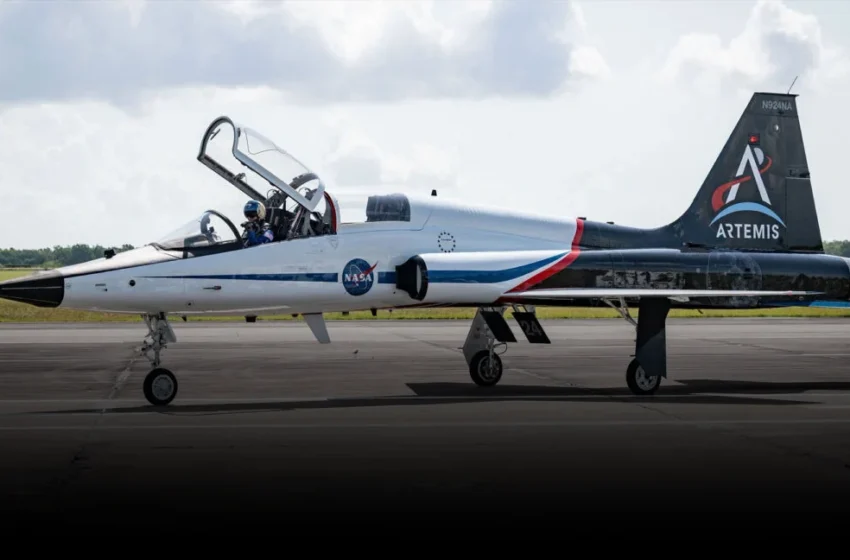
A fresh coat of paint rarely solves the underlying engineering challenges of deep space exploration. Yet, NASA’s unveiling of a new, striking livery for one of its venerable T-38 Talon training jets—a visible nod to the Artemis program—signals far more than a simple aesthetic refresh. It is a carefully orchestrated visual statement about a program still largely unseen by the public, operating with legacy assets while aiming for audacious future goals.
For decades, the T-38 has been the workhorse of astronaut flight training, a supersonic trainer designed in the late 1950s. It represents raw stick-and-rudder skills, spatial awareness, and the demanding discipline of high-performance aviation. Astronauts learn to manage complex systems under pressure in these jets, sharpening reflexes that translate to spacecraft command modules. Sean Brady, the T-38 project pilot who designed this new look, noted the black, white, blue, and red scheme, along with the Artemis program logo and moon imagery, as a clear departure from the classic “white rocket” appearance.
The critical observation here, however, is that while these jets prepare humans, they are fundamentally *terrestrial* training platforms. They simulate atmospheric flight, not the vacuum of space or the intricate orbital mechanics required for a lunar mission. Equipping a 60-year-old airframe with modern branding, while undoubtedly boosting morale for the pilots and ground crews at Johnson Space Center, does not advance the material readiness of lunar landers or the reliability of the Space Launch System. It instead juxtaposes a symbol of enduring, practical terrestrial training with the abstract, distant promise of a human return to the Moon.
Branding the Moonshot: NASA’s Public Relations Strategy for Artemis
NASA’s incentive for such a high-profile, cosmetic update is transparent: to maintain public and political enthusiasm for the Artemis program. This is not a new vehicle or a technological breakthrough; it is a visible marketing asset, a tangible manifestation of a future vision that currently exists mostly on blueprints and in slow-moving assembly lines. The Artemis program, designed to land humans on the Moon again, faces immense financial pressures, congressional scrutiny, and significant developmental delays that push back crewed missions.
In this context, a newly painted T-38 acts as a crucial public relations tool. It provides a visual anchor for a narrative of progress, a story that resonates with taxpayers and lawmakers who need to justify multi-billion-dollar investments. While the actual hardware for Artemis—the Orion capsule, the Gateway lunar outpost, and the Human Landing Systems—remain largely out of public view or subject to ongoing redesigns, the T-38 livery offers a palpable, if symbolic, connection to the grander mission. It’s a classic government agency move: provide visible, tangible tokens of momentum when substantive milestones are complex, costly, and inherently slow to materialize.
This strategy reflects a broader trend in how government-funded space agencies engage the public. Unlike the commercial space sector, which frequently showcases new rocket stages or satellite constellations in development, NASA must consistently articulate its value proposition for public funding. Updates like this T-38 livery are cost-effective methods to reinforce identity and purpose, bridging the gap between an aspirational future and the operational present, even if that present includes legacy aerospace assets rather than groundbreaking new technologies.
Symbolism vs. Substance: The Broader Implications for Space Exploration
The true measure of Artemis success won’t be found on the fuselage of a 60-year-old training jet, but in the sustained budget lines and the actual hardware delivered to lunar orbit. This livery is a brilliant piece of branding, skillfully connecting the past glory of NASA’s human spaceflight programs with its ambitious future. Yet, it also underscores a fundamental tension: the need to constantly *sell* the vision of space exploration, particularly when real-world challenges—from budget constraints to technical hurdles—threaten to erode public and political will.
As an observer who has watched global space programs grapple with public funding cycles from Geneva to Singapore, I note that this kind of symbolic gesture is often a precursor to larger demands. It’s about setting the stage, building a narrative, and ensuring that the public remains invested long before the rockets even roll out to the launch pad. The T-38, a symbol of consistent, reliable training, now carries the flag for a program that has been anything but consistent or always reliable in its execution timeline.
While the updated jet is undeniably striking, the more pertinent question for intelligent, skeptical readers is not about its aesthetics, but its strategic utility. Is this livery a genuinely motivating factor for the next generation of astronauts and engineers, or is it primarily a signal to Capitol Hill and the American public that Artemis is still flying high, even if only on a jet that will never leave Earth’s atmosphere? The answer likely lies in a complex interplay of both, but the emphasis on public perception over purely operational advancement is difficult to ignore.
