
Obsolete Mac Minis Power Cray-1 Replica, Showcasing a Supercomputing Revolution
Arjun Vedanta
- 0
- 10 minutes read
Obsolete Mac Minis Power Cray-1 Replica, Showcasing a Supercomputing Revolution
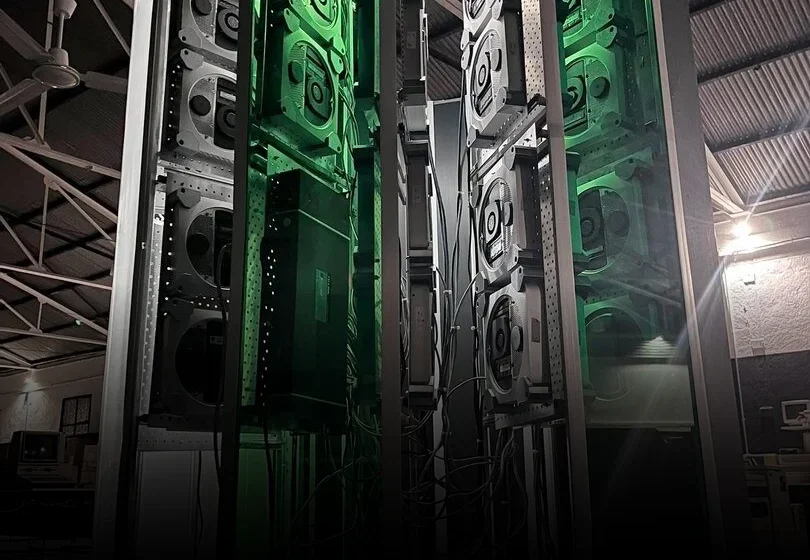
Spain’s Museo de Historia de la Computación has dramatically showcased the exponential leap in computing power by recreating a 1976 Cray-1 supercomputer, not with vintage parts, but by networking 30 ‘obsolete’ 2012-era Apple Mac Minis. This inventive project achieves up to 1.5 teraflops of performance, illustrating how modern commodity hardware now far surpasses the peak capabilities of a true supercomputing pioneer, highlighting the accessibility of immense computational power today for US businesses and researchers.
For American tech professionals and enthusiasts, this project serves as a compelling real-world demonstration of how far computing has advanced in just a few decades. The original Cray-1, a marvel of its time, was an elite machine costing millions of dollars, primarily accessible to government labs and large research institutions in the US. Its modern stand-in, powered by Mac Minis that are over a decade old, underscores a fundamental shift: sophisticated computational power is no longer confined to custom-built supercomputers but is now achievable with widely available, and relatively inexpensive, consumer-grade hardware. This evolution has profound implications for everything from cloud computing infrastructure to localized AI model training within the United States.
The Astonishing Leap in Compute Power: Then vs. Now
The stark difference in performance between the original Cray-1 and its Mac Mini-powered replica is truly mind-boggling. The 1976 Cray-1 boasted a peak theoretical performance of approximately 160 megaflops (million floating-point operations per second). In contrast, the replica, utilizing 64 active processing cores across its networked Mac Minis, achieved 1.3 teraflops (trillion floating-point operations per second) in recent tests, with a previous high of 1.5 teraflops using 70 cores.
To put this into perspective, the Mac Mini cluster is roughly 8,000 to 9,000 times faster than the original Cray-1. This enormous increase highlights the relentless march of Moore’s Law, or at least its spirit, well into the 21st century. It means that what once required a multi-million-dollar, room-sized machine now fits into a stack of compact, used desktop computers, each individually less powerful than many smartphones today but collectively a formidable force.
This performance explosion is not just academic; it underpins the entire modern digital economy. US companies, from Silicon Valley giants to burgeoning startups, rely on this accessible, high-performance computing to power everything from financial modeling and weather prediction to drug discovery and the increasingly prevalent field of artificial intelligence.
From Vector Processing to Distributed Clusters: An Architectural Evolution
The performance leap isn’t solely due to faster processors; it’s also a testament to a fundamental architectural shift in computing. The original Cray-1 pioneered vector processing, a method where a single instruction operates on multiple data elements simultaneously. This was cutting-edge for its time, allowing for highly efficient processing of large datasets critical for scientific simulations.
The Mac Mini replica, however, operates on a completely different principle: a distributed parallel cluster. Instead of a single, highly specialized vector processor, it distributes computational tasks across multiple independent processors, each running within its own Mac Mini node. These nodes work in parallel, combining their individual processing power to solve complex problems faster. The setup leverages standard Ethernet networking and a custom Python script for matrix multiplication, a common benchmark for scientific computing.
This distributed architecture, facilitated by the widespread availability of powerful multi-core processors from companies like US-based Intel (whose i5 and i7 chips power these Mac Minis), has become the backbone of modern cloud computing and large-scale data processing. American tech companies like Amazon Web Services (AWS), Microsoft Azure, and Google Cloud Platform (GCP) are built upon vast networks of commodity servers working in tandem, mirroring the concept demonstrated by the Mac Mini cluster, albeit on a vastly larger scale.
| Feature | Original Cray-1 (1976) | Mac Mini Replica (2012/2014 Hardware) |
|---|---|---|
| Architecture | Vector Processing | Distributed Parallel Cluster |
| Peak Performance | 160 megaflops | 1.3 – 1.5 teraflops (max) |
| Core Components | Custom, specialized hardware | Off-the-shelf Intel i5/i7 processors |
| Units | 1 supercomputer | 30 Mac Minis |
| Approximate Performance Multiplier | 1x | ~8,000x to 9,000x |
| Primary Use | Scientific research, defense | Museum exhibit, educational tool |
What Does This Mean for US Tech? The Democratization of Supercomputing
The Mac Mini Cray-1 replica is more than a nostalgic tribute; it’s a powerful symbol of the democratization of computational power. For US tech, this means:
- Accessible Research & Development: Startups and smaller research labs across America can now perform computations that were once the exclusive domain of national labs or major universities. Cloud computing platforms further extend this accessibility, allowing on-demand access to virtualized clusters that rival, or even surpass, the performance of the Mac Mini setup for various tasks.
- Innovation in Distributed Computing: The project highlights the ongoing importance of designing software and algorithms that can effectively leverage distributed resources. This is crucial for advancing fields like machine learning, big data analytics, and high-performance computing, areas where US innovation frequently leads.
- Redefining ‘Obsolete’ Hardware: The notion that decade-old hardware is automatically useless is challenged. These Mac Minis, individually, might struggle with modern tasks, but collectively they demonstrate significant utility. This has implications for sustainable tech practices and finding new life for electronic waste, a growing concern in the US and globally.
- Educational Value: For students and engineers in the US, projects like this provide tangible lessons in computer architecture, networking, and the historical trajectory of technological advancement. It makes abstract concepts of parallel processing real and accessible.
The fact that five of the Mac Minis are quad-core i7s and the remaining twenty-five are dual-core i5 models, predominantly from 2012, speaks to the enduring capability of well-engineered hardware, especially when cleverly repurposed and networked. This resilience and adaptability are valuable lessons for US hardware and software developers alike.
The Mac Mini as a Workhorse: A Practical Perspective
The choice of the Mac Mini as the base for this project is notable. Its compact form factor, relatively low power consumption for its era, and robust macOS operating system made it an ideal candidate for clustering. While the developers could have chosen other small form factor PCs, the uniformity and networking capabilities of the Mac Mini simplified the challenge of building a cohesive, multi-node system. This underscores a design philosophy that has permeated consumer electronics: powerful components packed into efficient, manageable packages, which then become viable building blocks for larger systems.
The project, developed over 18 months, also serves as a 50th-anniversary tribute to both the Cray-1 and Apple’s founding, connecting two distinct eras of computing innovation. It’s a powerful reminder that while the aesthetic of computing has changed dramatically, the core principles of pushing performance boundaries remain constant.
Key Takeaways
- A 2012-era Mac Mini cluster can achieve ~9,000 times the peak performance of a 1976 Cray-1 supercomputer, highlighting immense technological progress.
- The project demonstrates the power of distributed parallel processing, which now forms the backbone of modern cloud computing and AI infrastructure.
- ‘Obsolete’ consumer hardware, when repurposed creatively, can still deliver significant computational power, challenging perceptions of tech waste.
- This initiative underscores the democratization of high-performance computing, making advanced capabilities accessible to a broader range of US researchers and businesses.
- The architectural shift from specialized vector processors to networked commodity multi-core CPUs represents a foundational change in how we approach large-scale computation.
Frequently Asked Questions
How much faster is the Mac Mini replica than the original Cray-1?
The Mac Mini replica, running at up to 1.5 teraflops, is approximately 8,000 to 9,000 times faster than the original 1976 Cray-1 supercomputer, which had a peak performance of 160 megaflops. This dramatic difference showcases the exponential advancements in computing power over five decades.
What is the significance of using ‘obsolete’ hardware for this project?
Using 2012-era Mac Minis for the replica highlights that even older consumer-grade hardware, when creatively networked, can achieve performance levels once reserved for multi-million-dollar supercomputers. It challenges the notion of planned obsolescence and demonstrates the enduring value and adaptability of well-designed tech components for new applications.
How does the Mac Mini cluster architecture differ from the original Cray-1?
The original Cray-1 utilized a specialized vector processing architecture, applying single instructions to multiple data elements simultaneously. In contrast, the Mac Mini replica uses a distributed parallel cluster architecture, distributing computational tasks across 30 independent processors that work simultaneously, a model common in modern cloud computing.
Could a similar setup be used for modern computing tasks?
While a cluster of 2012 Mac Minis wouldn’t compete with state-of-the-art supercomputers or cloud instances for the most demanding modern tasks, the underlying principle of distributed computing is highly relevant. Similar, more powerful clusters built with current commodity hardware are routinely used for various applications, including local AI model training, data analytics, and scientific simulations in many US organizations.
